Conflict intensifies over relocation of presidential office

President-elect Yoon Suk-yeol reads a report during a meeting with presidential transition committee members at the committee's office in Tongui-dong, Jongno District, Seoul, Tuesday. Joint Press Corps
Clash over relocation plan risks smooth power transition
By Nam Hyun-woo
Concerns are growing over a smooth transfer of power due to an escalating conflict between the incoming and outgoing administrations over President-elect Yoon Suk-yeol's plan to move the presidential office to the defense ministry compound in Yongsan District.
The ruling and opposition blocs are refusing to budge in their confrontation over the controversial relocation plan, with Yoon, President Moon Jae-in and their parties exchanging salvos every day.
“Given the situation so far, (President-elect Yoon) may have to begin his presidency at the presidential transition committee office,” Yoon's spokesperson and Rep. Kim Eun-hye of the main opposition People Power Party (PPP) told reporters, Tuesday.
“If Cheong Wa Dae delivers its intention, we will carefully consider it,” she added.
Kim's remarks came a day after Moon voiced concerns over Yoon's plan to set up a new presidential office at the Ministry of National Defense headquarters and begin his presidency on May 10 without spending a single day at Cheong Wa Dae, citing a possible “security vacuum” caused by the sudden relocation of the presidential office and its security related facilities during the power transition.
Yoon wants to move the presidential office in order to become more accessible to the public. He believes the existing presidential office compound in Cheong Wa Dae is too secluded, while critics of his plan say the sequestered location ensures the safety of the President.
Citing concerns of a security vacuum, Cheong Wa Dae dismissed the presidential transition committee's proposal to approve necessary funding for the relocation at Tuesday's Cabinet meeting. Yoon seeks to tap into state reserve funds to finance approximately 50 billion won ($40.9 million) of the relocation cost. But that requires Cabinet approval.
Moon did not mention the relocation plan during the Cabinet meeting, but commented on a related issue.
“There should be no vacuum in state affairs, not even the smallest one,” Moon said. “National security, the economy and public safety, in particular, should be handled flawlessly.”
“With tensions surrounding the Korean Peninsula escalating, there should be no unstable factors when it comes to national security. We should spare no efforts to manage the situation of the Korean Peninsula stably in the period of transition.”
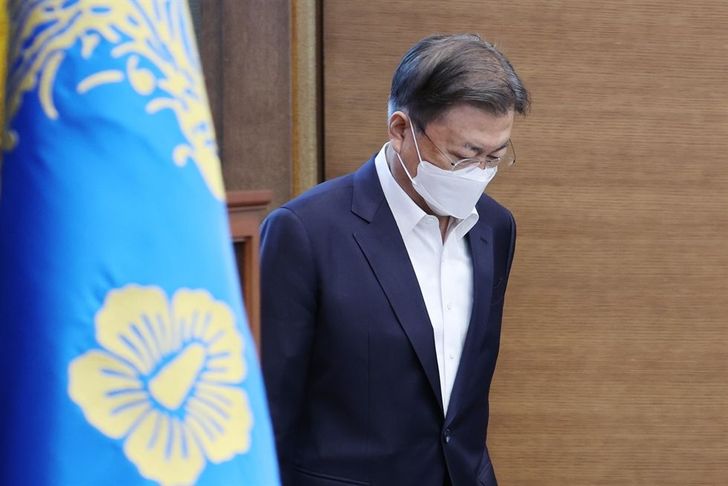
President Moon Jae-in enters a meeting room to preside over a Cabinet meeting at Cheong Wa Dae, Tuesday. Yonhap
The confrontation over the presidential office casts a grim outlook on Yoon's efforts to achieve a smooth transition of power. Reflecting such differences, Moon postponed a meeting with Yoon earlier this month to discuss the transfer of power.
“There is no fixed schedule for working-level talks to arrange a meeting between Yoon and Moon,” Yoon's spokesperson said.
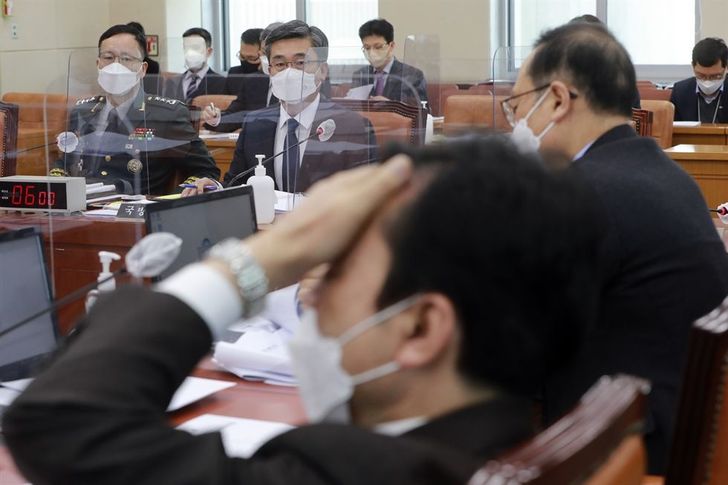
Rep. Ahn Gyu-back of the Democratic Party of Korea, front, touches his forehead during a National Assembly National Defense Committee meeting on Tuesday. Joint Press Corps
Defense ministry's move
Lawmakers of the main opposition PPP and the ruling Democratic Party of Korea (DPK) also clashed over the consequences of the defense ministry's relocation. Yoon seeks to set up the new presidential office inside the defense ministry building. The ministry will move to the Joint Chiefs of Staff (JCS) headquarters located in an adjacent building. The JCS will move to the Namtaeryeong area in southern Seoul later.
During a parliamentary National Defense Committee meeting on Tuesday, DPK lawmakers lambasted the relocation as “an unimaginably hasty plan” which will seriously compromise national security. PPP members fought back by insisting that the ruling party is citing an imaginary national security vacuum simply to oppose Yoon's plan.
“Even the Special Committee for National Security Measures would not imagine this kind of hasty, military operation-like relocation plan,” DPK Rep. Hong Young-pyo said, referring to a junta committee set up when former authoritarian President Chun Doo-hwan staged a coup to take the presidency. “Such a plan is bound to cause a serious national security vacuum. The current plan is close to disbanding the ministry into multiple branches.”
According to a defense ministry report to the transition committee, the ministry and the JCS will be categorized into nine groups that will be relocated to eight different locations. The minister's office and other departments related to the ministry's command function can share spaces with the JCS, but other departments have to be relocated to other buildings. Some functions of the JCS also need to be relocated when the ministry shares the same building.
DPK Rep. Kim Min-ki asked defense minister Suh Wook if it is possible to move the defense ministry to some place within two months. Suh said, “I wouldn't do that under normal situations.”
On the other hand, PPP members said there will be no security vacuum even if the presidential office and the ministry move.
“The JCS said there will be no security vacuum based on the current military operation capability,” PPP Rep. Sung Il-jong said. “If the incoming and outgoing powers cooperate in the process of government transition, there will be no vacuum in national security or state affairs. I cannot understand why the ruling bloc is trying to impede the incoming administration.”
PPP Rep. Shin Won-sik also said concerns of a national security vacuum are “exaggerated,” and added, “The defense minister does not work in his office in the ministry if there's an emergency situation.”