Defense ministry compound set for major readjustments

The defense ministry office in Yongsan / Yonhap
South Korea's key military compound in Yongsan, central Seoul is set to undergo major readjustments due to the planned relocation of the presidential office there at a time of rising security concerns caused by North Korea's continued missile tests.
The compound is home to the nation's defense ministry, the Joint Chiefs of Staff (JCS) and some other major military agencies.
President-elect Yoon Suk-yeol announced his decision to relocate the presidential office, currently at Cheong Wa Dae, to the Yongsan compound.
It followed days of controversy over the relocation's potential impact on defense readiness, concomitant costs and local residents' opposition, to name a few.
The decision came as South Korea and the United States are on heightened alert due to a series of recent North Korean missile launches, including Wednesday's botched test of an apparent intercontinental ballistic missile (ICBM).
On an area of about 276,000 square meters, the compound houses the ministry's 10-story main building, the JCS headquarters, the Cyber Operations Command, the Central Investigation Command, the Defense Installations Agency, the military court and prosecution and other agencies.
Some 4,000 troops and civil servants work in the compound.
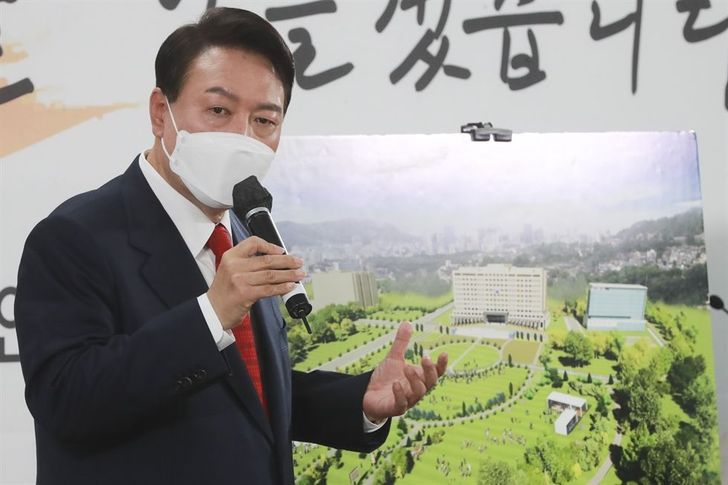
South Korea's president-elect Yoon Suk-yeol shows an aerial eye view of a reorganized Ministry of National Defense compound following the relocation of the presidential office there, during a news conference in Seoul, March 20. Yonhap
The presidential office's relocation apparently requires the speedy reorganization of those offices, including moving some of the facilities outside the ministry complex to areas such as the Capital Defense Command (CDC) in southern Seoul. Yoon, set to take office on May 10, is seeking to begin work immediately in Yongsan.
Defense ministry offices are set to move into the nearby JCS building.
Yoon said that there is space for those ministry offices inside the JCS building as it was initially built to be used together with the South Korea-U.S. Combined Forces Command (CFC). Currently, the allies plan to place the CFC in Camp Humphreys, a key U.S. base in Pyeongtaek, 70 kilometers south of Seoul.
The president-elect also expressed his desire to relocate the JCS to the CDC where there is a wartime command center. He said the JCS relocation, if realized, would enable a "unified" command structure for both peacetime and wartime operations.
At issue is how to expeditiously reestablish secure military communication networks used for exchanges of intelligence and other documents between the ministry and key JCS departments. Some raised concerns that during the process of reinstalling the networks, risks of online incursions could emerge.
Given the complexities of defense networks and materials and the ministry's building structure that makes it impossible to use ladders for relocation, officials said the relocation process would take at least 20 days without pause.
The relocation decision comes as Seoul and Washington are preparing to stage their regular annual springtime exercises amid expectations that Pyongyang could engage in more provocative acts based on its veiled threat to lift a years-long moratorium on nuclear weapons and ICBM tests.
The recalcitrant regime has a history of hardening its rhetoric and launching provocations while criticizing the allies' defense drills as a rehearsal for a nuclear war or invasion.
Concerns about another round of the North's saber-rattling have persisted as the regime has been preparing to celebrate the 110th anniversary of the birth of leader Kim Jong-un's late grandfather and national founder, Kim Il-sung, April 15.
Seoul and Washington have been closely monitoring the Sunan Airport in Pyongyang for its possible test of a Hwasong-17 ICBM, known to be a "monster" missile capable of carrying multiple warheads and with a range of more than 13,000 kilometers.
The North is thought to have tested Hwasong-17s, Feb. 27, March 5 and Wednesday.
Aside from potential missile launches, Pyongyang has also been seen as moving to restore part of its purportedly demolished Punggye-ri nuclear test site ― an indication that it could stage another underground test in line with its key defense project to develop tactical nuclear weapons arms and a "super-large" warhead. (Yonhap)