Moon says door remains open for dialogue with Japan

President Moon Jae-in speaks during a ceremony to commemorate the 103rd anniversary of the March 1 Independence Movement at the National Memorial for the Provisional Korean Government in Seodaemun District, Seoul, Tuesday. Yonhap
Calling Japan a close neighbor, president reveals hope for thaw in bilateral ties
By Nam Hyun-woo
President Moon Jae-in said Tuesday that the door remains open for dialogue with Japan.
He made the comments during a speech to commemorate the anniversary of an independence movement against Japan's forced occupation of Korea from 1910-1945, as bilateral relations remain at one of the lowest points since the two countries formed diplomatic ties in 1965.
“Cooperation between Korea and Japan is the responsibility of the current generation for the sake of future generations,” Moon said at a ceremony marking the 103rd anniversary of the March 1 Independence Movement.
The President made similar remarks last year and the year before as chilly relations between Seoul and Tokyo have continued, hampering economic and security cooperation between the neighboring countries to counter North Korea's missile threats.
“In this time of many difficulties, Korea and Japan ― close neighbors ― must be able to overcome the history of the once unfortunate past and cooperate for the future.”
Moon added that he hopes Japan will take a lead role as an advanced country, but also, that the country “faces its history and is humble before it.”
“Japan will become a trustworthy country only when it is able to empathize with the wounds of the people of neighboring countries, which are sometimes exacerbated by a once unfortunate past,” Moon said. “My administration will always keep the door open for dialogue to join forces not only for regional peace and prosperity, but also for responding to global challenges ― ranging from COVID-19 and the climate crisis, to the supply chain crisis and the new economic order.”
Relations between Seoul and Tokyo sank to a new low in recent years after Japan restricted exports of key industrial materials to South Korea in apparent retaliation against a 2018 Korean Supreme Court ruling that awarded compensation to laborers forced to work for a Japanese company during World War II.
Although the export restrictions themselves did not pose serious damage to the South Korean economy, the icy relations have been impeding security cooperation between Seoul, Tokyo and Washington to counter North Korea's increasing missile threats and nuclear programs.
Against this backdrop, Moon has been using a strategy of handling historical issues and practical cooperation separately. As his presidency nears its end, the words of Moon's March 1 Independence Movement Day speech this year appear to show a continuation of this strategy without major changes in policy direction.
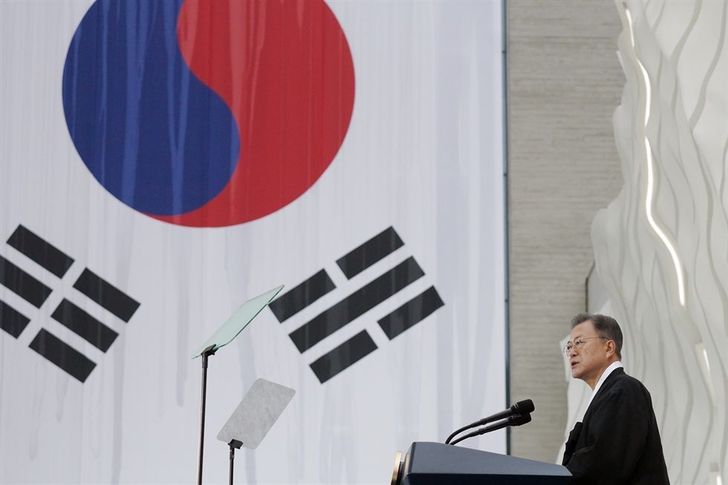
President Moon Jae-in speaks during a ceremony to commemorate the 103rd anniversary of the March 1 Independence Movement at the National Memorial for the Provisional Korean Government in Seodaemun District, Seoul, Tuesday. Yonhap
Moon also reiterated the necessity of Seoul's commitment to inter-Korean peace.
“Peace on the Korean Peninsula is a must for us to become stronger,” Moon said, adding that there was no South or North Korea during the time of the March 1 Independence Movement. “The Korean War and the history of division we have suffered since then have taught us that only dialogue ― not confrontation and hostility ― can bring peace.”
“If we do not lose our determination ― just as we dreamed of turning the PyeongChang Winter Olympics into a Peace Olympics amid the dark clouds of war ― it is certainly possible to bring denuclearization and permanent peace to the Korean Peninsula through dialogue and diplomacy.”
During the speech, Moon also noted the importance of national strength, in an apparent reference to Russia's invasion of Ukraine.
“State-centered nationalism, which seeks to gain hegemony by force, is also raising its head again. Concerns over a new Cold War are on the rise as well,” Moon said. The lesson that the spirit of the March 1 Independence Movement gives us today is that we should have the power to lead our history without being pushed around by an international order centered on powerful countries.”
The ceremony was held at the newly established National Memorial for the Provisional Korean Government in Seodaemun District, Seoul. In 2017, Moon had promised to build this national memorial and visited the building of the Provisional Republic of Korea Government in Chongqing.
“The March 1 Independence Movement and the Provisional Republic of Korea Government are a great legacy passed on to us by our forebears,” Moon said. “Remembering and honoring the history of our democratic republic will make our democratic republic of today stronger,” he said.
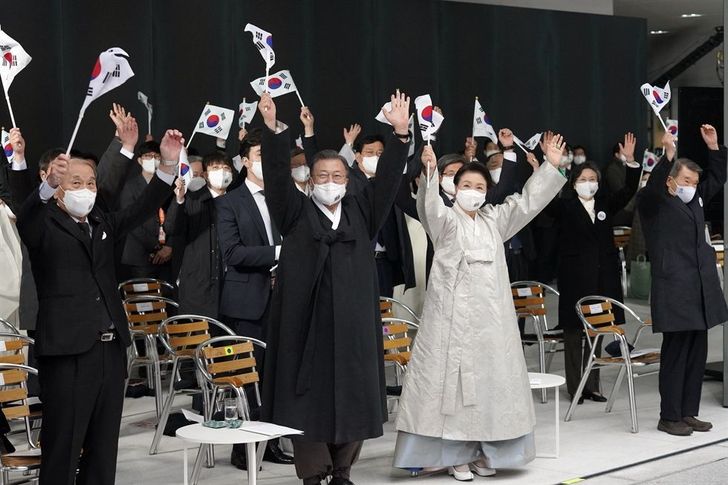
President Moon Jae-in and his wife Kim Jung-sook, on his left, raise Korea's national flags as they demonstrate the “manse” (cheer) action repeated across the peninsula in the 1919 March 1 Independence Movement during a ceremony to commemorate the 103rd anniversary of the event at the National Memorial for the Provisional Korean Government in Seodaemun District, Seoul, Tuesday. Yonhap