Opposition candidates face growing pressure to form coalition

People Power Party presidential candidate Yoon Suk-yeol speaks during a seminar at the Sheraton Grand Incheon Hotel in Incheon, Monday. Joint Press Corps
Third-ranked Ahn's growing popularity raises possibility of fielding unified candidate
By Nam Hyun-woo

The main opposition People Power Party (PPP) faces growing pressure to form a coalition with Ahn Cheol-soo of the minor opposition People's Party for the March 9 presidential election, as surveys show that an alliance offers a greater chance for the opposition bloc to beat ruling Democratic Party of Korea (DPK) presidential candidate Lee Jae-myung.
So far, the PPP has been downplaying the recent rise in Ahn's support rate, saying it is a “temporary phenomenon” stemming from infighting in the main opposition party between its presidential candidate Yoon Suk-yeol and party Chairman Lee Jun-seok throughout last month. However, anticipation is growing that the main opposition party may make a decision in the coming weeks in order to grab the public's attention before the Jan. 31-Feb. 2 Lunar New Year holidays.
According to a Realmeter survey released Monday, the DPK's Lee was leading the pack with a 40.1 percent support rate, followed by the PPP's Yoon with 34.1 percent and Ahn with 11.1 percent. It was the first time that Ahn logged a double-digit number in the weekly survey conducted by the poll agency at the request of OhmyNews.
When asked about who should be the single candidate from the opposition bloc in case the PPP and the People's Party form a coalition, 35.9 percent of respondents picked Ahn and 32.5 percent preferred Yoon. The poll surveyed 3,042 adults from Jan. 2 to 7.
Voters' preference for Ahn over Yoon was better shown in a separate survey by Southern Post, released on Sunday. According to the poll requested by broadcaster CBS, the DPK's Lee secured a 34.1 percent support rate, followed by Yoon with 26.4 percent and Ahn with 12.8 percent.
The survey showed if Yoon and Ahn form a coalition and select Ahn as their single candidate, Ahn outpaces Lee by 42.3 percent to 28.9 percent. If Yoon becomes the single candidate, their chance of winning significantly drops as Yoon takes the lead over Lee by 34.4 percent to 33.6 percent.
The Southern Post survey questioned 1,002 adults from Jan. 7 to 8. Further details on the two surveys are available at the websites of the polling agencies or the National Election Survey Deliberation Commission.
With the polls adding pressure on the opposition bloc to form a coalition between Yoon and Ahn, both sides are still denying any chance of an alliance.
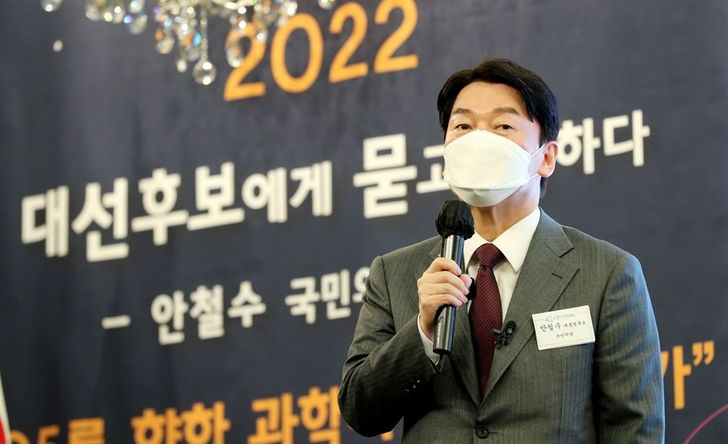
People's Party presidential candidate Ahn Cheol-soo speaks during a forum on Yeouido, Seoul, Monday. Joint Press corps
The PPP has been snubbing Ahn's growing presence by saying the recent reconciliation between Yoon and its Chairman Lee will facilitate a rebound in Yoon's support rate. The candidate and the party leader have been at odds since December over their election strategies, but they came to a settlement last week.
However, questions remain as to whether their reconciliation alone will resuscitate the PPP's presidential campaign, because there has been criticism that Yoon's faltering support rate is largely attributable to his own controversial remarks and doubts over his political ability to lead the main opposition party.
Against this backdrop, polls are showing that voters prefer Ahn as the single candidate for the opposition bloc, meaning a primary between Yoon and Ahn could end in Ahn's victory. To have its own candidate become a single candidate, it is said the PPP could seek a deal with the People's Party ― such as sharing the Cabinet after Yoon takes the presidential office ― in return for Ahn giving up his presidential bid. But this can also trigger conflict within PPP members, because the People's Party only has three seats in the National Assembly.
For his part, Ahn, encouraged by the rising support rate, is also snubbing any speculation of a coalition with the PPP.
“I'm running in the election to be elected and to change the administration. I'm not thinking of anything else,” he told reporters, Sunday.
“Talks involving the Yoon-Ahn coalition are anticipated to pick up momentum in the next couple of weeks, especially before the Lunar New Year holiday, in order to maximize the convention effect,” said Shin Yul, a political science professor at Myongji University.
“The PPP's scenario of the reconciliation between Yoon and Lee resuscitating Yoon's support rate is too rosy. Rather, they would think about a coalition, and there could be two options ― a coalition government between Ahn and Yoon or a major overhaul in the current DPK-PPP hegemony.”
Shin added that a coalition government could be possible, given the previous case of former President Kim Dae-jung and his Prime Minister Kim Jong-pil. In the 1997 presidential election, the two formed a coalition, with Kim Dae-jung becoming the single candidate and Kim Jong-pil and his party members taking prime minister and economic minister posts.