Reporter's notebook Concerns rise over PPP candidate Yoon's mastery of public speaking
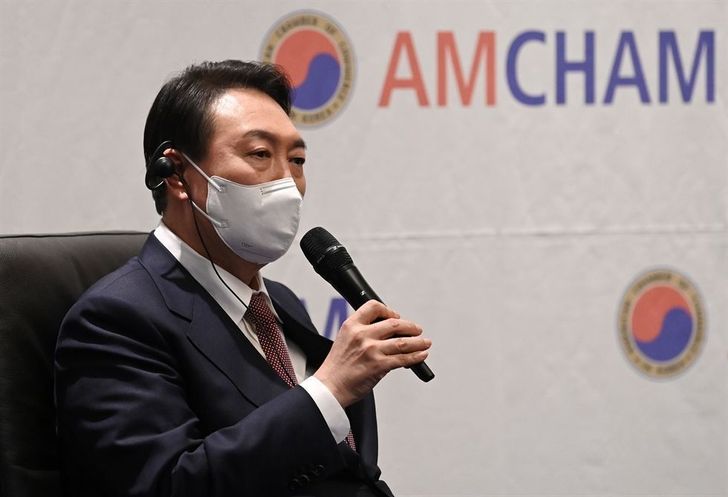
Main opposition People Power Party presidential candidate Yoon Suk-yeol speaks during an event hosted by the American Chamber of Commerce in Korea at the Conrad Hotel on Yeouido, Seoul, Tuesday. Joint Press Corps
By Nam Hyun-woo
Main opposition People Power Party (PPP) presidential candidate Yoon Suk-yeol is again at the center of controversy over his remarks that: “most Koreans hate China.”
Yoon added that this hatred is the result of the Moon Jae-in government's policies favoring of China. Concern is growing over the PPP candidate's rhetoric, in which he throws out controversial comments which he later has to add follow-up explanations to. Critics say this type of rhetoric can be a problem, especially in diplomacy, if he is elected president.
During an event hosted by the American Chamber of Commerce in Korea, Tuesday, Yoon said, “Most Koreans, especially young people, hate China, and most young Chinese hate Korea.”
He continued: “This wasn't so in the past. Koreans and Chinese had amicable feelings when Seoul engaged Beijing in strong trilateral cooperation between Korea, the U.S. and Japan. But the current Moon Jae-in administration resorted to policies pushed by China, while claiming to be an intermediary, and the outcome was not good.”
After the event, he clarified when asked by reporters that despite such bias toward China, people of the two countries have developed reciprocal animosity toward one and other.
Yoon's full remarks are interpreted as the candidate's attempt to criticize the Moon administration's effort to seek a balance between the current U.S.-China power struggle, which he views as leaning to much toward China. Yet criticism has now been raised that he made hastily generalizations even though he was speaking about extremely sensitive diplomatic matters that require delicacy.
The ruling Democratic Party of Korea (DPK) immediately lashed out at Yoon's remarks, saying they were, “ludicrous.”
“In the wake of the escalating U.S.-China rivalry, Korea's leader should strengthen the alliance between Korea and the U.S. and maintain a partnership with China through sophisticated and precise remarks,” DPK spokeswoman Kang Seon-ah said.
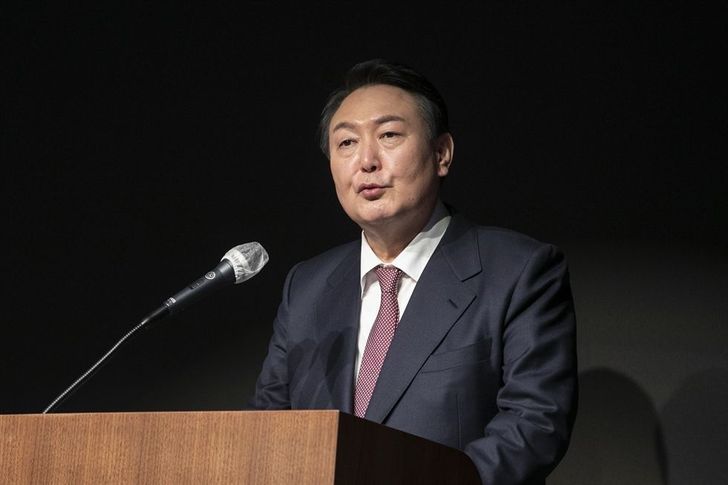
Main opposition People Power Party presidential candidate Yoon Suk-yeol speaks during a forum on balanced inter-regional development in Yeouido, Seoul, Tuesday. Joint Press Corps
This is not the first time that Yoon's “controversy-and-explanation style” came under fire.
On Dec. 22, Yoon caused controversy by saying, “People who are living in extreme poverty and who are uneducated know nothing about freedom and do not feel the necessity of freedom.”
He continued, “Though goods created by the society are distributed through the market, raising taxes and redistributing them to build the basis of economy and education for those in need are the prerequisite of freedom.”
Despite the follow-up explanation, his intention to emphasize support for education and welfare for people in need was overshadowed by the first comment, which was interpreted as an insult to the underprivileged.
On Sept. 13, Yoon said “These days, technology is key to earn a living, and manual labor makes nothing,” adding, “Even India does not do that. Only (countries in) Africa do that.”
After this remark drew criticism for insulting specific countries, Yoon explained he meant to “encourage college students to pay more attention to advanced science and computer technology.”
Whenever his comments trigger controversy, Yoon has claimed media reports are misinterpreting his comments by highlighting controversial parts. However, pundits say a politician should be able to express his or her intention precisely, in order to prevent his or her comments from being misinterpreted.
That is especially so for a serving president, whose choice of rhetoric bears extra significance.
Hundreds of reporters are eager to pick up a single quote from a state leader and strive to find any newsworthy meaning in the president's choice of words and phrases. Each news outlet releases its own interpretations on the president's remarks because it gives a significant hint on how state affairs will unfold. Throwing out controversial remarks first and then trying to clarify them is not the way for the president to give a message to the public.
When it comes to diplomatic matters, the importance of the president's rhetoric bears extra significance.
“Politicians should know every single word that they speak can mean problems,” a veteran diplomat said, asking not to be named. “Though they might feel direct rhetoric may satisfy the public, they have to be very careful in phrasing sentences to prevent misinterpretation.”