Main opposition candidate Yoon trapped in dilemma after Park's release
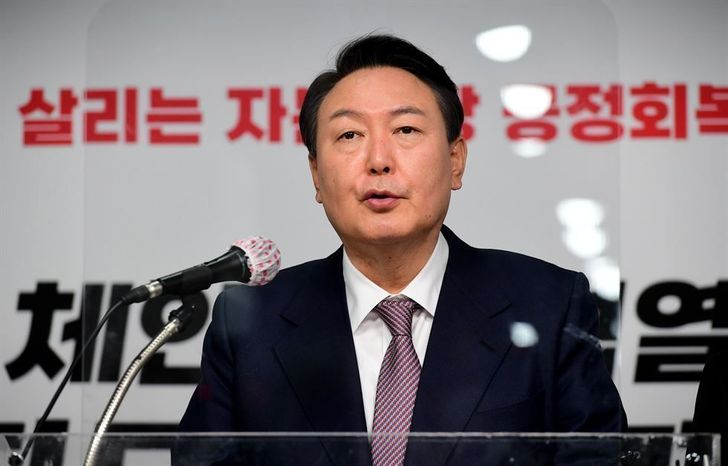
Yoon Suk-yeol, the presidential candidate of the conservative main opposition People Power Party (PPP), holds a press conference to announce his policy promises on the capital market sector, at the PPP's headquarters in Yeouido, Seoul, Monday. Joint Press Corps
By Jung Da-min
The main opposition conservative People Power Party (PPP) and its presidential candidate Yoon Suk-yeol are facing a dilemma over how to respond to last week's presidential decision on a special pardon for former President Park Geun-hye who had been jailed over a massive corruption scandal.
As Park still has influence in the conservative PPP's home turf of Daegu and North Gyeongsang Province while Yoon, as senior prosecutor, led the investigation into the scandal that ended with her imprisonment, he and the party are at a loss over whether they should make a more conciliatory gesture toward the former president to embrace her supporters, or keep their distance from her so as not to lose support from centrist voters, especially around the planned regional visit later this week.
The visit had been arranged before the government announced its decision to pardon the former president, citing mainly health reasons, while she was serving her 22-year prison term for multiple charges including corruption. Since her arrest in March 2017, she has received treatment for shoulder and back pain and recently for psychological anxiety.
Park had long represented a district in Daegu, and sympathy for the jailed former president has been relatively high among residents in the city and the surrounding provinces compared to other regions.
With Park's pardon decision being made just ahead of Yoon's visit to the region from Wednesday to Thursday, Yoon's plan to draw support from residents there faces an unexpected uphill battle as many Park supporters regard Yoon as one of the main figures behind Park's downfall ― Yoon, who had clashed with Park under her tenure, later led the investigation into the scandal as a member of the special counsel team, and was tapped as prosecutor general for the current Moon Jae-in administration.
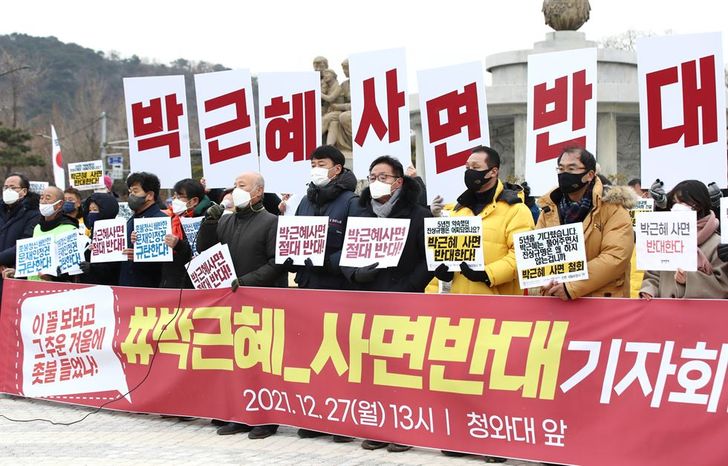
Members of a liberal civic organization hold a press conference to protest the Moon Jae-in government's decision to pardon former President Park Geun-hye, in front of Cheong Wa Dae in Seoul's Jongno District, Monday. Yonhap
Upon the amnesty decision, Friday, Yoon said he welcomed Moon's decision to pardon the former president but did not say whether he would welcome her back to the PPP.
While attention is paid to what kind of message the PPP candidate will issue during his visit to Daegu and North Gyeongsang Province, Yoon said on Sunday in a phone interview with Yonhap News Agency: “I would refrain from commenting on matters that are far from people's livelihoods, which is the purpose of my visit to the region.” Regarding questions related to the former president, he took a prudent stance, saying, “I hope she gets well soon, but relating her to current political issues or the presidential race would also add to her pressure.”
Since her impeachment, the conservative party has long struggled to regain public support, losing the 2017 presidential election and 2020 general election.
In a bid to rebrand the party and woo centrist voters, the conservative party has made many efforts including bringing in figures of the liberal and centrist blocs, such as veteran politician and economist Kim Chong-in as the party's election committee chief, and Kim Han-gil, former leader of the Democratic Party, a predecessor of the current ruling Democratic Party of Korea (DPK), as the chairman of a separate campaign committee aimed at winning support from centrists and liberals.
In that situation, taking a reconciliatory position to the impeached former president could leave a negative impression of the candidate on centrist and swing voters, according to political watchers. But at the same time, Yoon and the PPP also need to embrace Park's supporters, as Yoon and his rival Lee Jae-myung of the DPK are in a neck-and-neck race according to recent opinion polls.
If Park issues any political message to her supporters, it can also affect the composition of the two-way race between the liberal and conservative blocs, depending on whether her message would support Yoon and rally conservative voters or express disapproval of the former top prosecutor who led the investigation into her.