Rival candidates resort to tax delays, feminism to woo voters

Democratic Party of Korea presidential candidate Lee Jae-myung enters an event hall in downtown Seoul, Tuesday, to have an online discussion with professor Michael Sandel of Harvard University. Joint Press corps
By Nam Hyun-woo

With less than three months to go until the presidential election, Korea's major presidential candidates have been slammed for compromising their political consistency for votes, as the ruling party candidate churns out short-term pledges while the main opposition candidate has tapped into feminism despite his party's resistance to it.
The ruling Democratic Party of Korea (DPK) and the government announced on Monday that they will consider using this year's officially assessed land prices in calculating next year's property taxes for homeowners.
Initially, the government had been seeking to overhaul the official home pricing scheme to match official housing prices with market prices, which would result in tax hikes for homeowners. However, applying this year's prices in calculating next year's taxes means that the ruling party and the government will postpone the expected tax hike for one year.
The move came after DPK presidential candidate Lee Jae-myung on Saturday demanded a “full-scale review” of the government scheme, saying that “every policy should be aimed at addressing inconveniences of the public.”
“I appreciate the government and the party for making a prompt decision on my suggestion,” Lee wrote on Facebook, Monday.
Along with this review, Lee has been demanding in recent weeks that the government postpone new regulations by one year on capital gains taxes, which will also result in tax hikes,.
On Dec. 12, Lee suggested that the government postpone for a year its scheme to levy heavier capital gains taxes on those who own multiple homes, which Prime Minister Kim Boo-kyum opposed on Tuesday. Earlier on Nov. 11, Lee also pledged to postpone taxation of crypto assets for a year.
Lee's moves are interpreted as efforts to soothe the public sentiment against taxation, which was partially shown through the crushing defeat of the DPK in the April 7 mayoral by-elections. However, such promises to postpone sensitive matters raise concerns that Lee may flip-flop on his stance after the election.
“As the presidential election is near, the DPK came up with a patchwork measure,” main opposition People Power Party (PPP) spokeswoman Her Euna said. “Is Lee seeking to soothe public sentiment first and then impose hefty taxes after the election?”
Minor opposition Justice Party presidential candidate Rep. Sim Sang-jeung also said that tax policies are the fundamental policies of society, adding, “Just because he is now the presidential candidate, Lee is influencing government policies that were just implemented.”
As criticisms continue over his political inconsistency, Lee stressed “pragmatism,” as one of his mottos.
“Policies should serve the public need, not political ideologies or values,” Lee wrote. “Improving people's lives and relieving their pain always outweigh the act of accomplishing one's political beliefs.”
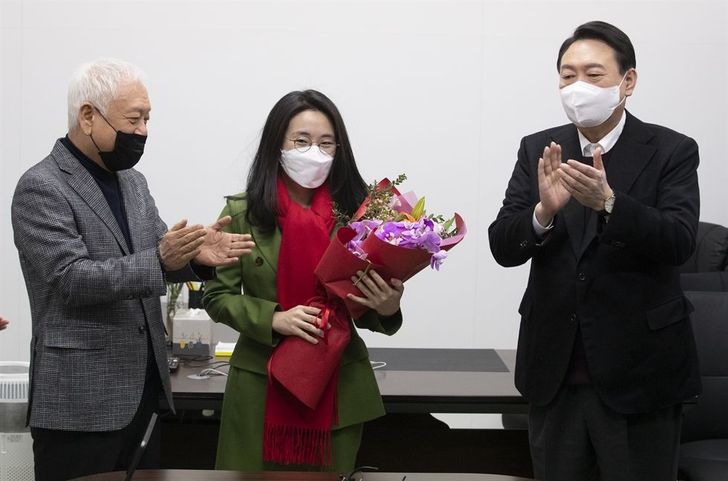
People Power Party presidential candidate Yoon Suk-yeol, right, applauds after appointing Shin Ji-ye, center, former head of the Korean Women's Political Network, as deputy head of the Saesidae Preparatory Committee, a sub-organization in his election camp, at the committee's office in Yeouido, Seoul, on Monday. On the left is the Committee Chairman Kim Han-gil. Joint Press Corps
PPP candidate taps into feminism, against party's stance
PPP presidential candidate Yoon Suk-yeol is also in the hot seat over his appointment of Shin Ji-ye, former head of the Korean Women's Political Network, as deputy head of the Saesidae Preparatory Committee, a sub-organization in Yoon's election camp. “Saesidae” means “new era” in Korean.
Shin is known as a vocal feminist, who garnered attention when running in the Seoul mayoral election in 2018 and in the by-election for the same post in April this year. In 2018, she ran as the candidate of Green Party Korea, a progressive party advocating for environmentalism and feminism.
Since the by-elections in April, the PPP has been enjoying wide support from men in their 20s and 30s, and this support is largely attributable to PPP Chairman Lee Jun-seok, who gained popularity by claiming that feminism-based policies discriminate against young men.
Due to this situation, Yoon has been attempting to include a touch of feminism in his election camp, appointing professor Lee Soo-jeong of Kyonggi University, a renowned forensic psychologist who is also described as a feminist, as co-chair of the PPP election committee.
Shin's appointment, however, drew backlash within the conservative party over claims of inconsistency.
Shin has been at odds with the PPP chairman, having compared him to Adolf Hitler. On Nov. 24, only about a month before joining Yoon's camp, Shin even tweeted: “The PPP cannot be an alternative for feminists.”
Regarding Shin's appointment, PPP Chairman Lee expressed his displeasure. “(I will) stop and correct Shin if she makes any remark that goes against the party's direction,” he told reporters, Monday.
Rep. Ha Tae-keung of the PPP also wrote on Facebook, Monday, that he opposes the appointment of Shin, who “only fuels gender conflict.”
“Yoon may simply think that adding some feminism to his camp will solve gender conflicts and result in greater support from young female voters. But he does not know the seriousness of the conflicts,” Ha wrote. “Gender conflict is not a candlelight but a wildfire. As Yoon has blown wind on the wildfire, the conflict will blaze up even further.”