Government under fire for diplomatic complacency on DEF shortage

Concrete mixer trucks are parked at a ready-mix concrete plant in Anyang, Gyeonggi Province, Tuesday. Including such trucks, drivers of diesel engine vehicles are suffering from difficulties securing diesel exhaust fluid due to a nationwide shortage of the substance. Yonhap
By Nam Hyun-woo
Criticism is rising over the government's diplomatic response to the domestic shortage of diesel exhaust fluid (DEF), also known as “urea water,” a key material for reducing emissions, as its complacency on the issue resulted in unnecessary confusion in the country's logistics and transportation sector.
The shortage is largely attributable to a diplomatic row between China and Australia, which caused China to suffer a coal supply shortage and subsequently tighten its exports of urea, which is produced as a byproduct of burning coal. As Korea has been relying almost exclusively on China for urea, Beijing's export ban has triggered a domestic shortage of DEF.
Relevant ministries have hurried to come up with countermeasures, with the Ministry of Foreign Affairs announcing Wednesday that it has confirmed China will approve the export process of 18,700 tons of urea for Seoul in accordance with existing contracts with local firms.
Although such measures may quench the immediate thirst for DEFs, criticism is growing as the government's complacent response has brought an unnecessary stir.
Despite the concerns of freight vehicle drivers, as well as media reports on the shortage and consumers' panic buying of DEF products, the government has been downplaying the issue so far.
“Since the government is making its best efforts to address the delay in importing urea water and find alternative import channels, I urge the public not to be excessively concerned,” President Moon Jae-in said during a Cabinet meeting on Tuesday.
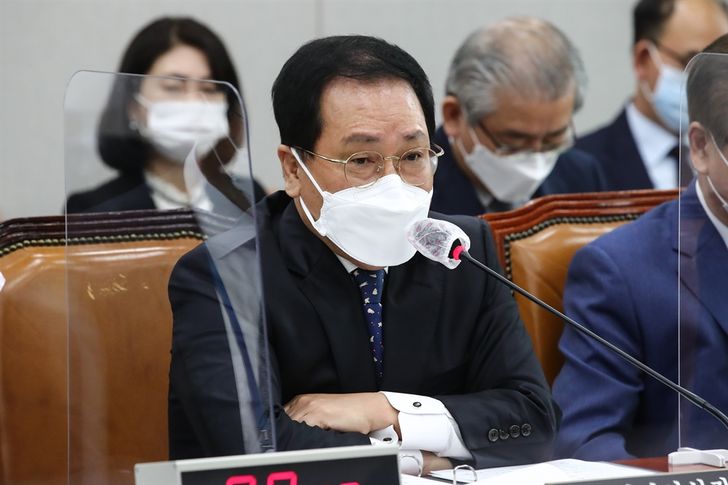
Presidential chief of staff Yoo Young-min speaks during his National Assembly appearance, Wednesday. Joint Press Corps
Reportedly, the presidential office has been refraining from seeing the current shortage as a “crisis,” because urea is not seen as a strategic or key industrial material which can sway the country's industrial activities. Since the government had been considering urea as a feedstock for fertilizer, it took time for Korea to make diplomatic efforts persuading China to resume its export.
Since mid-October, there have been news reports that Korea's retail stores and gas stations are running out of DEF following China's Oct. 15 announcement of a tougher screening process for urea exports. However, the Korean embassy in China reported China's export restriction to the foreign ministry on Oct. 21. The Korea Trade-Investment Promotion Agency (KOTRA), a state-run organization that assists Korean firms' overseas trade, reported the possibility of a DEF shortage to the industry ministry also on Oct. 21, even though it was aware of China's intention to curb exports of the fluid in early October.
As reports are delayed, Cheong Wa Dae belatedly began playing its control tower role on Nov. 5, launching a pan-government taskforce.
This is not the first time that diplomatic issues have caused Korea to suffer shortages in industrial materials imported from a certain country.
Japan has been restricting exports of three industrial materials critical for the chip and display industries since 2019, in an apparent retaliation against the South Korean Supreme Court's decision that ordered Japanese companies to provide compensation for surviving South Korean victims of wartime forced labor.
To dismiss the restriction, domestic companies found alternative trade channels and the Moon government launched a self-sufficiency campaign to localize production of key industrial materials. At the time, the government stressed the importance of diversifying industrial supply chains and promised to enhance efforts to prevent diplomatic issues from hurting the country's economy.
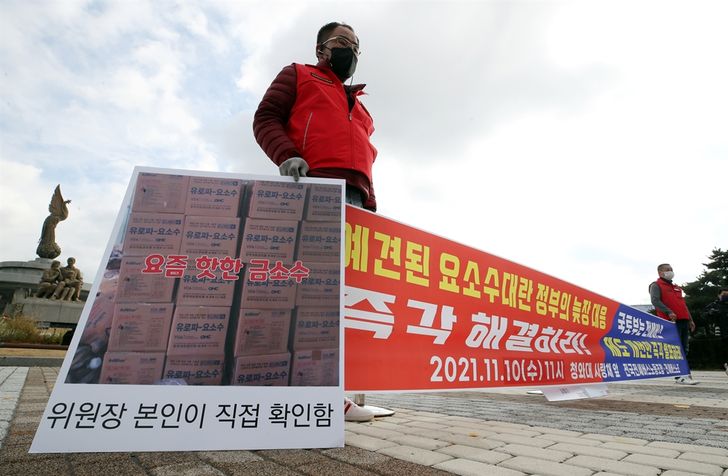
A member of a bus drivers' union stages a rally in front of Cheong Wa Dae, Wednesday, criticizing the government's belated response to a nationwide shortage of diesel exhaust fluid. Yonhap
Despite that experience, the government still believes it is in a “learning process.”
Presidential chief of staff Yoo Young-min said during his appearance at the National Assembly, Wednesday, that “we feel like we have paid an expensive tuition fee,” referring to the DEF shortage.
He added, “Japan's export restriction two years ago was a blessing in disguise for the country's industries. We had a similar lesson this time.”
Park Soo-hyun, senior secretary for public communications, also said in a radio interview on Wednesday, “This is a time that we are learning that a loophole in the global value chain causes massive side effects.”
Despite the government's optimism, drivers of trucks, construction equipment and buses are complaining that their livelihoods are being threatened due to rising DEF prices.
During a protest in front of Cheong Wa Dae, a union of bus drivers denounced the government for its belated response, even though the DEF shortage was widely expected, that has caused the current fiasco.