Ahn's third presidential bid to affect competition
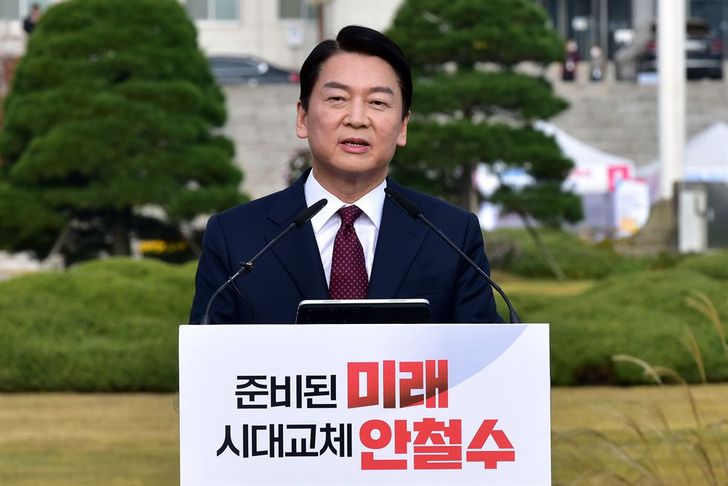
Minor opposition conservative People's Party leader Ahn Cheol-soo declares his bid for the March 9 presidential election at the National Assembly in Seoul, Monday. This is Ahn's third presidential run following those in 2012 and in 2017. Joint Press Corps
By Jung Da-min
The presidential bid of minor opposition conservative People's Party head Ahn Cheol-soo is expected to be a variable in the race between the contenders of the two major parties, because his potential solidarity with other opposition candidates could change the current neck-and-neck competition.
Although he has pledged to finish the race, many believe he will ultimately seek to back a single candidacy among other opposition candidates as he has done multiple times over the past decade.
Holding a press conference at the National Assembly, Monday, Ahn, 59, declared his bid for the March 9 presidential election, highlighting his vision with three keywords ― safety, future and fairness.
What is drawing public attention is whether he will seek solidarity with other opposition candidates for a single candidacy. He has done so multiple times since entering the politics in 2011, at first for the nation's liberal bloc but later for the conservatives by naming himself and his party as “centrist.”
In 2011, the former doctor and entrepreneur was one of strongest potential contenders in the Seoul mayoral by-election from the liberal side, but he said he would not run in the election and instead supported another liberal contender Park Won-soon in a unified front against the conservatives. Park won the election.
He was an independent presidential candidate in 2012 but dropped out while trying to field a unified candidacy with Moon Jae-in of the liberal main opposition Democratic United Party.
In the 2017 presidential race, Ahn finished in third place with support of 21.41 percent as the minor opposition People's Party candidate.
He ran for the Seoul mayoral post in 2018 but failed.
Ahn declared his bid for the April 7 Seoul mayoral by-election, but lost to the PPP's candidate Oh Se-hoon, now the Seoul mayor, in a bipartisan primary to select a unified candidate of the opposition bloc.
Despite his repeated failure to win in big elections, his third presidential bid is bringing attention, as Ahn could hold the casting vote according to whether he takes sides with the main opposition People Power Party (PPP) for a joint fight against the ruling liberal Democratic Party of Korea (DPK).
Political watchers said Ahn may be considering negotiating with the PPP for a unified candidacy after the PPP candidate is selected later this week.
Political commentator Lee Jong-hoon said Ahn's bid for the 2017 presidential election had been a game changer as he garnered considerable support of 21 percent but he would not have such a presence this time because of two major parties.
"However, as a neck-and-neck race is expected between the two, Ahn would be able to hold the casting vote even with a 5 percent to 10 percent support rate. This is why Hong Joon-pyo, a presidential contender of the PPP, is already talking about possibly negotiating with Ahn for a unified candidate," Lee said, adding there was a possibility that the PPP's candidate and Ahn could form a political alliance, so that the PPP's candidate would become the next president and Ahn the next prime minister if they win the election.
Cha Jae-won, a professor of special affairs at the Catholic University of Pusan, said Ahn had no choice but to declare his bid for the presidential election for his political career because his party would not survive after the election if it fails to show a presence in the presidential race.
"The necessity for unifying candidacies would certainly increase in this presidential election with the fierce competition between the two major parties. But even if Ahn's strategy of strengthening his presence succeeds, his political career prospects look dim as he has repeatedly failed to finish the race in big elections," Cha said.