Inter-Korean arms race intensifying

This photo released by North Korea's state-run Korean Central News Agency, Thursday, shows a missile test-launched from a train the day before in an undisclosed location in North Korea. Yonhap
Experts say Biden administration must change its North Korea strategy
By Jung Da-min
Contrary to the narrative of establishing peace on the Korean Peninsula, the arms race between the North and South is intensifying as both countries accelerate their missile development projects.
North Korea's state-run Korean Central News Agency (KCNA) said Thursday that the country's railway-launched missile regiment held a firing drill early in the morning the day before, striking a target in the East Sea 800 kilometers from its launch location in a central mountainous area.
Two hours later on the same day, the South Korean military successfully test-fired a domestically developed submarine-launched ballistic missile (SLBM) to become the world's seventh country to have actual combat operational capability for such a weapon. The missile was launched from the ROKS Dosan Ahn Chang-ho, the nation's first 3,000-ton submarine equipped with six vertical launch tubes, at a naval weapons test site off the west coast of Anheung, South Chungcheong Province. The missiles reportedly flew about 400 kilometers southwards to strike their target.
Aside from the missile tests carried out by both Koreas the same day, the countries have also engaged in other cruise and ballistic missile development programs, with test launches of such missiles escalating tensions on the peninsula. Both Koreas have said they would continue to develop various types of missiles to counter the military threats posed by each other.
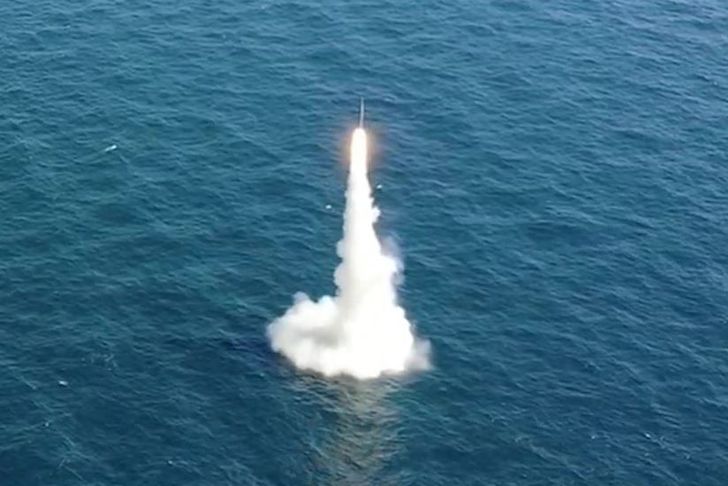
South Korea's domestically developed submarine-launched ballistic missile is test-fired from the ROKS Dosan Ahn Chang-ho, at a naval weapons test site off the west coast of Anheung, South Chungcheong Province, Wednesday. Courtesy of Ministry of National Defense
Watching the SLBM test, President Moon Jae-in called on the military to keep strengthening missile capabilities to counter Pyongyang's asymmetric power, such as its nuclear weapons and ballistic missiles. Regarding Moon's remarks, Kim Yo-jong, the sister of North Korean leader Kim Jong-un, issued a statement just hours later slamming Moon for branding the North's weapons tests as a provocation and warned that inter-Korean relations would be totally destroyed if Moon continues criticizing the North.
International relations experts said this arms race has been anticipated in light of recent developments. They said U.S. President Joe Biden's North Korea strategy, which sought to bring North Korea back to the negotiating table, has not been effective.
"North Korea's steadily advancing missile program should not come as a surprise. Kim Jong-un made defense development a major line of effort in his report addressing the eighth Party Congress in January 2021, and specifically mentioned long-range cruise missiles," said Eric Gomez, Washington-based think-tank Cato Institute's director of defense policy studies.
The KCNA said Monday that the country successfully test-fired what it called newly developed long-range cruise missiles over the weekend.
"The cruise missile tests also follow a report by the United Nations that North Korea restarted the plutonium-producing reactor at the Yongbyon nuclear complex this summer,” Gomez said. “The Biden administration's approach seeking a middle path between the Trump administration's dangerous maximum pressure campaign of 2017 and the subsequent summit pageantry is unlikely to stop North Korea's programs. The longer the United States waits to get serious at the negotiating table, the more technical thresholds and limitations Kim Jong-un will break through, leaving the United States in an ultimately worse-off position."
Jessica Lee, a senior research fellow at the Washington-based Quincy Institute, said the U.S. needs a different approach such as easing sanctions to make way for humanitarian exchanges first.
"U.S. Special Representative for North Korea Policy Sung Kim's recent remarks that the United States would provide humanitarian assistance to North Korea regardless of progress in denuclearization is a good first step, but more is needed. There is a total absence of trust between the two countries; North Korea will not accept any aid that is linked to the United States because it believes Washington will politicize it," Lee said. "Yet during this time of a pandemic, humanitarian work can be a powerful tool for trust-building and generate goodwill at the people-to-people level."