Has opposition contender Yoon reached his limit?

People Power Party presidential contender Yoon Seok-youl enters a party office in Eunpyeong District in Seoul, Aug. 3. Joint Press Corps
Support rate for ex-top prosecutor declining after controversial remarks
By Nam Hyun-woo
Yoon Seok-youl, a presidential contender of the main opposition People Power Party (PPP), is quickly losing support in polls, causing many to question whether the former prosecutor general has reached his limits as a politician.
According to a poll conducted on 1,004 adults by the Korea Society Opinion Institute (KSOI), Aug. 6 and 7, Yoon's support stood at 28.3 percent, down 4 percentage points from a week earlier.
While Yoon is hemorrhaging support, Gyeonggi Province Governor Lee Jae-myung from the ruling Democratic Party of Korea (DPK) has come from behind to lead presidential contenders with support of 28.4 percent, up 1 percentage point from a week earlier.
Of notice in the polls was Yoon's drops in South and North Gyeongsang provinces, which are the traditional strongholds of the conservative party. His support in Busan, Ulsan and South Gyeongsang Province stood at 30.3 percent, down 10.9 percentage points from a week earlier, and for Daegu and North Gyeongsang Province it was 42.5 percent, down 2.8 percentage points.
According to another poll conducted by Gallup Korea on 1,001 adults from Aug. 3 to 5, Yoon's rate declined to 19 percent from 25 percent tallied a month earlier, again allowing the DPK's Lee take the lead.
Yoon has been leading most surveys for potential presidential candidates since March, when he resigned from the top prosecutor post after clashing with the Moon Jae-in administration over his investigation of former Justice Minister Cho Kuk, a close aide to President Moon.
However, his support rate began to go down recently following a string of controversial comments he made. The KSOI noted that “Yoon was mired in a string of controversies over his remarks on the Fukushima disaster and unhealthy food.”
His latest slip of the tongue was a comment on the 2011 Fukushima disaster, as he said there was no radioactive contamination from the damaged nuclear power plant, despite clear evidence of harmful radioactive materials that were released.
Before the Fukushima remarks, Yoon was criticized for saying, “The have-nots should be allowed to choose low-quality food,” triggering doubts about his ability to address the income gap.
Yoon was also rebuked for his comments on the government's 52-hour statutory workweek plan after he said, “Workers should be allowed to work 120 hours a week and then take a good rest.”
Along with this, Yoon stirred another controversy on Aug. 2 by saying “political abuse of feminism hinders healthy relationships between men and women,” and “debates about feminism should be healthy ones, and should not be exploited for the sake of the election and the ruling bloc's staying in power.”
Criticisms followed from liberal pundits. Chin Jung-kwon, former Dongyang University professor and a political critic, said, “Yoon should clearly speak about what is healthy feminism.”
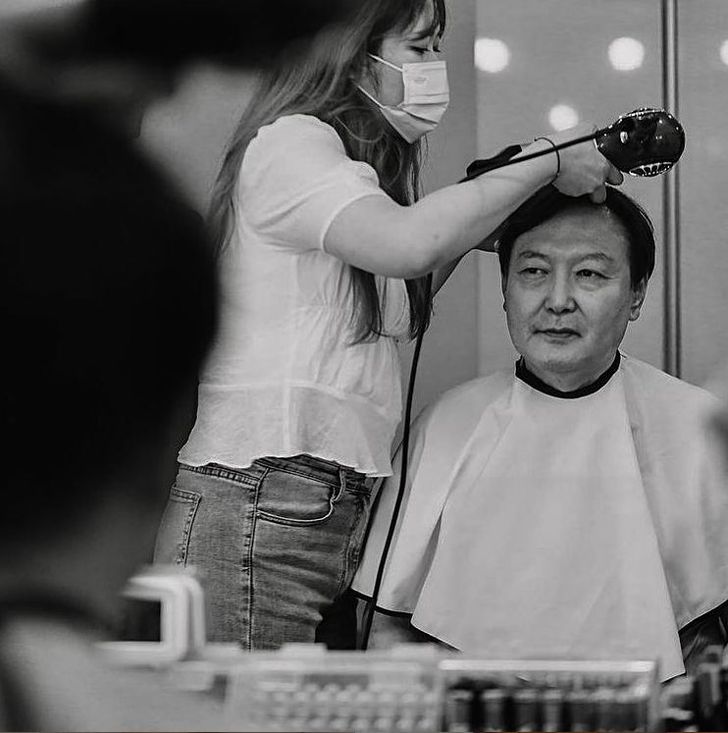
People Power Party presidential contender Yoon Seok-youl gets his hair styled in this photo uploaded to Instagram Aug. 5. Captured from Yoon's Instagram
Against this backdrop, Yoon is facing concerns that he is showing his limitations as a politician, because his support rate has been dropping since he began to speak and deliver political messages.
“The recent drops among conservative supporters show that Yoon's moves and messages were not effective,” said Eom Gyeong-yeong, a director of the Zeitgeist Institute, a private political think tank. “As his remarks continue to stir controversy, it seems that fundamental questions on Yoon's quality as a presidential candidate have grown among conservatives.”
Eom said Yoon has built his support on sentiment against the Moon administration, but is showing “no clear content” to become Korea's next president.
“A presidential election is decided on a combination of judgment on the current administration and an evaluation on presidential candidates' policies,” Eom said. “Former Presidents Roh Moo-hyun and Park Geun-hye both succeeded in having their parties stay in power despite strong calls for a leadership change.”
Roh succeeded former President Kim Dae-jung in 2003 as a liberal president, while Park succeeded former President Lee Myung-bak in 2013 as a conservative one.
“With Yoon's camp expanding, he will be able to come up with ideas on running the country. The problem is, however, whether he will listen to his politically experienced aides and improve on his shortcomings as a politician.”
In the meantime, Yoon's camp announced, Tuesday, that former top nuclear envoy Lee Do-hoon will advise Yoon on foreign affairs.
Lee was the top negotiator for the North Korean nuclear issue under the Moon Jae-in administration from September 2017 to December 2020, during which time three inter-Korean summits and three meetings between North Korean leader and then U.S. President Donald Trump took place. He was replaced along with the launch of the new U.S. Joe Biden administration.
Including Lee, the Yoon camp said 42 experts from various sectors will make up an advisory group to provide policy insights for Yoon.