Populist pledges for cash handout in presidential race draw concerns

Feasibility, sustainability of cash handout promises in question
By Jung Da-min
Amid increasing competition in the race for the presidency, presidential hopefuls are coming up with a multitude of promises, including providing cash handouts for all citizens, or certain specific groups such as young people or those with low income levels, in a bid to boost their popularity.
This is raising concerns among political watchers as to whether the nation will have sufficient funds to meet all their pledges, whether the measures will really help and whether offering money can ensure policy sustainability.
Gyeonggi Provincial Governor Lee Jae-myung, the leading presidential contender of the ruling Democratic Party of Korea (DPK), has promised to hand out 250,000 won ($218) per year to every citizen as a basic income starting from 2023, with the goal of increasing the amount to 1 million won during his term, which will be until May 2027 if he is elected. In addition to the universal basic income, he plans to provide an additional allowance of 1 million won annually to about 7 million young people aged between 19 and 29.
His rivals form the ruling party have also pledged to hand out money to young people to help jumpstart their careers ― former DPK Chairman Lee Nak-yon vowed to provide 30 million won to every man who finishes his mandatory military service; former Prime Minister Chung Sye-kyun suggested the government set aside 5 million won every year for each child and providing the accumulated 100 million won to them when they turn 20 years old; while Rep. Kim Du-kwan proposed the administration save 30 million won for each newborn and then double the amount to give 60 million won to each when they are 20.
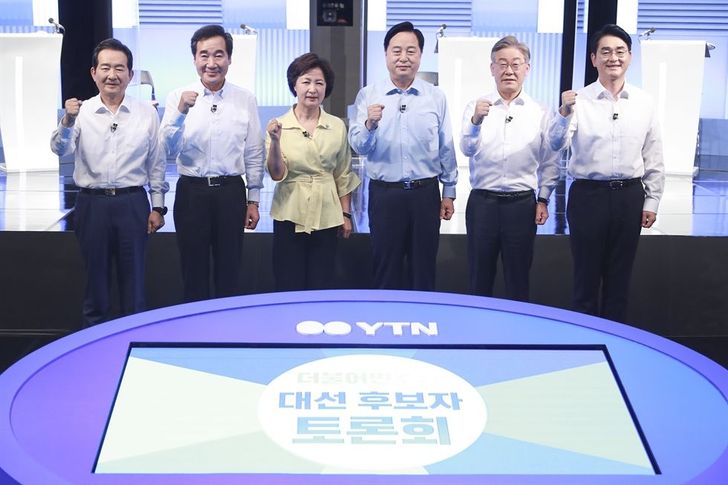
Presidential contenders of the ruling Democratic Party of Korea (DPK) participate in a live TV debate at local broadcaster YTN's headquarters in Seoul's Mapo District, Wednesday. From left are former Prime Minister Chung Sye-kyun, former DPK Chairman Rep. Lee Nak-yon, former Justice Minister Choo Mi-ae, Rep. Kim Du-kwan, Gyeonggi Province Governor Lee Jae-myung and Rep. Park Yong-jin. Joint Press Corps
Among the conservative opposition, former four-term lawmaker Yoo Seong-min of the main opposition People Power Party (PPP), who also ran in the 2017 presidential election, has come up with a “fair income” concept, under which people in the higher income brackets pay more tax while those with a lower income ― at a specific threshold ― receive subsidies.
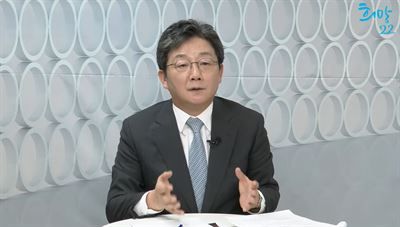
Former four-term lawmaker Yoo Seong-min, a presidential hopeful of the main opposition People Power Party, talks during an online press conference, Thursday. / Screenshot from Yoo Seong-min TV
Political watchers said that such promises to hand out money to citizens are reflecting changes in the country's economic structure and an altered paradigm for the government's role in boosting the economy.
“The times have changed. In the past, we believed only those in extreme poverty were in a difficult situation, but today those in the middle class are also having difficulties, with many of them in irregular jobs,” said Kang Nam-hoon, a professor at Hansin University. “Such promises of handing out money, especially Governor Lee's basic income policy pledge, are reflecting the changes.”
Cha Jae-won, a professor of special affairs at the Catholic University of Pusan, said the country focused on economic growth in the 1960s and 1970s and most of the people, not just economic bureaucrats, put their priority on growing the whole pie of the economy rather than on distribution. But he said this tendency started to change following the country's democratization in the late 1980s, and the change has been accelerated since the inauguration of the Moon Jae-in government.
“While the business sector previously led economic growth, the government is seeking to take the lead under the Moon administration,” Cha said, citing Moon's income-led growth policy which aims to increase household incomes through increased spending under the belief that this will lead to increased consumption and business growth. “So the fiscal paradigm has changed and this trend has been further accelerated since last year due to the COVID-19 pandemic.”
Cha said Governor Lee's basic income policy is also reflecting the changing times embodied by the Fourth Industrial Revolution, as many conventional jobs have been replaced or will disappear in the near future due to advanced technologies.
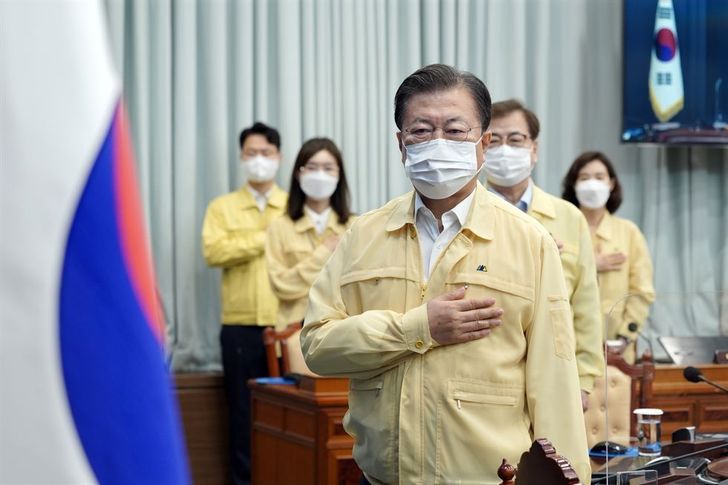
President Moon Jae-in salutes the national flag before a Cabinet meeting at Cheong Wa Dae in Seoul, Tuesday. Courtesy of Cheong Wa Dae
But political watchers and some opposition contenders question the feasibility and sustainability of such cash handout plans in terms of the national budget.
For example, Governor Lee's basic income policy alone would require a budget of 20 trillion won in 2023 and up to 57 trillion won annually in later years. Lee said 25 trillion won can be secured through fiscal restructuring and the adjustment of budget priorities, as well as establishing new areas for taxation such as land and carbon taxes. “All we need to do is to manage the nation's financial resources properly and adjust spending priorities,” he said during a press conference to introduce his campaign platform, July 22.
“Governor Lee should first make it clear if he is planning to introduce a basic income system while also maintaining the country's existing welfare programs. If he is planning to do both, I doubt that would be a sustainable plan,” said Shin Yul, a political science professor at Myongji University.
Cha also questioned whether such a cash handout policy would be sustainable as state coffers could dry up within five decades, and it would also increase the tax burden for future generations especially with an aged society.
“Such a policy may continue working until the administration after the next administration. But if it continues, we may see a sovereign default,” Cha said.
However, political watchers see the current trend of the government expanding welfare spending as likely to continue and presidential contenders of the conservative opposition will therefore have no choice but to follow the trend to win public support, although they are likely to opt for a selective welfare system for some of the more vulnerable groups, as seen in Yoo's pledge.
“Opposition contenders are criticizing the DPK hopefuls' pledges of more money, but they will have to follow suit so as not to lose public attention,” Shin said.
The PPP's other presidential hopefuls such as former Prosecutor General Yoon Seok-youl and former Board of Audit and Inspection Chairman Choe Jae-hyeong have yet to reveal any policy pledges for such “support funds.” But Choe criticized Governor Lee's basic income policy as being populist.