August comes as tough month for Moon's presidency

President Moon Jae-in speaks during a meeting with his secretaries at Cheong Wa Dae, Monday. Courtesy of Cheong Wa Dae
By Nam Hyun-woo
President Moon Jae-in is set to take on daunting tasks this month with his term heading to the final stage, as the continued surge in the country's Delta variant cases hurt his approval rating while his efforts to improve inter-Korean relations are hitting a snag.
According to Cheong Wa Dae, Moon was supposed to take a summer vacation this week but “postponed” the plan to hold meetings with his aides. Though the presidential office said the vacation was postponed, chances are high that Moon will not take it at all so as to address pending state affairs.
If Moon does not take the leave, it will be the third consecutive year that he has canceled his summer vacation. In 2020, he called off his leave due to heavy rainfall that wreaked havoc on the southwestern region of the country, and he scrapped his 2019 vacation plans due to the rising tensions with Japan after Tokyo imposed export restrictions on key industrial materials to Seoul.
Korea's President is allowed to use 21 or 22 days of leave a year, but Moon spent five out of his 21 days in 2019 and one out of 22 last year. He has not taken a single day off this year.
During a meeting with aides, Monday, Moon said he feels “heavy-hearted for the public not spending their summer vacations freely” due to COVID-19 and thanked the public and health workers for their service and cooperation in following social distancing measures.
Despite Moon's initial plan to contain the surge of Delta variant cases as quickly as possible, the country's daily COVID-19 cases have been hovering over 1,000 for weeks, with the country's total caseload surpassing 200,000 as of Sunday.
On July 12 when the government adopted the toughest Level 4 distancing measures in Seoul and surrounding cities, the President said, “Short but full measures will help our prompt return to daily lives.” But the government ended up adopting Level 3 distancing measures outside the capital area, as the Delta variant spreads fast.
Moon pledged Monday that the government will spare no efforts for faster vaccination, seeking to have more than 36 million people to get at least one shot before the Chuseok holiday period, which starts Sept. 20.
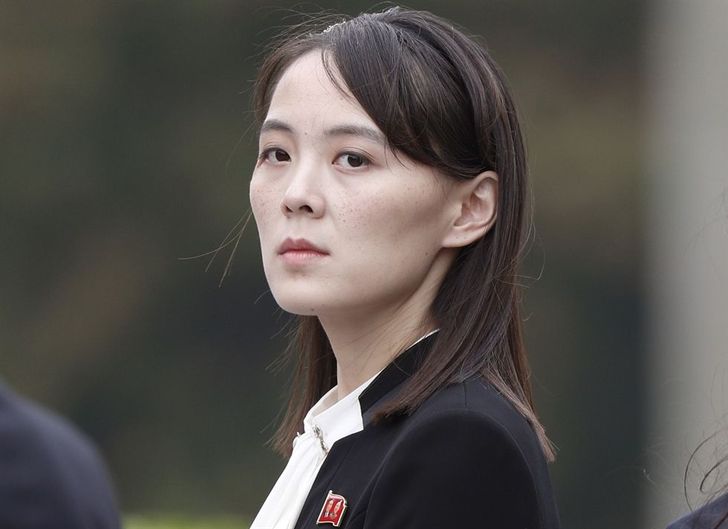
In this March 2, 2019, file photo, Kim Yo-jong, sister of North Korea leader Kim Jong-un, attends a wreath-laying ceremony at Ho Chi Minh Mausoleum in Hanoi, Vietnam. AP-Yonhap
The North Korea issue is also a conundrum for Moon.
Last week, the government announced that it restored communication lines with Pyongyang, with Moon and North Korea leader Kim Jong-un agreeing on the necessity to improve inter-Korean relations.
This raised hopes that the two Koreas may revive a reconciliatory mood, but the North threw a tough test for Moon on Sunday, demanding Seoul cancel the upcoming combined military exercise with the U.S.
According to Pyongyang's Korean Central News Agency, Kim Yo-jong, the sister of North Korea's leader, said the annual summertime drill will “cloud” the future of the inter-Korean relations.
“I surely see the military drill, which takes place at an important turning point like this, will become an unpleasant prelude to seriously hurting the will of the leaders of the North and South seeking to take the step toward rebuilding trust again and further clouding the path lying ahead for inter-Korean relations," she said.
Over the restored communication lines, she added “I think the restoration of communication lines is nothing but physical reconnection of what had been severed,” and “no more meaning than that should be attached to it."
According to sources, South Korea and the U.S. are planning to begin the second Combined Command Post Training on Aug. 16, while monitoring the country's COVID-19 situations. As the North directly demands a cancellation of the exercise, however, a number of ruling party lawmakers are raising voices for the government to postpone the drill.
Cancelling or postponing the exercise is a tough choice for Moon, because of political pressures and criticisms from the opposition bloc that the President appears to be “taking orders from the North.”
In December, the National Assembly passed a bill which bans sending anti-Pyongyang leaflets and other material across the inter-Korean border. This was interpreted as the Moon administration's bid to engage with the North, but the conservative opposition and a number of U.S. lawmakers have been slamming this, which they say seriously damages Korean people's freedom of expression, and also because the revision was passed after Kim Yo-jong demanded Seoul ban the leaflet campaigns.
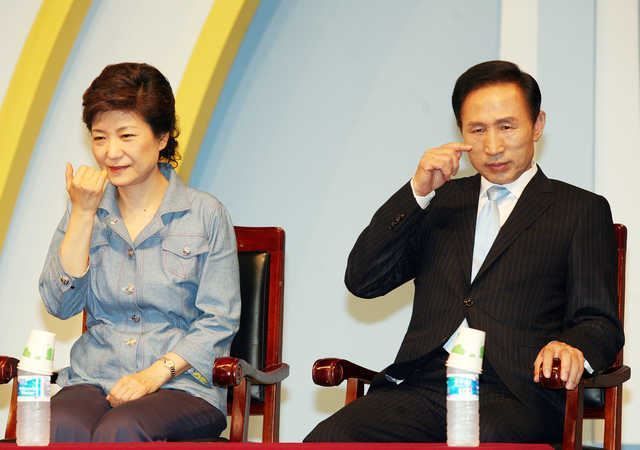
In this Aug. 8, 2007, file photo, then-presidential contenders Park Geun-hye, left, and Lee Myung-bak wait for their speeches during the primary of the Grand National Party, a predecessor to the current People Power Party, in Daejeon. Park and Lee became presidents in 2013 and 2008, respectively, and were jailed before and after the Moon Jae-in administration was launched, respectively. Korea Times file
Deciding whether to grant presidential pardons to former Presidents Park Geun-hye and Lee Myung-bak is also a tough task for Moon to address this month on the occasion of the upcoming Aug. 15 National Liberation Day.
Rumors of a possible pardon for Park emerged late last month, as multiple news outlets here reported that Samsung Electronics Vice Chairman Lee Jae-yong's case was under review by the Ministry of Justice for a National Liberation Day release on parole. Lee was jailed for bribing Park and her confidant Choi Soon-sil to win government support for his inheriting control of the Samsung conglomerate from his father, the late Samsung Chairman Lee Kun-hee.
Since Lee's case is intertwined with Park's, any decision on Lee is anticipated to affect a pardon for Park, which will also sway the presidential election next year, given the remaining Park loyalists in the country.