Ruling party primary mired in mudslinging

Gyeonggi Province Governor Lee Jae-myung, left, and former Prime Minister Lee Nak-yon pose before appearing a TV debate hosted by broadcaster MBN in central Seoul, Wednesday. Yonhap
By Nam Hyun-woo
The ruling Democratic Party of Korea's (DPK) primary to pick its presidential candidate is being tainted with excessive criticism and mudslinging between the leading contenders, despite the party leadership's efforts to pursue unity.
Political watchers warn that the escalating mudslinging could lead centrist voters to turn their back on the ruling party.
Gyeonggi Province Governor Lee Jae-myung, who is leading the pack among the DPK contenders, wrote on Facebook, Friday, that former Prime Minister Lee Nak-yon, the No. 2 among the ruling party hopefuls, “shouldn't be lying” about how many campaign pledges he had kept while serving as South Jeolla Province governor from 2014 to 2017.
“Lee said he kept 20 out of 21 campaign pledges he made to become South Jeolla Province governor during yesterday's TV debate, but there were no grounds for this claim,” the governor wrote. “According to 2016 Korea Manifesto Center data, he made 76 promises and kept 20, or 26.3 percent. The data show that the overall evaluation on his fulfillment of campaign pledges was the lowest in Korea.”
The posting came even though six DPK contenders, including the two Lees, met Wednesday and promised to “be one team” and “respect each other for fair and just competition.” The event was organized to prevent the contenders' rivalry from turning into smear campaigning, as the two Lees have staged a fierce battle over suspicions raised against them and past behavior.
The former prime minister denounced Governor Lee's recent remark made during an interview with the JoongAng Ilbo newspaper that “the Baekje Kingdom never unified the Korean Peninsula during the 5,000 years of Korean history.”
The Baekje Kingdom existed from B.C. 18 to 660 A.D. in the southwestern part of the Korean Peninsula, which is now home to Gwangju, and South and North Jeolla Provinces ― often colloquially called the Honam region. The area is widely thought of as the home turf of the liberal DPK, and former Prime Minister Lee was born in Yeonggwang County, South Jeolla Province, spending his teenage years in Gwangju.
Former Prime Minister Lee's camp said Governor Lee was instigating regionalism, adding, “He was trying to say a candidate from the Honam region cannot become president.”
Though Governor Lee's camp said he meant to note that a victory by Lee Nak-yon would be historical, the latter replied that it was an inappropriate remark “hurting the people of the Honam region.”
Before exchanging salvos over the ancient kingdom, the two Lees grappled over the attempted impeachment of the late former President Roh Moo-hyun, with Governor Lee claiming that his adversary cast a ballot in favor of this. President Roh led the Millennium Democratic Party, a predecessor of the DPK.
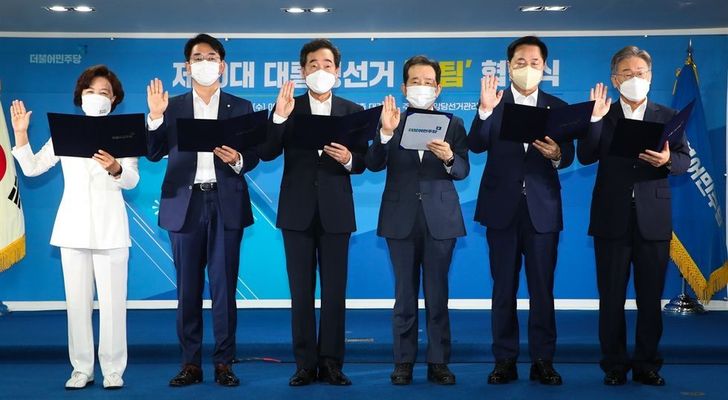
Presidential contenders of the ruling Democratic Party of Korea take an oath swearing to engage in fair competition in the party's presidential primary during an event on Yeouido, Seoul, Wednesday. Yonhap
This campaigning style appears to be damaging support for both. According to a poll conducted jointly by four agencies of 1,003 adults from July 26 to 28, Governor Lee's support stood at 25 percent while that for former Prime Minister Lee was 12 percent.
Compared to a previous poll conducted a week earlier, both rates declined by 2 percentage points each.
“Although the decreasing rates were within the margin of error, the decline of the two Lees' support rates at the same time may have come from the smear campaigns they are directing toward each other,” an official at Hankook Research, one of the four pollsters, said.