Should 'underperforming' ministries be abolished?

Main opposition People Power Party Chairman Lee Jun-seok speaks during a party meeting preparing for the next presidential election, held at the National Assembly in Seoul, July 9. Lee has recently stirred controversy by claiming that the Ministry of Gender Equality and Family and the Ministry of Unification need to be abolished in a move to establish a small but efficient government. Yonhap
Controversy rises over main opposition leader's call to abolish unification, gender equality ministries
By Jung Da-min
Calls have arisen among some politicians for the abolishment of certain ministries, which they claim to have not achieved any notable results in recent years, after some potential candidates for the next presidential, slated for March, raised this issue.
Lee Jun-seok, chairman of the main opposition People Power Party (PPP), stirred the controversy by stating that the Ministry of Gender Equality and Family and the Ministry of Unification need to be abolished as part of a move to establish a small but efficient government. He said the ministries have not recorded any achievements and have ceased to have any reason to exist.
The claim by Lee was made after former four-term lawmaker Yoo Seong-min and Rep. Ha Tae-keung, both presidential hopefuls of the PPP, said they would abolish the gender equality ministry and replace it with a presidential gender equality commission, if elected. Expressing support for the idea, Lee further made the claim that the unification ministry also needs to be got rid of.
But Lee's claim immediately drew criticism not only from the liberal bloc including the ruling Democratic Party of Korea (DPK) and the minor opposition Justice Party, but also within his own party. Both Unification Minister Lee In-young and Gender Equality Minister Chung Young-ai refuted his claim saying the ministries have done much work.
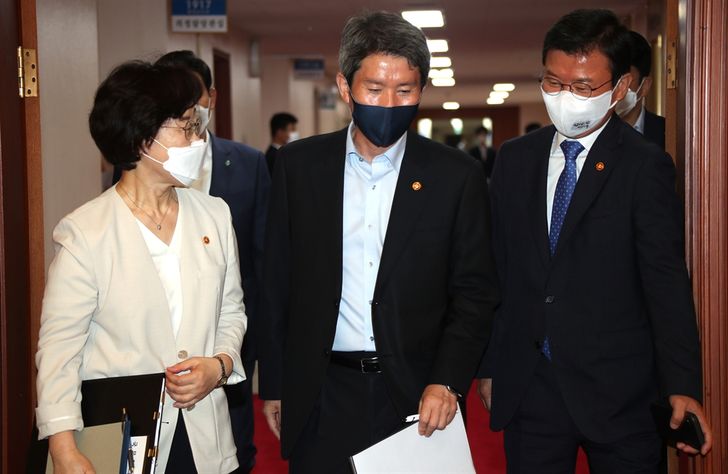
Gender Equality Minister Chung Young-ai, left, and Unification Minister Lee In-young, center, attend a Cabinet meeting held at the Government Complex Seoul, July 13. Yonhap
Those refuting Chairman Lee's claim said he lacks understanding of the unification ministry's role in dealing with North Korea issues, and of the gender equality ministry's role in overcoming the structural discrimination that still exists against women. They said the ministries' achievements should not be judged by visible outcomes in recent years as their function is for the long-term goals of achieving unification and gender equality.
However, Lee stuck to his guns, saying he hopes the removal of the two ministries would be part of a wide ranging reorganization of government departments. He said this is needed to make the administration smaller but more efficient.
In a radio interview with local broadcaster CBS, July 9, Lee said he has "always been calling for the dismantlement of the unification and gender equality ministries," as he believes the two ministries are not fulfilling their original purposes. "I hope the PPP's presidential candidate, whoever is selected (through the party's primary), makes it an election promise to abolish the unification and the gender equality ministries. And if our candidate wins the election, the next administration should carry out the promise by amending the Government Organization Act," he said.
Lee said Cheong Wa Dae and the National Intelligence Agency have directly dealt with inter-Korean relations, meaning the unification ministry has made no notable contribution. Regarding the gender equality ministry, he said, "The ministry is incapable and unprepared to achieve equality; it just carries out campaigns," in an interview with local broadcaster SBS, July 7.
Critics, however, have said abolishing the ministries was not the answer to making the government function more effectively. They said what's needed is decisions on how to operate existing ministries better rather than disregarding their functions.
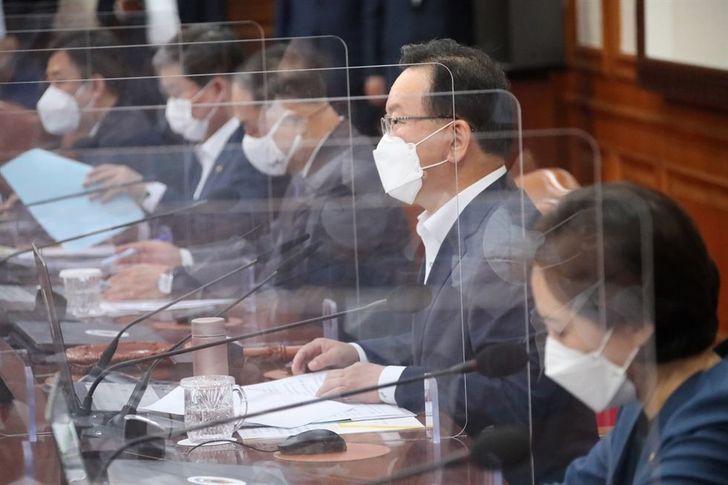
Prime Minister Kim Boo-kyum presides over a Cabinet meeting at the Government Complex Seoul, Tuesday. Yonhap
Yoon Ji-woong, a public policy and management professor at Kyung Hee University, said the issue of dissolving government ministries should be approached carefully, as there were various factors to consider.
“Efficient operation of government is not simply a matter of its size in a quantitative sense but rather the matter of value judgment," Yoon said.

President Moon Jae-in and North Korean leader Kim Jong-un shake hands in the Peace House building on the southern side of the truce village of Panmunjeom in this April 27, 2018, file photo. Yonhap
Rep. Kwon Young-se, head of the PPP's external relations council, said he believes the unification ministry should be maintained and the PPP leader Lee needs to be cautious in his words and actions.
"In the early days of the Lee Myung-bak government, I was astonished by some of his aides' claims that the unification ministry should be abolished, as they said they had factorized the ministry's tasks into which could be distributed to other ministries. It is embarrassing to again hear that the unification ministry is useless. I agree that under the current administration the ministry has performed poorly, but we should not abolish it but make it work better after our party wins the next presidential election," Kwon wrote on Facebook, July 10.
"Running a government is not about mathematics. There is no need for our party to be stigmatized as an anti-unification force. The unification ministry must be preserved," Kwon added.
Cha Jae-won, a professor of special affairs at the Catholic University of Pusan, said Lee's calls to abolish the ministries is not winning support as he is offering no alternative, only calling for abolishment for abolishment's sake.
"Lee's call for abolishing the gender equality ministry, in particular, seems to be made with the political intention of appealing to young men," Cha said. Young male voters, many of whom believe they are mistreated and victimized by extreme feminism, and who feel unhappy about the current administration's job policies, are believed to have contributed to the PPP's victory in the April by-elections for the Seoul and Busan mayoral posts, and the following election of Lee as party chairman.
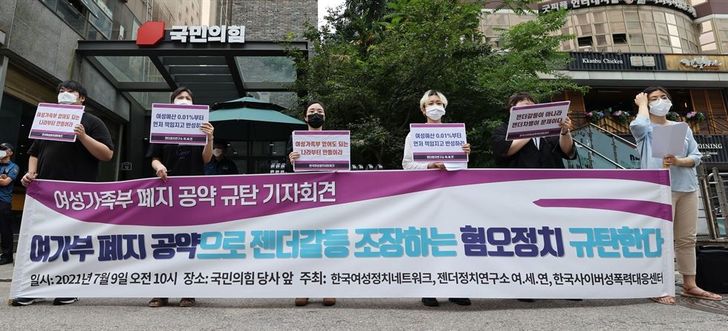
Women's rights activists hold a press conference in front of the main opposition People Power Party (PPP) headquarters in Seoul's Yeongdeungpo District, July 9, to condemn party Chairman Lee Jun-seok's call for the abolishment of the gender equality ministry, saying such a claim fuels gender conflict. Yonhap
Gyeonggi Provincial Governor Lee Jae-myung, a leading presidential hopeful for the DPK, said in an interview with Yonhap News Agency that he opposes the PPP chairman's idea of abolishing the gender equality ministry; but rather believes its functions should be expanded to cover various discriminatory acts against women. "In our society as a whole, women are still being discriminated against in wages, promotions, roles and other things," the governor said.
Rep. Lee Nak-yon, a former DPK chairman and another presidential hopeful, said the same day that the call to abolish the gender ministry was being made with political intentions, implying the PPP leader was trying to win votes from young men.
"Former President Kim Dae-jung, who created the gender equality ministry, paradoxically said that the ministry works for the day when it will be abolished. But that day has not arrived yet," Lee said.