Cheong Wa Dae faces growing doubts on vetting ranking officials

President Moon Jae-in hits a gavel during a Cabinet meeting at Cheong Wa Dae, June 22. Courtesy of Cheong Wa Dae
Presidential office under fire for overlooking public sentiment on real estate, fairness
By Nam Hyun-woo
Cheong Wa Dae is being subject to unrelenting criticism over its system of vetting candidates to serve as President Moon Jae-in's aides, as a series of controversies has continued over the true qualifications of many of those selected.
Causing greater problems is Cheong Wa Dae's insensitivity to public sentiment, as it persists in appointing secretaries and other top ranking officials despite knowing that their questionable backgrounds and real estate trading deals may trigger a public uproar.

Kim Gi-pyo, former presidential secretary for anti-corruption / Korea Times file
So far, five presidential aides have resigned over controversies related to their real estate deals. Marking the latest was Kim Gi-pyo, the presidential secretary for anti-corruption, who resigned June 27 as criticisms mounted over his real estate purchases, which were mostly financed with loans.
Kim, who was named as the anti-corruption secretary in March, reported that he owns 9.12 billion won ($8 million) worth of properties including an apartment, commercial stores and forest land. He has 5.36 billion won worth of debt, suggesting that he purchased a large portion of this real estate through loans.
While borrowing money to purchase property is clearly not illegal, it has raised public uproar because the Moon government has been imposing stringent regulations and taxation to curb such practices ― with the view that extensive issuing of loans and mortgages is contributing to the country's pumped-up home prices and is destabilizing the housing market.
Before Kim, four presidential aides dropped out following controversies involving real estate: Former chief of staff for policy Kim Sang-jo left Cheong Wa Dae in March; former senior secretary for civil affairs Kim Jo-won was replaced in August last year; former spokesperson Kim Eui-kyum resigned in March 2019; and former chief of staff Noh Young-min, who stepped down in December last year, was also dogged by his controversial property sales for months.
The former anti-corruption secretary's resignation raised greater questions on Cheong Wa Dae's vetting system, because the presidential office has already learned that the Korean public reacts sensitively to high-ranking public officials' speculative real estate trading through the disgraceful exits of the aforementioned aides.
Kim's real estate trading history and mortgage records were something the presidential office could have known of in advance, as they were available under ranking government officials' mandatory asset reporting and publicly available information on the real estate registry. So Cheong Wa Dae, which purports to run the toughest of background checks on presidential aides, was aware that Kim was increasing his wealth in a way that the government guides its people not to do.
“When vetting Kim for appointment, the presidential office checked how he obtained those properties, but it did not find any suspicions that he purchased the properties for the purpose of real estate speculation,” a senior official at Cheong Wa Dae said.
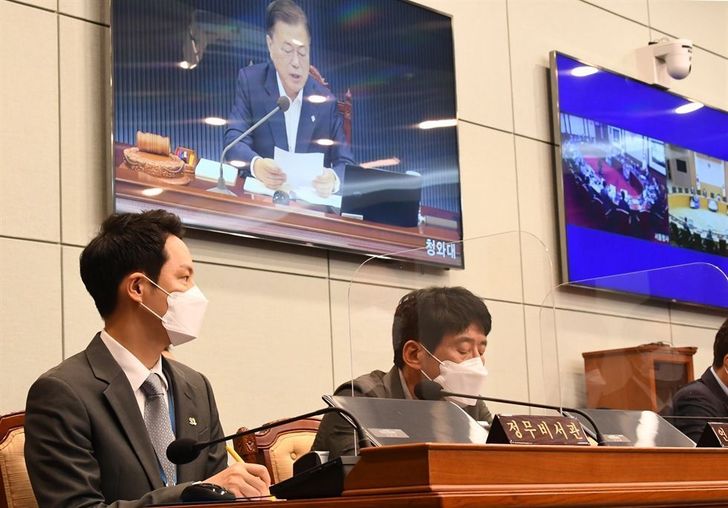
Kim Han-kyu, left, presidential secretary for political affairs, listens to President Moon Jae-in's remark during a Cabinet meeting at Cheong Wa Dae, June 22. Korea Times photo by Wang Tae-seog
Insensitivity to public sentiment
The former anti-corruption secretary is not the only one whose appointment raised questions over the presidential office's ability to check candidates for government positions.
Kim Han-kyu, who was appointed as the new secretary for political affairs June 21, is also mired in real estate speculation allegations over farming land which his wife, surnamed Chang, received from her father.
The country's law allows non-farmers to own land designated as “farmland” smaller than 1,000 square meters for the purpose of establishing “a weekend farm” which city dwellers usually visit on weekends and grow vegetables and plants for personal consumption and enjoyment. Local broadcaster SBS reported that only a small amount of plants were growing on Chang's land, indicating the family was not using it as a weekend farm, while the price of the land has risen more than 40 percent in the past five years.
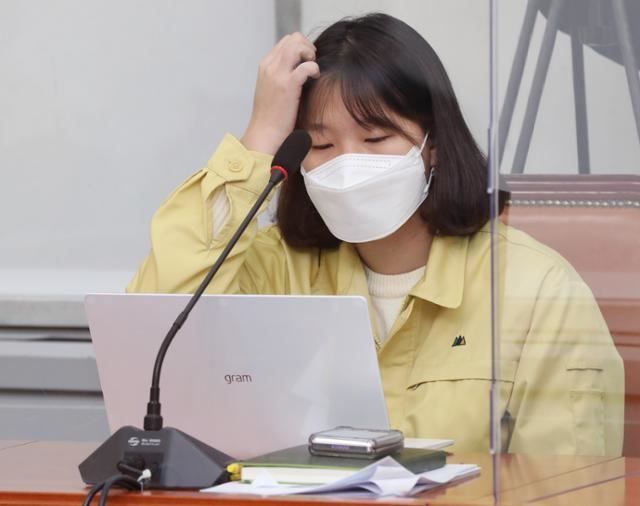
Park Seong-min, presidential secretary for youth affairs, sits in session during a meeting of the ruling Democratic Party of Korea's Supreme Council at the National Assembly, Seoul, Jan. 27. Korea Times photo by Oh Dae-keun
The appointment of 25-year-old presidential secretary for youth affairs Park Seong-min is also raising fairness issues. Park was one of the liberal ruling Democratic Party of Korea's (DPK) spokespeople representing young members and then became a member of the party's Supreme Council. Except for the career period of more than one year at the DPK, however, she does not have any record of employment and is still registered as a student at Korea University.
Her appointment was widely interpreted as Cheong Wa Dae's effort to gain young people's support, but this rather promoted anger form young jobseekers, as she will get a salary and other perks equivalent to those of Grade 1 government officials in the nine-tier public servant system, in which the first-level is the top level, without any supporting evidence of her capabilities as a presidential aide.

Kim Oe-sook, right, senior presidential secretary for personnel affairs, listens to Lee Cheol-hee, senior presidential secretary for political affairs, during a Cabinet meeting at Cheong Wa Dae, May 11. Yonhap
As Cheong Wa Dae continues to appoint people who are likely to stir controversies, criticism is mounting towards Kim Oe-sook, senior presidential secretary for personnel affairs, as well as the office's inability to grasp negative public sentiment.
Rep. Kim Gi-hyeon, the floor leader of the main opposition People Power Party (PPP), said the personnel affairs under Kim Oe-sook's control have been “a total failure,” calling on President Moon to sack her in hopes of calming public anger and revamping the personnel screening system.
Dealing a heavier blow to Moon, the ruling DPK also slammed Kim for the recent controversies over presidential aides. DPK Chairman Song Young-gil said “Cheong Wa Dae's vetting system should be scrutinized” while Rep. Back Hye-ryun, a member of DPK Supreme Council, said Kim should be held responsible for the screening system.
Despite the criticisms, the presidential office is protecting the senior secretary, saying the personnel affairs office is not solely responsible for the screening process.
A separate Cheong Wa Dae official said, “We humbly accept criticisms for our vetting system, but there were factors that Cheong Wa Dae's system is not able to find.”
Cheong Wa Dae has stated that recommending a candidate is the job of personnel affairs senior secretary, while candidate screening is the job of the civil affairs secretary. But critics are saying this does not relieve the personnel affairs secretary from responsibility because her office has recommended inappropriate candidates.
Against this backdrop, Kim's long-standing relations with Moon are gaining attention. Kim, a former lawyer, worked with Moon when the latter was a human rights lawyer in Busan in the 1990s.
Adding to the criticism is a controversy over the new Air Force chief of staff, whose appointment process was flip-flopped mid screening.
On June 28, the Ministry of National Defense announced that the government appointed Lt. Gen. Park In-ho as new Air Force chief of staff with a plan to approve him during a Cabinet meeting the following day. However, Cheong Wa Dae postponed the deliberation process on June 29, citing the necessity for additional checks for “uncertain factors.” Some media reports have alleged that the delay is in line with suspicions that Park had mishandled sexual harassment cases at Air Force Academy during his stint as superintendent of the academy.
Cheong Wa Dae maintained this stance until June 30, with a senior official of the presidential office telling reporters that Park's approval would not be tabled in a temporary Cabinet meeting on July 1. Hours later, however, the presidential office took an about face, with spokeswoman Park Kyung-mee sending a text message to reporters that Park's appointment would be reviewed in the meeting. The appointment was approved the same day.