Tight presidential race ahead, cohesion expected to be key for each rival bloc

gettyimagesbank
With South Korea's presidential election less than nine months away, the race promises to be a tight battle between the ruling and opposition blocs.
The curtain is about to rise first on the primary of the ruling Democratic Party of Korea (DPK), and this is getting off to a rough start, as demonstrated by in-house disputes over when to choose its standard bearer.
A boisterous, albeit failed, attempt to postpone the contest by dozens of lawmakers who are apparently opposed to the front-runner Gyeonggi Province Governor Lee Jae-myung, portends a fierce contest and probably more serious wrangles before a winner is decided on in early September ― the aftermath of which could be damaging.
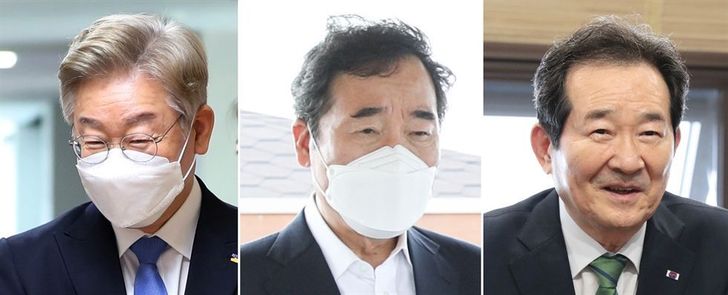
From left, Gyeonggi Province Governor Lee Jae-myung, and former Prime Ministers Lee Nak-yon and Chung Sye-kyun / Yonhap
The DPK's primary is shaping up virtually as a competition between the governor and some other mainstream contenders close to President Moon Jae-in, who under the Constitution is prohibited from seeking reelection.
Lee is the party's only figure to consistently score double digits in popularity surveys, far ahead of two former prime ministers ― Lee Nak-yon and Chung Sye-kyun ― and several other aspirants, including former Justice Minister Choo Mi-ae.
It is unclear whether Lee will be the DPK's nominee, given a host of uncertainties typical of the country's dynamic politics.
Even if he is selected, Lee will likely face the daunting task of drumming up unified support from members and supporters of the party.
He does not belong to the DPK's inner circle, and has no career background linked to the National Assembly.
It is an open secret that a number of party members, largely diehard supporters of Moon, have antipathy toward Lee, a former lawyer and mayor of Seongnam, just south of Seoul. The emotional rift dates back to the 2017 primary, during which Lee, then an underdog, ferociously challenged Moon.
Some local media have raised speculation about a potential anti-Lee coalition, led by the two former prime ministers, throughout the primary expected to kick off next week with the registration of candidates.
Lee is seemingly looking to overtly differentiate his policy goals from those of Moon, as such an approach is a proven way for the ruling party's candidate to win in the presidential election with an image of change and forward-looking leadership.
Public fatigue and displeasure are widespread over Moon's policies, especially those related to real estate.
The governor's dilemma is that he needs backing from the pro-Moon forces to secure the party's ticket and win the spring election. There is no clear indication yet that Moon has become a lame duck, with his approval rating staying at around 40 percent, relatively high for a South Korean president in their final year in office.
DPK officials also have the traumatic experiences of losing the presidential elections in 2007 and 2012 in the midst of sharp internal conflicts and divisions.
"At that time, our party remained divided internally," a DPK official privy to relevant information said, requesting anonymity. "Such rifts between rival camps are usual in the process of presidential primaries. But we failed to patch them up smoothly."
He expects things to be different this time, as party members have learnt lessons from the harsh consequences of divisions and election defeats.
If Lee is chosen as the party's candidate, pro-Moon forces will eventually have to embrace him in a strategic move for the presidential race, the outcome of which will heavily affect the results of the June 1, 2022, local elections, he added.
Meeting with DPK lawmakers, Moon emphasized the importance of a "one-team" mindset.
A few years ago, then party leader Lee Hae-chan repeatedly stated an ambitious vision for the “liberal” party to maintain power for at least two decades. At that time, the conservative People Power Party (PPP) seemed hopeless when it came to the next presidential election.
The tables have since turned, with the PPP's election preparations getting off to a relatively good start.
Multiple polls show a surge in voter support for the main conservative opposition party, with an increased number of people hoping for a transition of power from the DPK.
The PPP has been rebuilt as a party with unified political forces critical of the Moon administration. It gained confidence from its overwhelming victory in the April 7 Seoul and Busan mayoral elections.
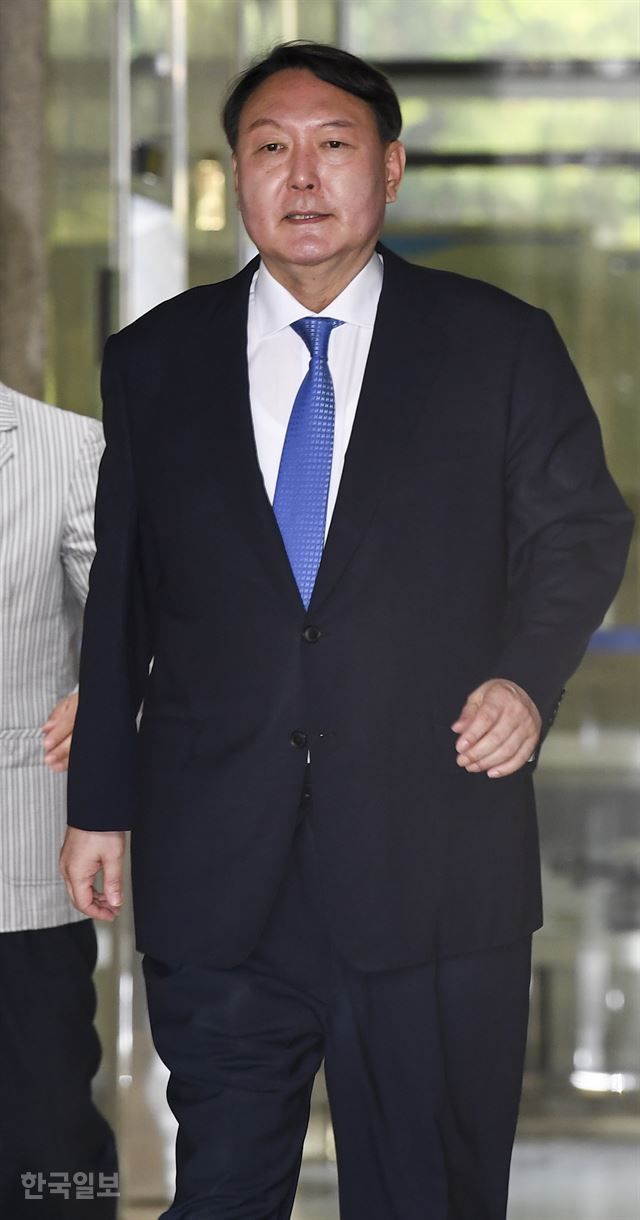
Former top prosecutor Yoon Seok-youl / Korea Times file
The key is whether and how to unite the opposition camp and field a single candidate.
Former top prosecutor Yoon Seok-youl looks poised to declare his political ambitions Tuesday, taking the lead in various opinion polls among opposition presidential hopefuls. It seems to be only a matter of time before the rookie politician joins hands with the PPP, although not immediately.
The party is seeking a merger with the minor opposition People's Party headed by Ahn Cheol-soo. The PPP has also allowed the return of Rep. Hong Joon-pyo, a well-known heavyweight, 15 months after his departure to run in the general election as an independent.
Choi Jae-hyung, head of the Board of Audit and Inspection, also appears to be flexing his muscles to run in the presidential election as an opposition candidate.
Earlier this month, the PPP elected Lee Jun-seok, a 36-year-old politician with no experience as a lawmaker, as its leader, a move regarded as reflecting its aspirations for a presidential election victory.
"It demonstrates the strong desire among party members and its supporters for two things: one is winning the presidential election and the other is a generational shift," Park Sung-min, a veteran political consultant, said.
The PPP made the strategic choice to reach out to voters in their 20s and 30s, and publicize its resolve for change, according to Park, head of MIN Consulting.
Many observers are placing their bets on the high chance of a de facto two-way contest for Cheong Wa Dae between the former prosecutor general and the Gyeonggi governor.
They say the question is whether the opposition campaign will unite and Lee gets to bask in the full support of his party.
In the latest Realmeter survey, Yoon garnered 32.3 percent of support from eligible voters nationwide, while Lee received 22.8 percent. (Yonhap)