Calls for women's mandatory military service lose momentum following sexual assault revelations

Defense Minister Suh wok, facing front row, third from left, attends a session of the National Assembly's Defense Committee at the Assembly on Yeouido, Seoul, Wednesday. Yonhap
By Jung Da-min
The recent debate on mandatory military service for women has all but disappeared, following the suicide of a female Air Force non-commissioned officer last month after her report of a sexual assault was allegedly covered up.
Critics say the military's macho hierarchical culture is to blame for this and other ongoing sex crimes, many of which go unreported.
The decades-long debate on women's mandatory service had again been brought up by some presidential hopefuls after the April 7 by-elections, in which the ruling Democratic Party of Korea (DPK) suffered a crushing defeat at the hands of the main opposition People Power Party (PPP), which took the mayoral seats of the country's two biggest cities, Seoul and Busan.
After a large percentage of men in their 20s voted for opposition party candidates seemingly being the most dissatisfied with government policies, the two major parties and their presidential hopefuls jumped into a policy competition to appeal to them. Besides improving service conditions for young men during the mandatory military service, and offering them “rewards” for serving, some came up with the idea of conscripting both men and women.
Public opinion in favor of this has also grown. A survey of 1,003 adults conducted from May 25 to 27 by Gallup Korea showed that 46 percent of respondents supported the idea, while 47 percent said that only men should be conscripted. The figure was notable, as military service has long been considered the duty of men alone.
But this debate has quickly almost disappeared following additional revelations of sex crimes, in which mostly women service members were victims and their superior officers were the assailants.
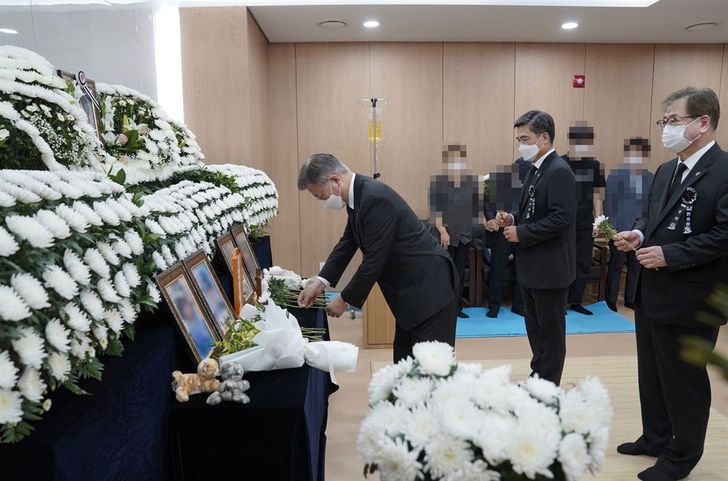
President Moon Jae-in pays tribute to an Air Force master sergeant who killed herself after being sexually assaulted by a fellow service member, at her memorial altar at the Armed Forces Capital Hospital in Seongnam, Gyeonggi Province, Sunday. Yonhap
The military has recently come under fire for poorly handling such crimes, especially after the master sergeant was found dead at her residence, May 22, two months after a fellow master sergeant sexually assaulted her. Public outrage grew as it was alleged that the Air Force not only failed to properly investigate the case, but also tried to cover up the incident by “persuading” her to reach a settlement with the offender, while not providing proper counseling.
Experts said that changing the male-centered military culture into a more female ―friendly, gender-equal one should come first, before discussing the matter of conscripting women.
The military's culture creates the conditions for discrimination against women service members. According to a 2019 survey by the National Human Rights Commission of Korea, 26.4 percent of female non-commissioned and commissioned officers picked “discrimination” when asked what kind of unjust treatment they experienced in the military; while their male counterparts raised issues of superiors giving orders on private matters (16.8 percent) and verbal abuse (13.5 percent).
In the meantime, Defense Minister Suh Wook apologized Wednesday for the death of the Air Force officer sergeant, vowing to conduct a thorough investigation and overhaul the military's system for handling sex crimes, during a session of the National Assembly National Defense Committee. It was the first public apology issued by the defense chief over the case.