Cryptocurrency surfaces as issue for presidential election

gettyimagesbank
By Nam Hyun-woo
Regulations on Bitcoin and other cryptocurrencies are surfacing as an issue for next year's presidential election here, as parties and presidential hopefuls are formulating policies to win support from the younger generation, who are flocking to the digital tokens with the belief that these are the only lucrative investment opportunity left for them.
According to party officials, the ruling Democratic Party of Korea (DPK) and the main opposition People Power Party (PPP) have both begun policy and regulation studies on cryptocurrencies.
During a meeting with reporters, Tuesday, DPK spokesman Rep. Han Jun-ho said the party will explore measures on the cryptocurrency issue within its policy planning committee.
Initially, the DPK was reported to be planning to set up an organization within the party to look into digital currency policies. However, it took a step back, in what appears to be a cautionary move to prevent policies or bills from being leaked at an immature stage.
Despite the party-level moves, DPK lawmakers are individually speaking out on proper regulations for “crypto-investments.” During an April 26 online seminar, Rep. Kim Byung-wook said, “(the government) should come up with a proper review of systems to protect crypto investors and do better than warning of the risks.”
The PPP is also making efforts to capitalize on the cryptocurrency issue as political leverage. The party has already set up a taskforce to study systems and policies to protect investors, with acting Chairman Rep. Joo Ho-young criticizing the DPK and the government for being “at a loss” over cryptocurrency issues.
The parties' moves came amid growing criticism of the government's plan to impose tax on income generated from crypto investments, while not acknowledging digital tokens as financial assets or protecting investors with laws.
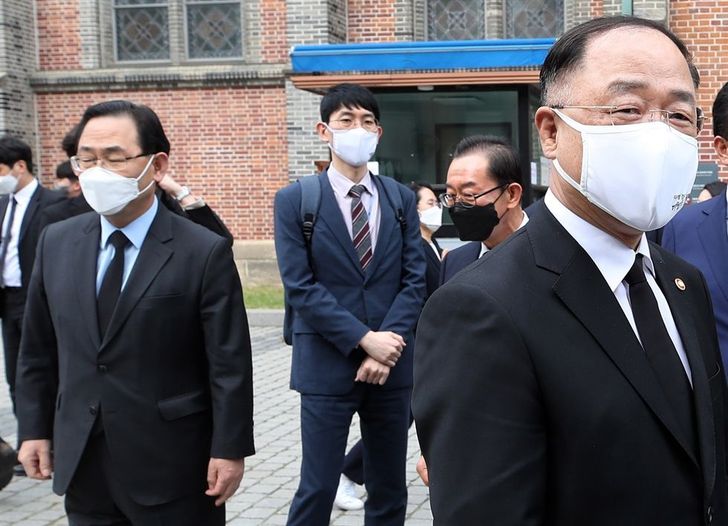
Acting Prime Minister Hong Nam-ki, right, walks past Rep. Joo Ho-young, left, acting chairman of the main opposition People Power Party, after paying his condolences to the late Cardinal Nicholas Cheong Jin-suk at Myeongdong Cathedral in Seoul, Wednesday. Yonhap
Acting Prime Minister Hong Nam-ki said in a press conference, Tuesday, that the government will stick to its initial plan of levying duties on “virtual assets” from Jan. 1 next year, despite opinions urging the government to postpone its implementation.
“It is difficult to equate virtual assets with stocks or bonds, which are stipulated as assets designed to help the public increase their wealth in a productive manner,” Hong said. Though he did not acknowledge cryptocurrency as an asset that can be regulated under financial law, he stressed that income generated from crypto trading is subject to duty because of “the equity of taxation,” adding trading works of art is also subject to taxation.
Along with Hong, Financial Services Commission (FSC) Chairman Eun Sung-soo also said in early April that the country's cryptocurrency trading firms that do not register with the Financial Intelligence Unit by September could be closed, triggering a backlash from cryptocurrency investors.
An online petition calling for Eun's resignation for “attempting to suppress the cryptocurrency market” was posted on the Cheong Wa Dae website, April 23, and had garnered more than 146,000 signatures as of Thursday afternoon. Cheong Wa Dae is required to give answers to petitions which secured more than 200,000 signatures within 30 days from posting.
'Last chance'
Despite cryptocurrencies' volatile price swings, the number of Koreans investing in them has been on a steady rise for several years, and it is showing a noticeable growth this year, with those in their 20s to 30s jumping on the bandwagon.
According to FSC data submitted to Rep. Kwon Eun-hee of the minor opposition People Party, the number of new subscribers to Korea's top four cryptocurrency exchanges which require real-name accounts was 2.5 million in the first quarter of the year. They accounted for 48.8 percent of the total number of subscribers at the exchanges during the period, doubling the number of total subscribers.
Of the new subscribers, 32.7 percent were in their 20s, followed by those in their 30s at 30.8 percent ― indicating that digital tokens are now a go-to investment option for the younger generation.
“At first glance, this can be attributable to the recent uptrend in Bitcoin and other major tokens' prices,” an official at a leading cryptocurrency exchange here said. “However, what underlies this movement is the young generation's sentiment that cryptocurrencies are the only remaining option for them to increase their wealth through investment, given the circumstance of Korea's real estate market.”
For a long period of time, property was regarded as one of the most reliable methods for Koreans to increase their wealth. However, home prices and rents in metropolitan areas have continued to soar and it has become almost impossible for young people with an average income to purchase or lease homes through savings or mortgages. The Moon Jae-in government's policies of tightening banks' lending criteria has also made it more difficult for young people to purchase homes while failing to serve the original purpose of controlling the country's housing prices.
As real estate policies have failed, experts say the younger generation have shifted focus to the stock and cryptocurrency markets.
Former lawmaker and economist Yoo Seung-min wrote on Facebook: “The country's awful real estate policies have deprived the younger generation of the dream of owning their own home, and they have been forced to jump into the stock and Bitcoin markets because they see no way of buying a home even after getting the largest loan available to them.”
Against this backdrop, those in their 20s or 30s cast their ballots for the main opposition PPP candidates during the April 7 by-elections to pick new mayors of Seoul and Busan. Both the PPP and DPK interpreted the outcome as the young generation's anger at the government's real estate policies.
With the government now also signaling hardline policies on cryptocurrencies, the ruling DPK is attempting to distance itself from the Moon administration in an apparent effort to prevent digital tokens from becoming another issue that could find the party losing the “youth vote” during next year's presidential election.
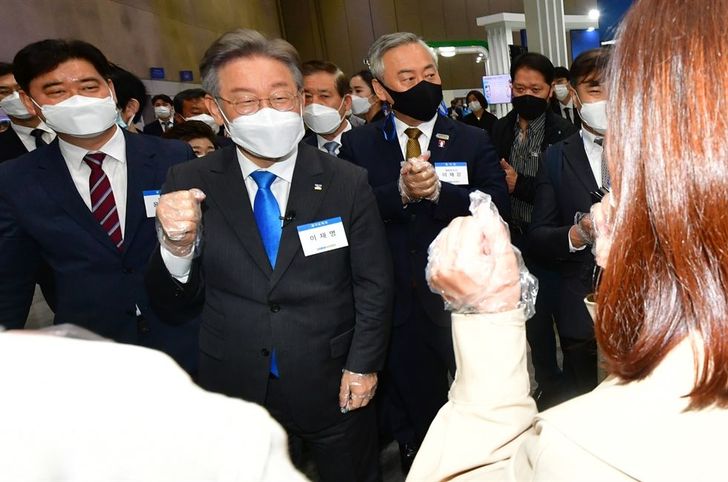
Gyeonggi Governor Lee Jae-myung, second from left, gestures during a visit to a fair on basic income at KINTEX in Goyang, Gyeonggi Province, Wednesday. Courtesy of Gyeonggi photo press corps
Rep. Lee Kwang-jae from the DPK said in a radio interview, “The younger generation do not understand the government's policy of levying tax on tokens without legal protection.” Rep. Noh Woong-rae, also with the DPK, said the government's plan to impose tax from next year was premature and needed improvements.
Gyeonggi Provincial Governor Lee Jae-myung, who is a leading presidential candidate for the DPK, said Wednesday, “The younger generation is investing in cryptocurrencies as a breakthrough,” noting it was “inappropriate to prohibit that entirely.” Another DPK presidential hopeful and former prime minister, Chung Sye-kyun, said the government needs to conduct a more thorough review on the issue to find out whether Korea needs regulations or protections to be put in place.
As the cryptocurrency issue evolves into a political tool to grab the younger generation's support, experts are calling for virtual assets to be handled from an economic viewpoint.
“Issues related to virtual assets should be handled with economic logic,” said Sung Tae-yoon, a professor at Yonsei University's School of Economics. “Regardless of political points of views, there seems to be a need to protect investors because it is difficult to prevent excessive losses from investments. Also, there are some cases of cryptocurrency being used for illegal purposes, so this also needs to be regulated.”