Variable for by-elections - voting on work day
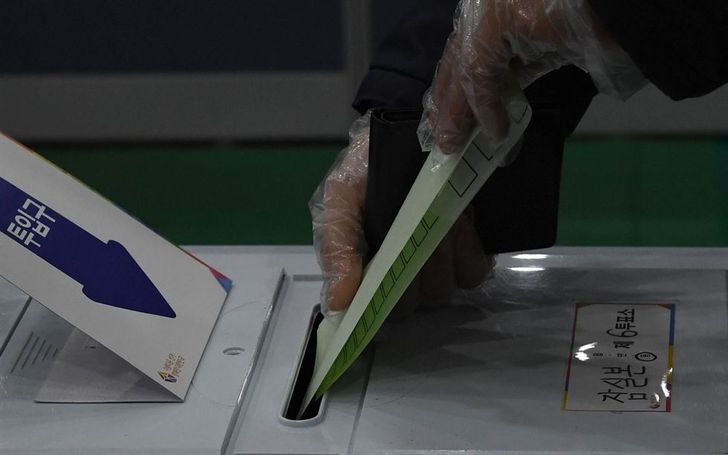
A voters puts a ballot into a box in a polling station at an elementary school in Seoul in this April 15, 2020, photo, to participate in the general election for the 21st National Assembly. This year's by-elections are set to be held on April 7, with early voting slated for April 3 and 4. Korea Times file
By Jung Da-min
With less than two months left ahead of this year's Seoul and Busan mayoral by-elections set to be held on April 7, political watchers are forecasting that voter turnout will be a key factor in determining the winners.
While there are several variables that could affect voter turnout, one of them is that the elections are being held on a work day, not on a public holiday.
Election days are usually public holidays here to encourage people's participation, but by-elections, which are held only in affected regions, are not classified as regular election days, meaning that the days of by-elections are regular working days.
Some said this could discourage public participation, especially voting by office workers in their 20s to 40s. But others said, considering keen public attention to the elections, many younger people would still vote by participating in early voting. Plus the voting hours are until 8 p.m., two hours longer than usual.
Oh Meoung-seok, 35, an office worker in Seoul, said he will vote for the Seoul mayoral by-election.
“I am planning to cast my vote for the Seoul mayoral post, as I think it is necessary for us to judge the current regime under President Moon Jae-in through this year's by-elections,” Oh told The Korea Times.
Another office worker, Ryu Hee-bong, 32, said he will vote as he sees casting a ballot as his right as a Seoul citizen.
“I think many young office workers in Seoul will participate in the mayoral by-election as the election will take place on a working day and people will be staying in Seoul rather than going out of the city to enjoy a vacation day,” Ryu said.
Political watchers said the turnout for the Seoul mayoral by-election could set a new record for a by-election, as it could be seen as a barometer for the upcoming presidential election set to be held in March 2022.
Political watchers also said early voting, slated for April 3 and 4, the weekend before the April 7 by-elections, could also see a higher turnout compared to previous by-elections, as a growing number of people are casting ballots during early voting ― the turnout for early voting for last year's April 15 general election was 26.69 percent, the highest since its introduction in 2014, despite the COVID-19 pandemic situation.
Mayoral hopefuls competing for the Seoul mayoral post include former SMEs and Startups Minister Park Young-sun and four-term lawmaker Rep. Woo Sang-ho from the ruling Democratic Party of Korea (DPK); former four-term lawmaker Na Kyung-won and former Seoul Mayor Oh Se-hoon from the main opposition People Power Party (PPP); minor opposition People's Party leader Ahn Cheol-soo; and independent former lawmaker Keum Tae-sup.
Among mayroal hopefuls competing for the Busan mayoral post are PPP member and former National Assembly Secreteray General Park Heong-joon, and DPK member and former National Assembly Secretary General Kim Young-choon.