Justice Party leader steps down over sexually harassing party lawmaker
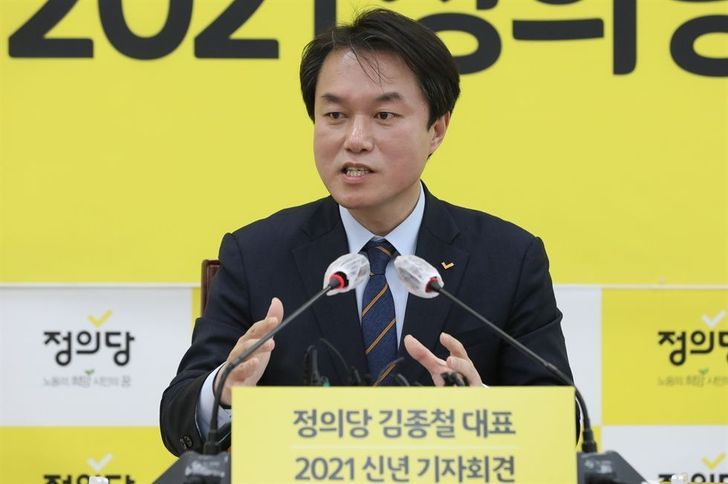
Kim Jong-cheol, former leader of the liberal minor Justice Party speaks at his New Year's conference held last Wednesday at the National Assembly. Kim stepped down from the position as party leader on Monday admitting to sexually harassing Justice Party Rep. Jang Hye-young. Yonhap
By Jung Da-min
Kim Jong-cheol stepped down from his post as leader of the minor progressive Justice Party, Monday, after admitting to sexually harassing Rep. Jang Hye-young, deputy floor leader of the party.
Justice Party deputy leader Bae Bok-joo gave an official statement after a closed meeting that the leadership decided to dismiss Kim from his position, even though he had already expressed his intention to resign after admitting that he had sexually harassed Jang following a dinner meeting to discuss political activities, Jan. 15.
Jang on Jan. 18 reported Kim's sexual harassment to Bae, who leads the party's department of gender and human rights affairs. Bae investigated the case for a week, holding multiple meetings with the victim and the accused. Bae said Kim admitted to all the allegations.
“It is a sexual harassment case committed by the leader of a political party which has taken the lead to realize gender equality. It has delivered a fatal wound to the members of the party and the people who support and care for the Justice Party. We sincerely apologize,” Bae said. “We will take time to deeply reflect on the situation.”
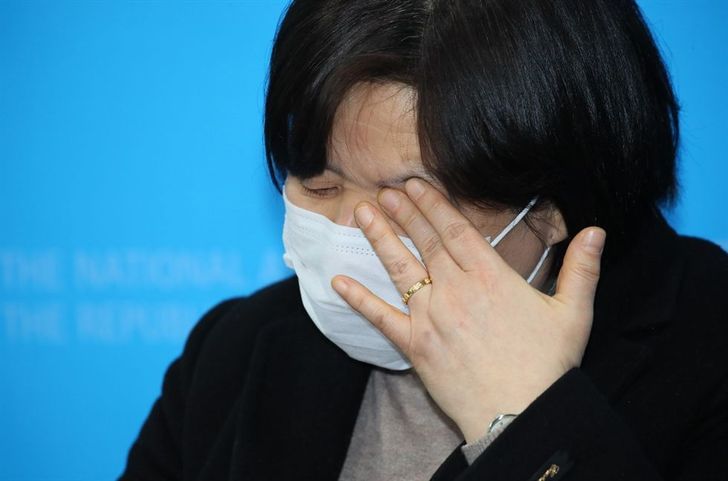
Bae Bok-joo, deputy leader of the minor progressive Justice Party, sheds tears at the National Assembly in Seoul, Monday, while announcing the party's statement regarding its leader Kim Jong-cheol's resignation over his sexual harassment of Rep. Jang Hye-young. Korea Times photo by Oh Dae-geun
After Bae's announcement, both Jang and Kim also issued statements.
Jang said she was at first afraid of revealing the case and still in fear of secondary victimization following it, but decided to speak out so that she could continue her political activities as a lawmaker with the Justice Party, which has stood firm on issues of gender inequality.
“Politics is about communicating values with citizens in the light of one's sincere experiences. I am really afraid of unfair secondary victimization that will come to me after disclosing the facts. But what I am more scared of is losing myself. If I hide it forever to separate myself as a victim from myself as a member of the National Assembly for the sake of protecting myself, I would be locked up in this case forever,” Jang said. “I want to talk about my suffering and be truly free from this problem. I want to go back to my daily life of politics.”
Jang said this case showed that there are no stereotypes of victims or harassers when it comes to sexual harassment cases, in that she was a lawmaker and Kim was the leader of a political party, which are both positions of power.
Kim said he truly apologized to Jang. He said he presented three ways to take responsibility and accept punishment for the matter, including resigning from the party leader post, taking sexual harassment and violence prevention education courses and requesting the party's disciplinary committee to punish him.
“No matter what responsibility I take now, it is difficult to cleanse my offense. I will reflect on my actions and try to change my distorted gender sensitivity. I apologize to the victim and the numerous people who have supported the Justice Party. I am sincerely sorry,” Kim said.