COVID-19 affects every aspect of life in 2020

A medical staffer in protective clothing sits on a step near Gangnam Station in southern Seoul, Thursday, on Christmas Eve, while taking a break from COVID-19 tests at a makeshift testing booth there, with a Christmas tree standing behind her. The pandemic, which started here in January, has affected almost all aspects of people's daily lives throughout the year. Yonhap
By Yi Whan-woo
COVID-19 has dominated daily life throughout most of 2020, forcing people to adjust to a new normal in which many adults work from home, children spend their school days doing online classes, clubs and other crowded places are frequently shut down, restaurants close early and so on.
The fear of the pandemic, however, did not stop voters from casting their ballots in the April general election, which, with the highest turnout in 28 years, gave a supermajority to the ruling Democratic Party of Korea (DPK).
The pandemic added to worsening inter-Korean relations in September when North Korea fatally shot a South Korean fisheries official adrift in the North's territorial waters of the Yellow Sea and set his body on fire. The North said it burned the corpse out of fear he was carrying the coronavirus.
Here are 2020's top 10 political and national news topics.
1. COVID-19 pandemic
Everything has been affected by the pandemic, which began to spread in Korea in January. Social distancing measures changed what is considered normal at work, schools and at dining facilities as well as affecting the viability of travel and leisure activities' especially the strengthened measures implemented during the strongest waves of the pandemic.
Many office workers have had to work from home; while students have been taking online classes after universities and schools repeatedly closed their premises.
Takeout and delivery services have become increasingly common, as eating at restaurants and cafes has been only possible under limited circumstances or banned completely.
Regarding leisure activities, indoor gyms and sports facilities have been temporarily closed multiple times when considered necessary. With international travel restrictions, people have turned to domestic travel, which also stirred up concerns over public health and safety.
The government rolled out emergency disaster relief programs twice ― one each in May and September ― and it is planning to implement a third one soon to help revive the COVID-19-hit economy. The amount spent on stimulus packages was 14.3 trillion won in May and 7.8 trillion won in September.
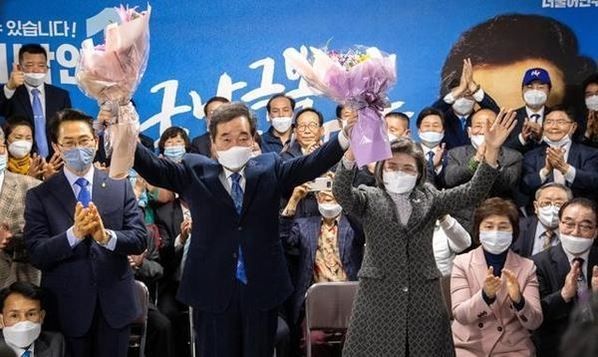
Ruling Democratic Party of Korea (DPK) Chairman Lee Nak-yon, left, and his wife celebrate at his election camp in Jongno, central Seoul, after winning a National Assembly seat in the general election in this April 15 photo. The DPK became a supermajority party with a landslide victory. Yonhap
2. General election, DPK's supermajority
The ruling DPK with its satellite party achieved a landslide victory in the general election on April 15, securing a combined 180 seats, or three-fifths of the total, in the 300-seat unicameral National Assembly.
Such a number of seats marks the biggest majority a party has claimed since the country adopted the direct presidential election system in 1987.
The victory has given the party the upper hand to push ahead with its agenda despite opposition from the main opposition People Power Party (PPP).
The voter turnout of 66.2 percent was the highest for a general election since 1992 and also a record-high for any nationwide election since 2000.
It was the world's first nationwide election during the pandemic, so strict infection control guidelines were introduced at polling stations, such as encouraging voters to wear face masks, sanitize their hands, wear plastic gloves and keep a 1-meter distance while waiting in line.
3. Worsening inter-Korean relations
Two incidents in June and September further deteriorated the relations with North Korea which has held the South responsible amid the stalled denuclearization dialogue with the United States and prolonged international sanctions.
In June, North Korea demolished the inter-Korean liaison office in its border city of Gaeseong. The measure came after a warning from Kim Yo-jong, the powerful sister of North Korean leader Kim Jong-un, against South Korean activists' sending of anti-Pyongyang leaflets across the border. The liaison office was established in September 2018 following the first summit between President Moon Jae-in and North Korean leader Kim in April that year.
In September, the North shot to death a South Korean fisheries official who was floating in the North's waters in the West Sea and allegedly burned his dead body. The North said its action was in fear of coronavirus contagion and issued an apology under the name of Kim Jong-un.
As to the reason the official came to be floating in North Korean waters, the South Korean government said he was trying to defect to the North, an allegation the bereaved family strongly denied.
The South has called for a joint investigation into the matter and some healthcare cooperation to fight COVID-19, but the North has yet to respond to any such offers.
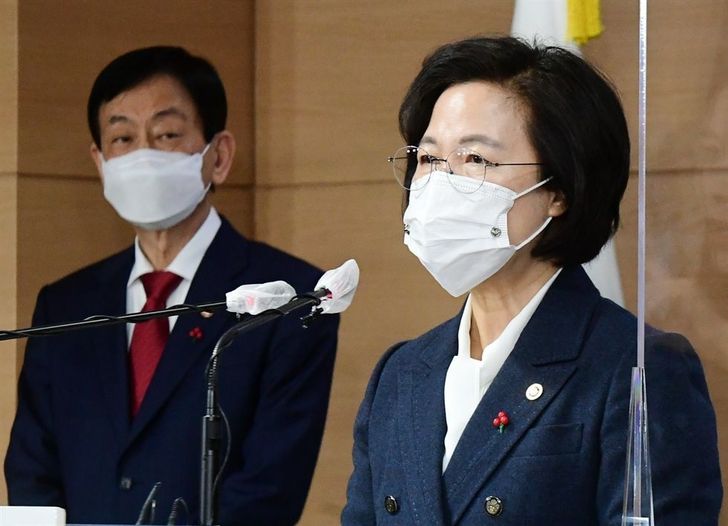
Justice Minister Choo Mi-ae gives a media briefing at the Government Complex Seoul, Dec. 16. Yonhap
4. Clash between justice minister, prosecutor general
Justice Minister Choo Mi-ae and Prosecutor General Yoon Seok-youl have been engaged in a months-long feud over prosecutorial reform.
In November Choo ordered for Yoon to be suspended from duty and requested he face disciplinary action over six counts of alleged misdeeds. Yoon has asked local courts to halt the order and the punishment set by the ministry's disciplinary committee, requesting the charges be dismissed.
Once considered President Moon's man to lead prosecutorial reform, Yoon has since clashed with the Moon administration on several occasions especially after the prosecution began to investigate corruption allegations involving Choo's predecessor Cho Kuk.
Ahead of the planned launch of a new investigative body to handle high-profile corruption cases, Choo recently tendered her resignation, which the President has so far not accepted.
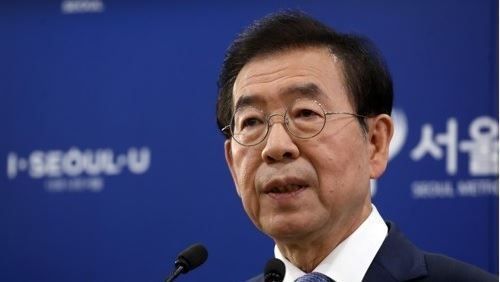
Former Seoul Mayor Park Won-soon committed suicide in July after sexual misconduct allegations were filed against him. A new mayor will be elected in an April 2021 by-election. Yonhap
5. Mayors face sexual harassment allegations
Busan Mayor Oh Keo-don stepped down in April after admitting to allegations that he sexually harassed a female civil servant, tarnishing his image after he became the city's first mayor from the ruling DPK.
In July, Seoul Mayor Park Won-soon, also a DPK member and long-time champion of women's rights, committed suicide after his former secretary filed a complaint with the police alleging she was sexually harassed by him.
The allegations involving the mayors of the nation's two largest cities dealt a blow to the reputation of the DPK.
The DPK was embroiled in a dispute again months later when it announced its intention to field candidates for the by-elections to replace the two former mayors by revising internal regulations that prohibited the party from fielding a candidate for a by-election triggered by the wrongdoing of a DPK member.
6. Passage of bills to reform 'power' agencies
Led by the supermajority DPK, the National Assembly approved all three contentious bills aimed at reforming the country's powerful institutions and preventing them from abusing authorities.
All three bills were in accordance with President Moon's political reform drive.
One of the three involved the Corruption Investigation Office for High-ranking Officials, a new investigative body to be launched to handle high-profile corruption cases.
The second was about banning the National Intelligence Service from interfering with domestic politics, while the third was a major police law revision to give them more investigative authority while introducing a local autonomous police system.
7. Telegram sex crimes
The police arrested operators of notorious pornography channels on Telegram, including one named the “Nth room.”
Dozens of women and children fell victim to sexual abuse because of the operators of the chat rooms who forced them to appear in pornographic videos that were shared in chat rooms full of members who paid for entry.
The police made public the identity of the perpetrators, including Cho Ju-bin who was the first to be arrested in March, as part of efforts to prevent such sex crimes from recurring.
The government and the National Assembly have stepped up efforts to impose more severe punishment on those who possess or watch child pornography and clamp down on sex crimes against those who are underage.
8. Record-long monsoon
Apparently affected by climate change, a record-long monsoon lasted for 54 days in summer, surpassing the previous 49-day streak in 2013.
Coupled with several typhoons, the downpours caused serious damage across the country, killing more than 30 people and causing 8,000 to be displaced from their homes.
Between June 1 and Aug. 15, the nation received around 920 millimeters of rain, which is the second-largest amount since the weather authorities began compiling related data in 1973, according to the Korea Meteorological Administration. The record was set in 2011 when about 970 mm of rain fell. The average precipitation during the cited period was about 570 mm.
9. Doctors on strike
Thousands of junior doctors went on a two-week strike from August to September in protest against the government's medical reform plan, which was to expand admission quotas at medical schools by 4,000 over the next 10 years, starting in 2022.
The Korean Medical Association (KMA), which represents 130,000 doctors across the country, backed the protest, with staff members and major hospitals also siding with trainee doctors and medical students, despite the government's back-to-work orders.
The doctors ended the strike after their representatives reached an agreement with the government and the ruling party, such as putting on hold the government plan to increase admission quotas and discussing the issue once again when the COVID-19 pandemic eases.
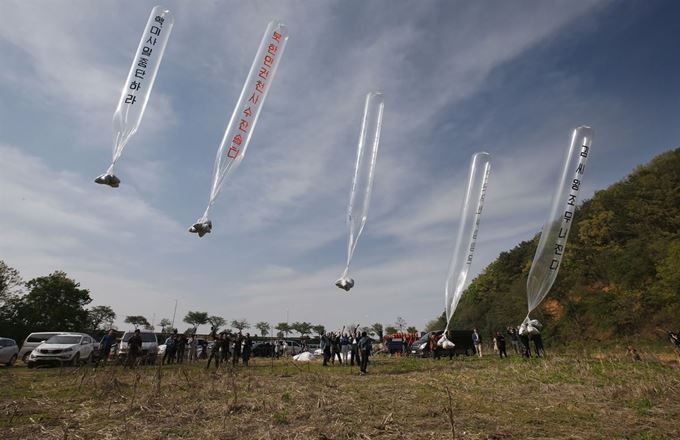
Anti-Pyongyang activists fly balloons carrying leaflets critical of North Korean leader Kim Jong-un and his regime from the border city of Paju, Gyeonggi Province, in this file photo. Yonhap
10. Anti-Pyongyang leaflet campaign
The National Assembly passed a controversial bill banning anti-North Korea leaflet campaigns.
The ruling DPK and the minor opposition Justice Party took part in the vote, while the main opposition PPP and the minor opposition People Party boycotted it. A violation could lead to a sentence of up to three years behind bars or a fine of up to 30 million won.
Advocates of the law argue it is to safeguard residents of the border villages who were intimidated by the possibility of retaliatory attacks from the North. But the law stirred up concerns over freedom of speech both domestically and internationally, with many U.S. congressmen expressing regret over the South Korean ruling bloc's move.