'One property per household' bill causes controversy
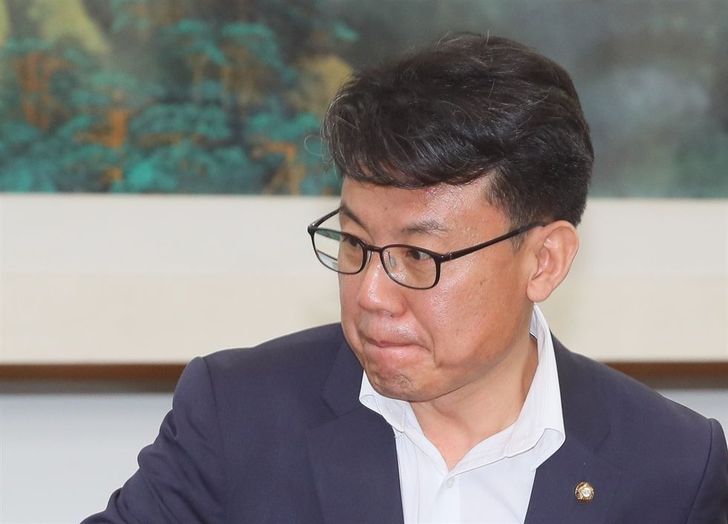
Rep. Jin Sung-joon of the ruling Democratic Party of Korea attends the party's Supreme Council meeting in this July 17 photo. Jin has come under fire for proposing a revision bill that will limit home ownership to one property per household as part of the government's real estate policy, which critics said could harm the spirit of capitalism by infringing on individual's property rights. Yonhap
By Jung Da-min
A ruling party lawmaker has come under fire for proposing a revision bill that will limit home ownership to one property per household as part of the government's real estate policy.
Rep. Jin Sung-joon, a two-term lawmaker with the ruling Democratic Party of Korea (DPK), said Monday that he and other DPK lawmakers have proposed a revision bill for the Framework Act on Residence, to include three more articles ― the principle of one property per household; providing houses first to those not owning a home; and preventing the use of properties for the purpose of speculation or increasing personal assets
The bill has come amid increasing criticism of the government's repeated policy failures to curb rising housing prices, with the assets gap between those owning homes and those without only widening.
“The number of houses nationwide has more than doubled in 20 years, with the housing supply rate increasing from 73.9 percent to 104.2 percent. But the home ownership rate has increased by just 4.5 percentage points over the same period, from 53.5 percent to 58 percent,” Jin said. He added that the purpose of the bill was to ensure housing stability for the people and reduce assets inequality.
From 1995 to 2018 the number of homes nationwide grew from 9.57 million to 20.82 million.
According to the lawmaker on the National Assembly Land Infrastructure and Transportation Committee, the number of people owning a home increased by 13.7 percent from 1.04 million in 2012 to 1.18 million in 2018, while the number of those with multiple homes increased by 34.4 percent from 160,000 to 220,000. Jin said such a tendency in the real estate market has made the ownership structure even more unequal.
But the revision bill has raised controversy among other politicians in the conservative opposition bloc, as well as the public; and political watchers pointed out that such a bill could harm the spirit of capitalism by infringing on individual's property rights.
Members of the main opposition People Power Party (PPP) and the minor opposition People's Party called Jin's idea socialistic.
“I am totally against this bill. There could be cases in which you have to live near your parents, a couple may have different workplaces in different regions, or a retired person could receive rent for a house which is not their main residence when they have no other means of earning money,” Rep. Park Soo-young of the PPP wrote on Facebook, Tuesday.
“Above all, it is fearful that such a socialist bill to restrict private property rights could come out. Since when did the Korean people agree to abandon a liberal democracy and the market economy and move to socialism?”
An Hye-jin, a spokeswoman of the People's Party, also said Jin's bill was a heinous trick to cover the failure of the government's real estate policy. “The idea infringes on economic freedom of individuals and businesses protected by the Constitution,” Ahn said in a statement. “The ruling bloc may further say that the state will confiscate all real estate to lower housing prices and provide rations to stabilize the economy.”
As controversies grew, Jin said the bill is aimed at setting a standard and direction for the government's real estate policy and it is not about denying the right of multiple house owners.
But it was found that among the other 11 DPK lawmakers who also signed for the bill, Rep. Yoon Joon-byeong was an owner of two homes in Seoul. DPK spokesman Choi In-ho told reporters after the party's Supreme Council meeting on Wednesday that the council members agreed that lawmakers of the party would need to consult with the party leadership before proposing bills, adding the discussion was related to the bill proposed by Jin, seen as a move by the DPK leadership to distance the party from the controversial bill.