Opposition overtakes governing party. What is to blame for reversal?

Rep. Kim Tae-nyeon, second from left, floor leader of the ruling Democratic Party of Korea (DPK), participates in a party meeting, Thursday. Yonhap
By Do Je-hae
The main opposition conservative United Future Party (UFP), formerly the Saenuri Party, is ahead of the ruling Democratic Party of Korea (DPK) in public approval ratings for the first time since the end of October 2016, according to a poll released Thursday.
A Realmeter survey showed the approval rating for the DPK stood at 33.4 percent, 1.7 percentage points down from the previous week, while the UFP's approval rating had risen 1.9 percentage points to 36.5 percent.
The results are drawing keen attention as it is the first time the support rate for the conservative bloc has overtaken that of the liberals since a corruption scandal led to the ousting of former President Park Geun-hye. Park's Saenuri Party was slightly ahead of the DPK in the third week of October that year, but in the fourth week, the liberal party started to overtake it, according to data from Realmeter. Until now, the liberal party had retained the lead in its opinion polls.
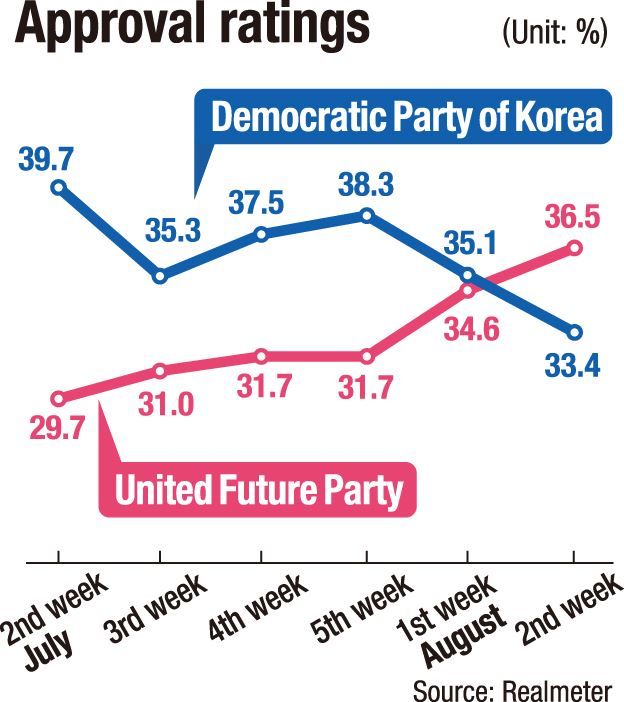
The latest Realmeter survey showed that the DPK is losing favor among its primary support groups ― the approval rating among residents of Gwangju and North and South Jeolla provinces (sometimes known as Honam), the party's home turf, declined by 11. 5 percentage points, while that among liberal respondents also fell by 3.9 percentage points.
One of the biggest reasons for loss of support for the DPK is the negative public sentiment toward the government and the ruling party's mishandling of real estate policies.
On the contrary, the main opposition has been gaining more public support with regard to housing, particularly after a speech at a National Assembly plenary session by Rep. Yun Hee-suk who highlighted the struggles of being a tenant under the Moon administration.
“Amid the negative public sentiment toward the government and the ruling party, the UFP has been able to take advantage with Rep. Yun's speech,” a Realmeter official said. “Also the UFP leadership headed for the Honam region to help flood recovery efforts, made a quick proposal for a fourth supplementary budget, and decided to honor the spirit of the May 18 Gwangju pro-democracy movement, all of which positively affected centrist people.”
Cheong Wa Dae is being subdued about the alarming change in the approval rating. “We are not swayed by ratings,” a senior presidential official told reporters, Thursday. “We are firmly determined to focus on the tasks at hand, such as flood recovery efforts, COVID-19 and stabilizing the housing market, in addition to other economic challenges.”
The presidential office has sought to turn things around with a reshuffle of the secretariat. Four out of six senior presidential secretaries who offered to resign last week were replaced this week, except for chief of staff Noh Young-min and Kim Oe-sook, the senior secretary for personnel affairs. But critics say the reshuffle, aimed at recharging the office following weeks of controversy surrounding the housing ownership status of Noh and other senior aides, lost any significance after Moon decided to retain Noh.
“We can say that personnel appointments at the senior secretary level has been concluded,” a presidential aide said.