Committee recommends to reduce top prosecutor's authority
By Bahk Eun-ji
The Justice and Public Prosecutors Reform Committee under the Ministry of Justice said Monday that it has drawn up a recommendation to decentralize, and reduce the prosecutor general's authority to subordinate agencies. It is effectively reducing or abolishing the prosecutor general's authority to direct investigations into district prosecutors across the country, sparking concerns of “infringement of the prosecution's independence.”
During a press briefing at the ministry, the committee announced the recommendations, which include dispersion of the prosecutor general's specific investigation command authority, improvement of the prosecution personnel's statement procedure, and diversification of the appointment of the prosecutor general.
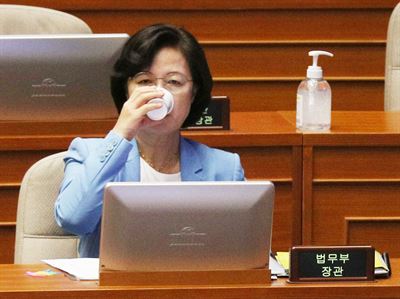
Justice Minister Choo Mi-ae /Korea Times file
If Justice Minister Choo Mi-ae accepts the recommendations, the prosecutor general's specific investigation command will be largely delegated to regional offices and diminish the top prosecutor's power.
The committee also suggested measures to allow outsiders and women to be actively appointed to the position of prosecutor general, even if they are not prosecutors, which is strongly opposed by the prosecution.
A prosecution official said, “The appointment of the prosecutor general from outside the prosecution can only be interpreted as an intention to appoint a person who listens to the administration.” According to the Public Prosecutors' Act, the prosecutor general can be appointed if the person has served as a judge, prosecutor or lawyer for more than 15 years. However, most of the incumbent senior prosecutors have been appointed to the position of prosecutor general so far.
The possibility of the prosecutor general's intervention in the upcoming appointment of prosecutors is also expected to be greatly limited. Under the current law, the justice minister has to listen to the prosecutor general's opinion when making personnel appointments.
In the first personnel reshuffle of the prosecution in January, shortly after Choo took office, one of Yoon Seok-yeol's closest aides, the chief prosecutor of the Supreme Prosecutors' Office, who was in charge of investigating the administration, as well as the deputy chiefs of the Seoul Central District Prosecutors' Office, were moved to the provincial offices.
At the time, the justice ministry notified the Supreme Prosecutors' Office that it would listen to Yoon's opinion for 30 minutes before the prosecution's personnel committee meeting, sparking controversy over its violation of the Public Prosecutors' Office Act. In this regard, an official of the prosecution's reform committee explained, “There is a practice where personnel changes are decided in a secret session, so the plan to improve such cases is also subject to be reviewed this time.”