Moon's new security aides face tough hearings ahead
By Kang Seung-woo
Contrary to initial expectations, President Moon Jae-in's choices for the intelligence agency chief and the unification minister ― both of whom need to undergo National Assembly reviews ― may not breeze through their confirmation hearings, as some “risk factors” are popping up that give ammunition to those that oppose their nominations.
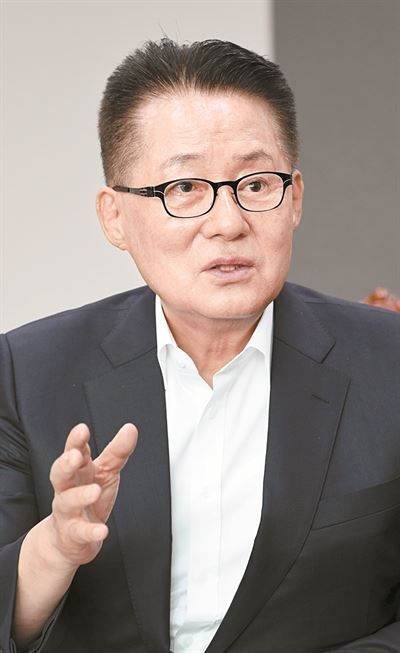
Park Jie-won, nominee for National Intelligence Service director / Korea Times file
Earlier this month, Moon nominated veteran former lawmaker Park Jie-won to lead the National Intelligence Service (NIS), while picking Rep. Lee In-young, a former floor leader of the ruling Democratic Party of Korea (DPK), to serve as the unification minister in an apparent bid to normalize soured inter-Korean relations. On Wednesday, the President asked the National Assembly to undertake confirmation procedures regarding their appointments.
The Assembly is legally required to complete the confirmation procedures within 20 days of the President's request, meaning that July 27 is the deadline. Even if lawmakers fail, or refuse, to approve their nomination, Moon is empowered to press ahead with the appointment of Lee and Park.
The biggest hurdle for Park, 78, a former chief of staff of late former President Kim Dae-jung, is his former conviction over the first inter-Korean summit between Kim and then-North Korean leader Kim Jong-il.
In 2003, a special investigation team found the government was behind Hyundai Group sending $450 million to North Korea ahead of the 2000 summit, which included government money of $100 million. Park, who was involved in the scandal, was sentenced to three years in prison at the time.
The main opposition United Future Party (UFP) says Park, with such a history, should not take charge of the intelligence agency.
Park is also embroiled in another controversy over his college transfer and early graduation while undertaking compulsory military service.
According to documents that Park submitted to the Assembly for his hearing, he served in the military from April 15, 1965 to Sept. 23, 1967, but he transferred to Dankook University, Sept. 1, 1965 and graduated from the school, Feb. 28, 1967, which means that he attended school while on military duty.
“According to the then Military Service Act, active duty service personnel must stay on base, so how could Park attend school?” an official of the UFP asked. “We will thoroughly review this issue at the hearing.”
In response, Park explained that his commander gave consideration for him to study and attend night lectures.
Besides the school issue, some point out Park had commended former President and military junta Chun Doo-hwan and North Korean leader Kim Jong-un.
According to Rep. Ha Tae-keung of the UFP, Park told a KBS interview in 1982 that Korea needed a hero like Chun who made bold decisions like the Dec. 12 military coup and the May 18 massacre ― a mass killing of pro-democracy protesters who stood against his authoritarian regime in Gwangju in 1980.
“Thanks to his praise of Chun, Park was conferred with a medal from the former president,” Ha said.
In addition, Park apparently said in 2013 that the North Korean leader was “manly” enough to execute his uncle Jang Song-thaek “without batting an eye,” Ha noted.
Some critics also point out that his two daughters, both of whom were born in Gwangju, ditched their Korean nationality in 1994 to maintain their U.S. citizenship.

Lee In-young, nominee for unification minister / Yonhap
The unification minister nominee is in the hot seat over his and his son's exemption from mandatory military service.
The inaugural leader of the now-defunct association of university student representatives, a pro-democracy and pro-unification student organization in the 1980s, he was exempted from military service due to his imprisonment linked to student movements in defiance of the National Security Law and the Law on Assembly and Demonstration. The military act stipulates that people sentenced to more than 18 months in prison may not perform military service.
His son was also exempted from military service in 2016 due to him being diagnosed with spondyloarthropathy, an inflammatory rheumatic diseases.
Also, some are concerned that the four-term lawmaker, 56, is an ideological politician, who may push for a North Korea policy that the United States may not agree with in terms of possible violations of international sanctions on Pyongyang.
Last week, Lee hinted he would seek to revamp the South Korea-U.S. working group, a forum to coordinate North Korea-related issues, amid growing complaints from the liberal side that it does not contribute to inter-Korean cooperation.
“I am worried that South Korea and the United States are not on the same page about how to handle the North. Is Lee the right fit for the unification minister job?” Rep. Kim Gi-hyeon of the UFP wrote on Facebook.