President honors pro-democracy activists

President Moon Jae-in looks around room No. 509 at the former site of a police interrogation office in Namyeong-dong, Seoul, where student activist Park Jong-chul died from torture. Moon and first lady Kim Jung-sook laid flowers in front of Park's photo and observed a moment of silence to pay tribute to the late pro-democracy activist. Korea Times photo by Wang Tae-seok
By Do Je-hae
President Moon Jae-in paid tribute to pro-democracy activists during an event to mark the 33rd anniversary of the June 10 Democracy Movement, Wednesday, at a site in Namyeong-dong in Seoul, notorious for the interrogation and torture of pro-democracy activists that occurred there in the 1970s and 80s at the hands of the authoritarian government.
The protest, also known as the “June Struggle,” refers to a nationwide anti-government movement in 1987 from June 10 to 29 against the Chun Doo-hwan regime. The movement was critical for Korea's democratization as it ultimately brought about a constitutional revision which enabled direct election of the president.
In the 1980s, a number of university students lost their lives during the anti-government protests. One of the notable student activists was Park Jong-chul, a student at Seoul National University. He died on Jan. 14, 1987, after being tortured during police interrogation about his activities. His death and the authorities' attempts to cover it up fueled the public's indignation against the Chun regime.
President Moon honored Park and other activists during the ceremony by awarding government medals to their bereaved families. It is the first time for the government to award medals during a memorial ceremony for the June 10 movement, the presidential office said.
“This is the notorious place where many had to suffer illegal arrests, torture and human rights violations just because they hoped for democracy,” Moon said in the ceremony at the site, which is now being transformed into the Democracy and Human Rights Memorial Hall.
“On Jan. 14, 1987, Park Jong-chul of the linguistics department at Seoul National University died at age 22 from police torture in interrogation room 504. But due to the June Struggle, the truth behind the state's violence conducted in Namyeong-dong was finally revealed to the outside world.
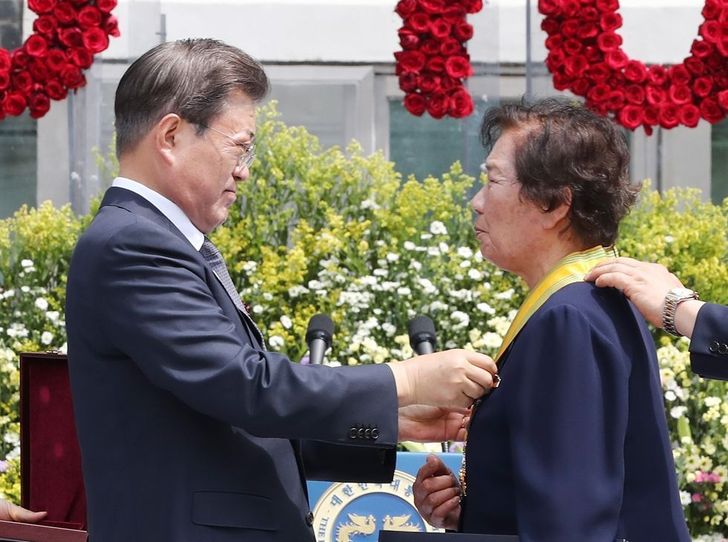
President Moon Jae-in awards the Moran medal, the second-highest grade in the Order of Civil Merit, to activist Bae Eun-shim, Wednesday, during a ceremony at the Democracy and Human Rights Memorial Hall in Namyeong-dong, Seoul, to mark the 33rd anniversary of the 1987 June pro-democracy movement. Bae is also the mother of late student activist Lee Han-yeol, who became one of the symbols of the June struggle after he was brutally killed by police. Yonhap
“Now we are building a memorial for human rights at this site. It will be a place to heal the pain of the victims and remember the history of our struggle for democracy.”
It is the first time for a sitting President to visit the Namyeong-dong police interrogation site, according to Moon's office. “The visit is to pass on the spirit of democracy and respect for human rights to future generations,” a presidential aide said.
During the ceremony, Park's father the late Park Chung-ki, a former public servant who devoted his life to the pro-democracy movement after the death of his son, was posthumously awarded the second-grade Moran medal for civilians.
The medal was also bestowed on 11 others for their special contributions to promoting the nation's democracy. They included the late Lee So-son, mother of Chun Tae-il, a worker's rights activist who died by self-immolation; and Bae Eun-shim, mother of Lee Han-yeol, another student activist from Yonsei University who was seriously injured when a tear gas grenade punctured his skull during a protest at his campus on June 9, 1987. He died from his wounds a few weeks later, becoming a symbol of the June movement.