Moon pays tribute to independence movement hero

Crew members of the Republic of Korea Navy vessel, named after the independence fighter Hong Beom-do, stand in formation on June 5, ahead of the 100th anniversary of the Battle of Bongodong. Yonhap
By Do Je-hae
President Moon Jae-in urged Koreans Sunday to remember the sacrifices of independence fighters who struggled against Japanese imperalism on the centennial of the victory of the Bongodong (Fengwudong) Battle.
He paid tribute to Hong Beom-do, a commander-in-chief of the Korean Independence Army, who led his force of 1,200 to 1,300 freedom fighters to victory at the Battle of Bongodong, with 157 Japanese killed and 300 wounded of a force of 500 soldiers. It was the first large-scale battle between the Korean Independence Army and Japanese troops in Manchuria.
“The Bongodong Battle occurred only five months after the Provisional Government declared the year of war for independence,” Moon said in a social media message Sunday. “The Bongodong Battle gave confidence and hope for independence to our people who were suffering under the colonial rule.”
“The victory was all the more special because the army consisted of ordinary people, including farmers and laborers at the end of the late Joseon period.”
Moon also paid tribute to the power of ordinary citizens, who are still driving the fight against national challenges. “After 100 years, it is our ordinary neighbors who are the driving force against national crises such as COVID-19. Our people have emerged as an example of overcoming the pandemic through solidarity and cooperation. Today I am reminded of the great power of the ordinary people that have written a history of victory and hope.”
In 1921, Hong and his forces relocated to the Soviet Union to seek refuge from the Japanese forces and were relocated to Kazakhstan in 1943 as a result of Stalin’s deportation of Koreans in the Soviet Union. He died there in 1943.
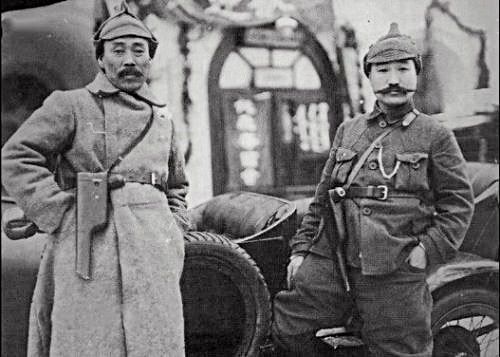
Hong Beom-do, left, poses during a conference in Moscow in January 1922. Korea Times file
The Moon administration has been trying to repatriate the remains of independence fighters who died abroad.
Moon made special mention of Hong and other independence fighters in his speech to mark the 101st anniversary of the March 1 Independence Movement.
“Last year, we brought home the remains of independence activists Gye Bong-woo and Hwang Woon-jeong as well as those of their spouses. To commemorate the 100th anniversary of the Battle of Fengwudong this year, the remains of General Hong will be repatriated and buried in his homeland on the occasion of the Kazakh president’s visit to Korea,” Moon said.
“I extend my profound gratitude to the officials of the Kazakh government and Kyzylorda provincial government for their cooperation as well as to the ethnic Koreans there, who protected the general until the last moment and have looked after his grave. I hope that the repatriation of General Hong Beom-do’s remains will serve as an opportunity for us to contemplate the patriotism of our forefathers and realize the value of the nation’s existence.”
The president of Kazakhstan was going to bring back Hong’s remains during a planned visit here in March, but the visit has been delayed due to COVID-19. The two countries have decided to reschedule the visit for later this year, according to Moon’s office.
Moon made an official request for the repatriation of Hong’s remains during an official visit to the country in April 2019.
“It is a duty for the government to remember the members of the independence army and educate the future generations about them,” Moon said.
“Due to COVID-19, the repatriation has been delayed. But we will bring back his remains and show him the highest level of respect and honor his cause for the independence movement.”
The Moon administration has been more active about the commemorative activities for the independence movement than previous conservative governments.
The government will build a memorial hall in Seoul and held a groundbreaking ceremony in Seodaemun on April 11.
In December 2017, Moon became the first sitting President to visit the provisional government complex in Chongqing, China, during a state visit to the country.
The provisional government moved around various cities such as Shanghai, Hangzhou and Guangzhou among others before settling in Chongqing in 1940. The last three years of the provisional government from 1945 through 1948 were based in Seoul.