Parties in last-ditch election campaigning

Lee Hae-chan, co-head of the ruling Democratic Party of Korea's election strategy committee, speaks during a meeting at the party's regional branch in Gwangju, Wednesday, a week ahead of the April 15 general election. Yonhap
By Jung Da-min
Political parties are going all out to promote their policy pledges for the April 15 general election as they only have a few more days to campaign before voters cast their ballots.
For the ruling Democratic Party of Korea (DPK), the main strategy is to divert the high approval rating for President Moon Jae-in to support for the party. As the public has a favorable opinion of the Moon government over its handling of the COVID-19 situation, the DPK has adopted “Overcoming COVID-19” and “Stability in state affairs” as its top campaign slogans.
“This year's general election is about overcoming the difficult situation caused by COVID-19, overcoming the economic crisis and stabilizing state affairs,” Lee Hae-chan, party leader and co-head of the DPK's election strategy committee, said Friday during a party meeting in Daejeon. “The Moon Jae-in government is doing well right now, so the opposition party must win and hold back the National Assembly.”
The DPK says voters should vote for its candidates to facilitate cooperation between the National Assembly and the government in dealing with state affairs in a time of crisis.
On the other hand, the main opposition United Future Party (UFP) is challenging the ruling bloc by attacking the “failure” of the Moon Jae-in government's income-led growth policies.
“The Moon government said it will create income-led growth but there has been no growth, only shutdowns of businesses and unemployment, while the economy continues to go downhill,” said Kim Chong-in, co-head of the UFP's election strategy committee. “The government is under the illusion that the people cannot recognize its failures over the past three years.”
Just weeks ahead of the election, the UFP scouted Kim, a veteran economist and politician who helped both President Moon and former President Park Geun-hye get elected. Kim has expressed confidence in leading the UFP's election campaign saying now is the time to “judge” the Moon government and the only way to prevent further damage to the country's economy is with a UFP majority.
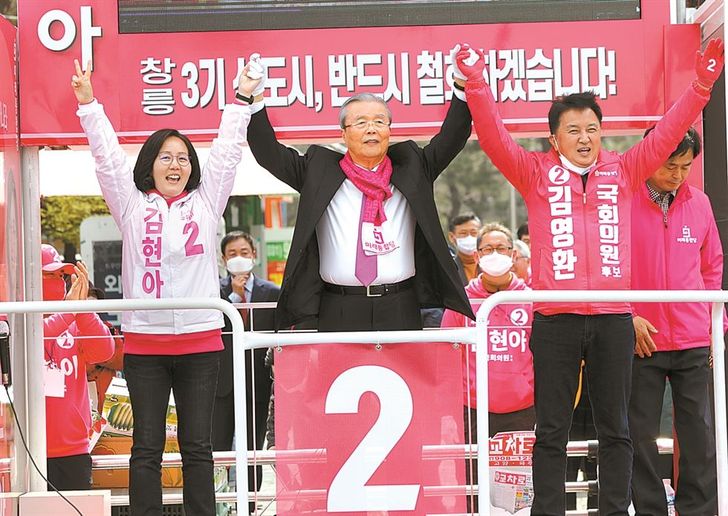
Kim Chong-in, center, co-head of the main opposition United Future Party's election strategy committee, campaigns for the April 15 general election, Friday, with candidates running in Goyang, Gyeonggi Province. Yonhap
But the UFP is also trying to minimize the negative impact from some of its candidates' inappropriate comments. The UFP's ethics committee decided to expel Kim Dae-ho, who was running in the Gwanak-A district of Seoul, after he said people in their 30s and 40s lacked logic and did not support the conservative party because they did not know the history of the country's development. Another candidate Cha Myung-jin, who is running in the Bucheon-C district in Gyeonggi Province, said some bereaved family members of the Sewol ferry disaster victims were engaged in “promiscuous conduct” at a memorial site of the disaster. The party's ethics committee recommended he leave the party.
So far public support seems to be leaning toward the ruling party. According to a survey conducted by Realmeter of 1,509 eligible voters from Monday to Wednesday, the last day allowed for such surveys before the election, 42.6 percent said they support the ruling DPK while the UFP garnered 30.2 percent.
But the election results are still hard to predict as the approval ratings of parties do not directly mean voters will vote for the candidates running in the single-member district constituencies, when the competition could be more about the individual candidates' capabilities rather than the race between parties.
The results of the proportional representation vote also remain to be seen, when the country's two major parties decided not to directly run in the race but instead created satellite parties to garner more seats under a new electoral system aimed to increase the representation of minor parties. The Realmeter survey showed 27.9 percent supported the UFP's satellite Future Korea Party, while the DPK's satellite party Civil Together garnered 24.2 percent of support.
Civil Together is competing to win the support of liberal voters with another minor liberal party, the Open Minjoo Party, which was created by former DPK members who were not chosen as DPK candidates and other activists who support former Justice Minister Cho Kuk.