Early voting kicks off

President Moon Jae-in and first lady Kim Jung-sook cast ballots at the Samcheong-dong Community Service Center in Seoul near Cheong Wa Dae, Friday, the first day of early voting for the April 15 general election. They wore face masks and protective gloves as part of measures taken at polling stations to prevent the spread of the COVID-19 pandemic. / Yonhap
By Kang Seung-woo
The nation started its two-day early voting, Friday, for next week's general election, with more people than expected casting their ballots despite the COVID-19 pandemic that is restricting outdoor gatherings.
According to the National Election Commission (NEC), 3,508 polling stations across the nation opened at 6 a.m. for a 12-hour stretch on the first day of advance voting. Those unable to vote on April 15 can cast their votes until 6 p.m. Saturday. Voters must bring their resident ID card, driver's license or passport.
As part of efforts to encourage voters to take part in the election, President Moon Jae-in, along with first lady Kim Jung-sook, voted at the Samcheong-dong Community Service Center near Cheong Wa Dae at around 9 a.m. In 2018, Moon also cast his ballot for the local elections through early voting, becoming the first incumbent head of state to do so since the pre-election polling system was introduced in 2013.
In accordance with the NEC guidelines to prevent the spread of the coronavirus, Moon and Kim showed up at the polling station wearing face masks, and they put on protective gloves before receiving ballots. They also had their temperatures checked and their hands disinfected with sanitizer.
“I hope early voting will help disperse gatherings of people on Election Day,” Moon said.
One hour later, Prime Minister Chung Sye-kyun also voted at the same polling station and he assured voters that they would be safe.
“Seeing people keeping a safe distance from each other while waiting to vote, I believe voters can go to polling stations without concerns (over the coronavirus infection),” he said.
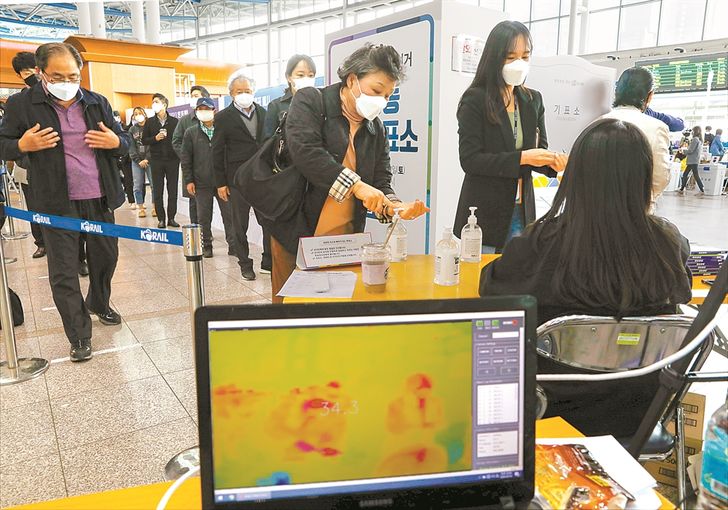
Voters disinfect their hands with sanitizer before casting ballots, with a thermal camera checking their temperatures, at a polling site in Seoul Station, Friday, the first day of early voting for the April 15 general election. Voters are strongly recommended to wear a face mask and protective gloves as part of measures taken at polling stations to prevent the spread of COVID-19.
Along with them, other politicians, including Seoul Mayor Park Won-soon, ruling Democratic Party of Korea Chairman Rep. Lee Hae-chan and former presidential chief of staff Im Jong-seok, also participated in early voting, urging people to come to polling sites.
The quadrennial election to make up the 300-strong National Assembly comes as the government is still fighting the coronavirus pandemic, raising concerns that many people may not show up to the polls due to concerns over possible infection at polling places.
In fact, overseas voting, held on April 1 to 6 at only 85 diplomatic missions due to virus-caused lockdowns and movement restrictions in other countries, recorded the lowest-ever voter turnout of 23.8 percent, according to the NEC, as only 40,858 of 171,959 eligible voters could cast their ballots. The figure was 45.7 percent in 2012's general election and 41.4 in 2016.
Later in the day, the NEC said 18 missions in 17 countries, including Brazil, Poland, Uzbekistan and Nigeria, will count ballots on their own but they cannot send ballots home due to border controls prompted by the coronavirus. It is the first time that votes will be tallied in overseas missions since the system was introduced in 2012.
Turnout on the first day of early voting here, however, far exceeded expectations, hitting a record high.
It stood at 12.14 percent as 5.34 million out of 43.99 million eligible voters went to the polls, according to the NEC. For the 2016 general election, the turnout on the first day was 5.45 percent. It also outnumbered the 2017 presidential election's 11.7 percent and the 2018 local election's 8.77 percent.
Political analysts say the turnout was higher than expected as people may prefer the less-crowded early voting out of virus fears. They say increased early voting can lower the election-day turnout.
Meanwhile, those who are in self-quarantine at home cannot vote during the early voting period after the government failed to come up with a measure for them.
“Relevant government ministries are in negotiations to allow them to vote on Election Day while preventing other voters from being exposed to the risk of infection,” Vice Health Minister Kim Gang-lip said during a briefing, Friday. “The government plans to announce its measure on Sunday.”
The government initially considered allowing those in self-isolation to vote during a separately designated timeslot, but it is said to still have issues to address.