Coronavirus increasingly casting shadow over general election

An airship to encourage voting for the April 15 general election flies over the coastline of Busan, March 1. Experts speculate campaign promotion avoiding physical contact will be common due to the spread of the COVID-19 coronavirus. / Yonhap
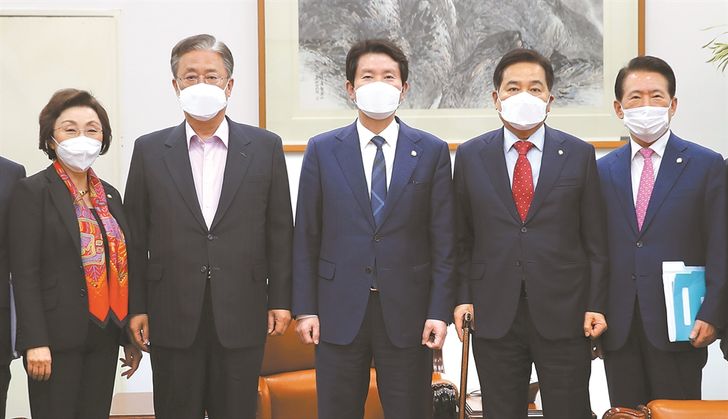
Floor leaders of the rival parties pose at the National Assembly, March 1, before discussing electoral district rearrangement and a supplementary budget to fight the COVID-19 epidemic. / Yonhap
Spread of contagious disease likely to change conventional practice of outdoor campaigning
By Yi Whan-woo
The coronavirus outbreak has been emerging as one of the top political agenda items in the lead up to the April 15 general election.
It is also increasingly affecting preparations for the election including methods of interviewing candidate hopefuls and campaigning, following the rapidly growing number of infections and rising death toll.
For the ruling Democratic Party of Korea (DPK), the COVID-19 (2019-nCoV) epidemic is posing the challenge of voters turning their back on the party as the virus hits the economy and diplomacy, fueling mistrust of the government.
The DPK used to have a lead over opposition parties in approval ratings up until January. Now, as the DPK slips to a 35.3 percent approval rating, the main opposition United Future Party (UFP) is closing in with 30 percent in the latest survey conducted by Realmeter from Feb. 27 to 28.
The result comes after President Moon Jae-in's administration fell short of taking pre-emptive measures against the spread of the coronavirus, such as keeping the supply and prices of face masks under control, and providing enough hospital beds for patients.
“This is a painful mistake for the government as it once lauded the country's quarantine system as excellent. And it is obviously hurting the DPK, too,” said Myongji University political science professor Kim Hyung-jun.
The public fear of the virus has resulted in people limiting their outdoor activities and refraining from inter-city travel. This has added to concerns over the sluggish economy, which has been a political liability for the Moon administration.
The government has been also criticized for not imposing a complete ban or taking other restrictive measures on the entry of Chinese nationals in January. Moon said a total ban on their entry was not only “impossible” but also “would not lead to tangible interests” for the country.
Now China is among over 100 countries and territories that have imposed entry bans or tougher quarantine procedures for travelers from Korea, following the hike in the number of infections here.
The difficulties arising from overseas travel bans is hitting travel agencies and airline carriers hard.
“This apparently shows every country with any common sense would prioritize protecting public health and other national interests even at the risk of diplomacy,” Shin Yul, a political science professor at Myongji University, said. “And our government's measures make criticism more convincing as it remains excessively low-key when it comes to relations with China.”
He argued that the Assembly elections have generally been about evaluating what is wrong with the government and the ruling party, and that April 15 could be “punishment day” for the DPK.
To make the situation worse, the DPK once heightened public fear when its top spokesman Hong Ik-pyo said Dageu and North Gyeongsang Province, the hotbed of the epidemic in Korea, would be locked down to prevent the spread of the coronavirus - which was false information.
As a way to contain the outbreak, the government allocated 11.7 trillion won ($9.9 billion) in a supplementary budget and submitted the bill to the Assembly, Wednesday.
For the UFP, the analysts said its prospects for the election do not look bright, either.
Although the UFP has been ratcheting up criticism against the government and the DPK, it is cautious of any backfire, because the epidemic is bringing up the memory of the incompetent response by the conservative Park Geun-hye administration during the Middle East Respiratory Syndrome (MERS) outbreak in 2015. The Saenuri Party, a predecessor of UFP, was then the ruling party.
“The people still associate the UFP with the incompetence of the conservatives as seen in the 2015 MERS outbreak,” Shin said. “In that regard, the UFP should not be too harsh on the ruling party to avoid a backlash.”
Changes in campaign methods
The highly contagious virus and the public's avoidance of outdoor activities have completely changed candidates' electioneering.
“The coronavirus is going to change the way the elections take place,” Shin said.
He referred to the UFP's nomination committee conducting a video call interview with candidate hopefuls from coronavirus-hit Daegu and the surrounding North Gyeongsang Province.
The regions are the epicenter of the epidemic in Korea, with many of the cases since mid-February being linked to the city's branch of the Shincheonji Church of Jesus, a secretive religious sect.
“Given the circumstance, online campaigning using Facebook and YouTube will increasingly replace conventional, offline campaigns in which candidates have sought to meet as many voters as possible,” Shin said.
He speculated online campaigning will settle as the mainstream practice on the campaign trail in future elections, instead of a candidate giving a blaring speech through a loudspeaker while cruising the streets on the back of a truck on a makeshift stage.
“Korea's offline campaign style has often been criticized for creating noise. Such a practice is outdated compared to those from other OECD member countries that address pledges in a low-key manner,” Shin said.
Professor Kim also said even the offline campaign methods will increasingly minimize physical contact in the future.
“Outdoor billboards and posters will become more common ways to let voters learn about candidates and their pledges. They will certainly become a trend in offline campaigns,” he said.