Conservative parties' consolidation faces hurdles
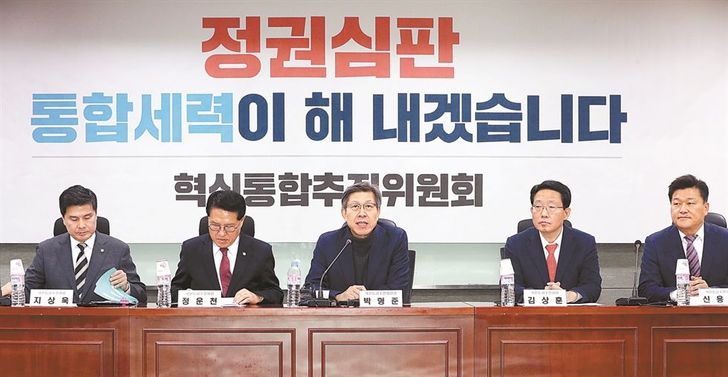
Former National Assembly Secretary-General Park Heong-joon, center, leader of a newly launched committee for the renovation and unification of conservatives, speaks during the second meeting of the committee at the National Assembly, Wednesday. The committee includes members from the Liberty Korea Party, the New Conservative Party and several independent lawmakers. Yonhap
Merger committee launched; friction already surfacing among parties
By Jung Da-min
Conservative parties are gearing up for a merger to form a “big tent” to win the April 15 general election, but questions are whether the move will succeed when signs of fragmentation among the members have already emerged.
A committee for the renovation and unification of the conservatives held its first meeting, Tuesday. With former National Assembly Secretary-General Park Heong-joon being the head, the committee is comprised of members from conservative parties including the main opposition Liberty Korea Party (LKP); the minor New Conservative Party, a breakaway group from the minor Bareunmirae Party; and some other independent lawmakers who had left the LKP or the Bareumirae.
A day before the meeting, the LKP and the New Conservative Party agreed to participate in the move, saying they agreed on six principles announced by the unification committee. The principles include that the unity should be made across the groups against the Moon Jae-in administration, including the conservative-centrist groups; the merger should be made in a way that would receive support from young voters; and no one should be blamed for the impeachment of former President Park Geun-hye.
In a meeting Wednesday, the participants again confirmed their goal: To set up a party consolidating the centrist and conservative groups in order to hold the Moon administration accountable for its “totalitarian” policies and form an alternative group that can give hope to the people.
But questions are already rising over whether the unification of the parties will be possible. The New Conservative Party and independent lawmakers split off from the predecessors of the LKP in recent years due to different political stances or factional conflicts. They have only two things in common: they strongly oppose the Moon administration, and want to win the general election.
Complaints and fragmentation among the committee participants have already emerged.
Rep. Yoo Seong-min, a key member of the New Conservative Party and a former presidential candidate, expressed discomfort over the situation that the LKP is leading the merger plans.
“If we build a new house, the old house should be demolished and new people should be the owners,” Yoo said in a party meeting, Wednesday. “If it becomes an LKP-centered merger and the New Conservative Party adds only a small number of lawmakers to it, people will not think it is a new house.”
Lee Jun-seok, an iconic young politician who is leading a committee for the “young visions” at the New Conservative Party, said devotion by the long-term lawmakers and renovation by young members should be the two main parts of the unification.
“The unification is unnecessary if it does not bring about synergy,” Lee said. He said long-term lawmakers should run for heavily competitive constituencies while young members should devise an agenda for the new conservatives. “Without such a division of roles, there would be no synergy through the unification.”
Rep. Lee Un-ju, independent lawmaker who has prepared to launch a new conservative party named Onward for Future 4.0, complained that the LKP and the New Conservative Party are ignoring the opinions of other minor participants of the committee.
“If the unification discussion ends up creating another league for those who have ruined the nation's politics, instead of bringing renovation or a generational shift, I would steadfastly contend against them,” she said
Shin Yul, professor at the department of political science at Myongji University, said the members of the conservative's “big tent” lack a sense of crisis, not in that they do not feel the need to unify, but in that each of them wants to be the main player representing the group.
“From the LKP's point of view, they think it is natural that they would be the beginning or the ground of the big tent as they are the biggest. But the New Conservative Party would not agree with this idea when they also have strong figures such as former presidential candidate Yoo,” Shin told The Korea Times.
“But talks for unification, or even solidarity ― if unification is too difficult to achieve ― could be facilitated if they feel a higher sense of crisis that they would lose the election. The unification is not the only way but they could form a political solidarity.”
The committee participants are also showing different opinions on whether to invite former Bareumirae Party head Ahn Cheol-soo to the committee. Ahn, a former presidential candidate who left Korea to study in the U.S., said recently he would come back to the political arena soon.
LKP leader Hwang Kyo-ahn said he would welcome Ahn if he joins, but the New Conservative Party members are displaying a lukewarm stance.
Ahn, who is considered to be conservative-centrist, is expected to return to the Bareunmirae Party for the moment. He said he has “no intention to participate in the unification discussion that is about political engineering,” which focuses on scaling up the size rather than renovation.
Shin expected there was only a low chance of Ahn joining the consolidation committee. “Ahn would not want to risk getting rid of his label as a 'centrist,' when it has been his top selling point on the political stage,” the professor said.