Parties trying to woo young voters

New members of the minor opposition Justice Party, who are 18 years old, hold a performance calling for legislation for young people, at the National Assembly, Seoul, Jan. 7. / Korea Times photo by Oh Dae-geun
By Kim Rahn
The political parties are coming up with strategies to woo young voters in the April 15 general election. The focus on young voters intensified after a recent law revision lowered the voting age from 19 to 18, allowing 520,000 new voters to cast their ballots to select members of the National Assembly in the upcoming election.
The minor progressive Justice Party announced a set of pledges targeting 18-year-olds, Jan. 7.
The party said it will seek to lower the voting age further to 16 and the age of eligibility to run in an election from the current 25 to 18; to set up a law protecting students’ human rights; to provide college students with interest-free loans for tuition; to increase conscripts’ monthly salary to 1 million won ($861); and to offer a 200,000 won monthly housing allowance to people aged between 19 and 29 who live alone and make below the average wage for those in their age group.
The party has also signed up 54 people aged 18 as official party members. While the current law on political parties bans people aged under 19 from joining a party, the Justice Party decided to accept 18-year-olds as members because they now have the right to vote. It also filed a petition with the Constitutional Court to review the constitutionality of the law.
“Eighteen-year-olds entering politics is a signal of a generational change in Korea’s outdated and corrupt politics,” Justice Party Chairwoman Sim Sang-jeung said in a ceremony to accept the young members.
“It is a victory achieved by you, who did not give up your rights as citizens and voiced your opinions in the political arena.”
The Justice Party also said it is considering selecting a young person as No. 1 in its proportional representative candidates.
“We’ll give priority to young people, the disabled and those from other socially weak groups when making our list of proportional representation candidates,” a party official said.
A new conservative party, a breakaway group from the minor Bareunmirae Party, has submitted bills on the treatment of discharged conscripts.
“We represent ourselves as a party for young people, so our first bills are focused on supporting them,” Rep. Ha Tae-keung, the leader of the party, said, Jan. 7.
The bills are aimed at providing “compensation” to young people who’ve finished their military service — offering a payment of up to double their total salary during their roughly two years of service, so they can use the money for tuition or other job-seeking expenses. Also they will be given priority for state-built houses for up to 10 years after their service.
“The bills reflect demands from numerous young people who suffer because of their military duty,” Ha said.
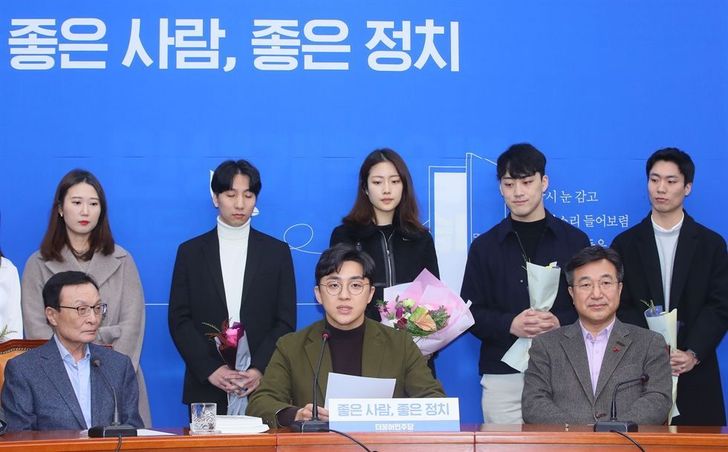
Won Jong-geon, front row center, speaks at the National Assembly, Seoul, Dec. 29, after joining the Democratic Party of Korea. The party is recruiting young people ahead of the April 15 general election. Yonhap
The parties are inviting young people to join them, in a move to make them “look young” and in a “show” of their intention to reflect young people’s opinions in their campaign pledges and party policies.
The ruling Democratic Party of Korea (DPK) has announced six new recruits. Among them is Won Jong-geon, 26, an eBay Korea worker, who appeared in a 2005 TV program in which his blind mother gained sight through a corneal transplant. Another is Oh Young-hwan, 31, a former firefighter.
The DPK said it recruited Won and Oh to reflect their opinion in pledges on welfare for the socially weak and public safety, respectively.
The main opposition Liberty Korea Party (LKP) also invited former tennis player Kim Eun-hee, 29. She disclosed and spoke out against sexual violence in the sports sector in 2016 when she sued her former tennis coach who raped her when she was in elementary school.
The LKP expressed the hope that Kim’s courage will help Korea become a better society.
LKP Rep. Jun Hee-kyung said the party is trying to discover what young people, including 18-year-olds, are interested in. “We’ll conduct a study in other countries where the voting age is 18,” she said.