Prospects mixed on President's engagement policy

North Korean leader Kim Jong-un's response to President Moon's proposals remains to be seen. Yonhap
By Do Je-hae
One of the things that stood out in the 2020 New Year's address from President Moon Jae-in is the scant attention to North Korea's “denuclearization.”
Instead, President Moon declared his resolution to get the North to join various inter-Korean projects that have been sidelined due to pressure from the U.S. to maintain economic sanctions against Pyongyang until it takes “visible steps” to abandon its nuclear and missile programs.
The South Korean leader's pro-engagement speech suggested that he will not choose to be bound by the U.S. focus on sanctions as he stressed that there were things that the two Koreas could work on together.
This is seen as a noticeable departure from previous speeches where Moon was more careful about rushing the progress in inter-Korean relations, saying that international factors must be considered as well.
In the New Year's speech delivered Tuesday, the President mentioned some very specific proposals such as linking inter-Korean railroads; sports exchanges such as the co-hosting of the 2032 Olympic Games and forming a joint team at the upcoming Tokyo Games; and the creation of a peace zone in the Demilitarized Zone (DMZ). Moon even renewed his invitation to North Korean leader Kim Jong-un to visit Seoul, which is something that the President has refrained from publicly mentioning amid the rising U.S.-North Korea tension.
Defying Washington?
Going against Washington's firm stance on sanctions, Seoul also responded positively to a recent China-Russia resolution to remove part of the sanctions on North Korea.
Some analysts were positive about Moon's proposals, saying that Seoul cannot wait indefinitely for U.S. approval to proceed with inter-Korean relations. “Moon has waited for a long time as the U.S. stood in the way of improving inter-Korean ties,” former unification minister Chung Sye-hyun said in a recent press conference. “This year, we must take our own path.”
The ruling Democratic Party of Korea (DPK) backed up the President's engagement policy. “Moon is making a bold push for inter-Korean relations. Kim Jong-un is urged to follow suit,” DPK Chairman Lee Hae-chan said during a party meeting, Wednesday.
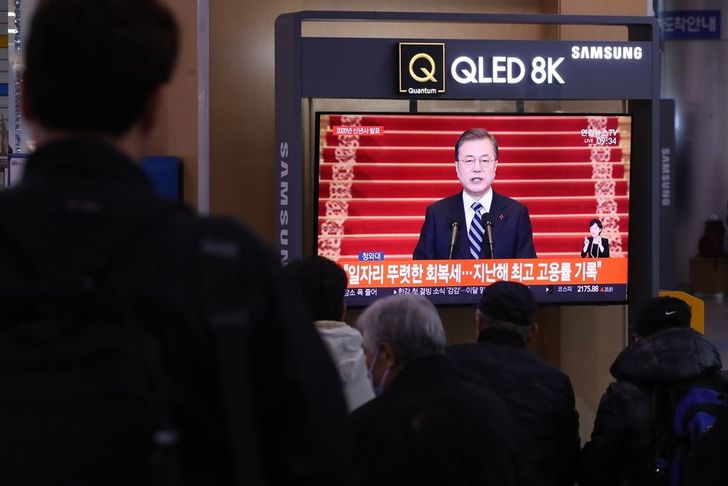
Citizens watch Moon's New Year address. Yonhap
However, doubts are rings on Moon's persistent focus on engagement as North Korea is looking to take a different course from the two-year moratorium on nuclear and intercontinental ballistic missile (ICBM) tests.
Washington reacted negatively to Moon's speech. In a KBS interview on Tuesday, U.S. Ambassador Harry Harris stressed that any success in inter-Korean relations must take place in “lockstep” with progress in “denuclearization.” The top U.S. envoy also emphasized the need for a “consultation with the U.S.” before Kim's visit to Seoul.
Cheong Wa Dae declined to respond to Harris' remarks, Wednesday, but the government still underlined the need to take an “independent” stance from the U.S. and asserted South Korea's role in matters regarding the Korean Peninsula.
"As a member of the international community, we will continue to cooperate with the U.N. Security Council resolution and so on. But as a direct party in issues regarding the Korean Peninsula, we will expand our maneuvers and keep up the position that we will do what we can to advance inter-Korean relations independently,” a unification ministry spokesman said Wednesday.
Widening discrepancy with US
The widening Seoul-Washington discrepancy on engagement with North Korea has triggered concerns once again about a rift in the Korea-U.S. alliance. But the presidential office reiterated that nothing gets done without close consultation with the U.S. Moon's office also underlined that Seoul is fully aware of the importance of the U.N. sanctions and is devoted to their implementation.
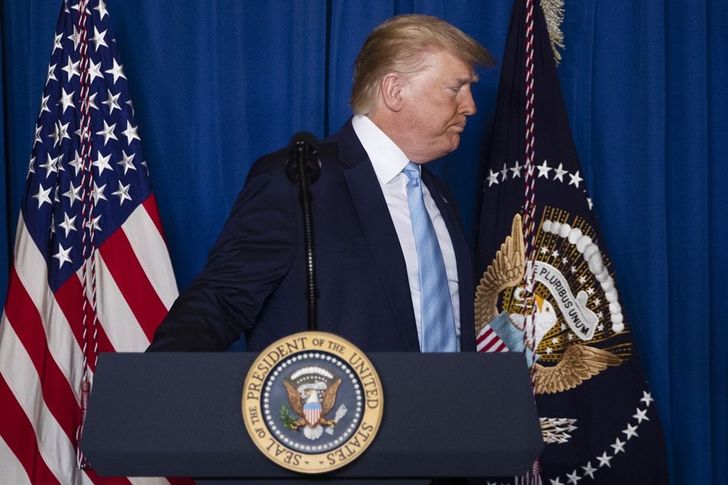
President Donald Trump wants sanctions in place until complete denuclearization is achieved. Yonhap
“It is not that we are unaware of the importance of U.S.-North Korea dialogue or that we are changing the tone of our policy in this regard. Moon's speech reflects our determination to strive for the success of the U.S.-North Korea talks and at the same time, to make efforts to promote inter-Korean cooperation,” a presidential aide said. In a related move, Moon sent his top security adviser Chung Eui-yong to the U.S. for a trilateral meeting with Japan on security issues including the North Korea one.
Pressed for 'outcomes'
The President's renewed focus on engagement also reflects various woes he faces in the latter phase of his presidency. Cheong Wa Dae has been pressured by the growing need to produce “outcomes” as the President starts his fourth year in office and seriously needs a victory in the April general election to maintain momentum for his policies in the twilight of the presidency.
Moon highlighted his North Korea policy as something to be "proud of" during a town-hall meeting to reflect on the first half of his presidency in November 2019. With a lackluster economic performance hampering his job approval ratings, Cheong Wa Dae is counting on improvement in inter-Korean relations to boost the President's public support.