Gov't to focus on revitalizing investments

Economy and Finance Minister Hong Nam-ki speaks during a press briefing at the Government Complex in Gwanghwamun, Seoul, Thursday. Yonhap
Korean economy forecast to grow 2.4% in 2020
By Lee Kyung-min
The government will place top priority on rehabilitating sluggish investment in 2020 by inducing 100 trillion won ($85.9 billion) from the private and public sectors, the Ministry of Economy and Finance said Thursday.
It also plans to spend 240.5 trillion won to support export firms reeling from a series of trade conflicts ― the U.S.-China trade dispute and Korea's feud with Japan ― amid a global slowdown.
These are part of the 2020 economic outlook and policy directions the finance ministry unveiled Thursday.
“The government will mobilize the utmost efforts to find turnaround momentum for economic recovery in the first half of 2020 via investment in both the public and private sectors,” Finance Minister Hong Nam-ki said during a press briefing at the Government Complex in Gwanghwamun, Seoul.
“The economy has undoubtedly been tough in 2019, but we expect a substantial turnaround will follow in the months to come with the government's comprehensive plan. 2020 is filled with uncertainties but provides opportunities at the same time.”
The ministry forecast the Korean economy to grow 2.4 percent next year, following 2 percent growth this year.
To achieve the target, the government has earmarked 60 trillion won for public housing, new energy and social overhead capital (SOC), including building new expressways and ports and refurbishing old power plants.
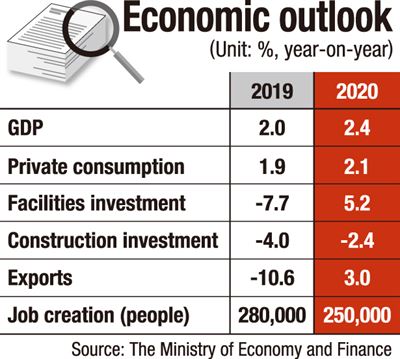
It plans to help businesses invest up to 40 trillion won next year by removing regulatory hurdles, key factors that frustrated corporate investment.
A financing program will be organized via state-run lenders to foster small and medium enterprises (SMEs) with facility investment plans.
A combined 4.5 trillion won in loans will be offered via the Korea Development Bank (KDB), Industrial Bank of Korea (IBK) and the Export-Import Bank of Korea (Eximbank), with up to a 15-year maturity.
Of the 240.5 trillion won allocated for export firm financing ― up from 217 trillion in 2019 ― 7.7 trillion won will be spent to help SMEs find business opportunities in emerging markets.
The government also wants create an ecosystem in which the private sector can advance technologies fully utilizing data, networks and artificial intelligence (AI).
This is part of a broader effort to identify a new source of growth after semiconductors.
Skeptical views
Experts said the plan to boost investment and exports is a step in the right direction, but lacks details, vision and risk assessment.
“The plan should have been about specifics of the fiscal stimulus not numbers,” said Ju Won, economy deputy director of Hyundai Research Institute (HRI).
“Prompt execution of corporate investments in the first half of 2020 is key to spur the economy, but the plans mostly concern projects scheduled for the latter half. Despite the government's pledge to execute over 60 percent of the plan, this will not be enough to meet the 2.4 percent growth rate.”
Yonsei University economist Sung Tae-yoon also raised questions about the feasibility of the government's plan, citing its lack of consideration of fiscal soundness.
“Increased government spending means an increase in government bonds issuance, a grave cause for concern without enough tax revenue collected,” he said. “Government spending should ensue in a way that best encourages and sustains corporate investment, but no such coordination is found. More efforts should have been made to identify regulations that hamper businesses, especially in the labor and environment sector.”
The government has failed to paint a big picture, according to another expert, only seeking to claim credit for helping businesses with what should not have been there in the first place.
“Helping business with regulatory hurdles is hardly an achievement,” said Yun Chang-hyun, an economist at the University of Seoul.
“The unnecessary regulations are there only because the government had not removed them in time. Creating an environment conducive to investment will be key to bring vigor to the economy. Government placing priorities on investment could nonetheless send a positive signal to market participants to make investment in businesses away from speculation-heavy real estate.”