Speaker's bill on forced labor faces opposition from lawmakers

National Assembly Speaker Moon Hee-sang participates in a meeting with floor leaders at his office at the National Assembly, Dec. 8. Korea Times photo by Hong In-ki
By Park Ji-won
Contentious bills by National Assembly Speaker Moon Hee-sang on compensating the surviving South Korean victims of wartime forced labor were proposed Wednesday.
However, Moon has been having a hard time gathering signatures to submit the proposals because several other lawmakers declined to join the move amid criticism from civic activists claiming they don't mandate legal responsibilities for the Japanese government over its past wrongdoings against Koreans during World War II.
Sources at the National Assembly said at least 10 lawmakers declined Moon's request to sign the draft bill as they are worried about fierce backlash from civic activists who are ready to step up criticism against the lawmakers for approving the bill.
As of Wednesday, lawmakers including Reps. Kang Chang-il, head of the Korea-Japan Parliamentarians’ Union and a member the ruling Democratic Party of Korea and Chun Jung-bae, an independent lawmaker, have rejected Moon’s request.
Lawmakers including reps. Kim Jin-pyo, Kim Sung-soo, Baek Jae-hyun of the ruling Democratic Party of Korea (DPK) Yoon Sang-hyun and Hong Il-pyo of the main opposition Liberty Korea Party (LKP) and Lee Dong-sup of the minor opposition Bareunmirae Party approved the bills. By law, a bill should receive approval from 10 lawmakers in order to be submitted to the Assembly.
“Signing the bills may put me in an awkward position as a lawmaker who has been working on reconciliation between Seoul and Tokyo,” a lawmaker who rejected the bill said on condition of anonymity.
Some civic organizations are planning to take legal action against the lawmakers who approved the submission. One plan is to rally against them so they will lose their seats in the April general election.
Speaker Moon's plan would pressure the South Korean government to use President Moon Jae-in's upcoming bilateral summit with Japanese Prime Minister Shinzo Abe as an “excuse” to initiate an “exit strategy” in resolving bilateral friction that has continued since July after Japan enacted export curbs on industrial materials crucial to Korean industries.
The two countries have been holding high-level talks over the export controls, but ended negotiations empty-handed after failing to narrow their differences.
“Japan may think the current situation or internal strife in Korea (over Moon's bill) is good for its domestic politics as well,” Ha Jong-moon said.
The two draft bills, copies of which were obtained by The Korea Times, have been already set out. One is to establish a fund for compensation of the victims “voluntarily” financed by Korean and Japanese firms and individuals and to compensate the victims including those who worked overseas in Japanese factories, such as in Sakhalin, present-day Russia, as well as soldiers and military employees. The proposal also obliges the victims who would receive the fund should be giving up the individual rights to seek compensation from the Japanese side.
The bills have been largely improved compared to earlier drafts; the previous ones were to establish a fund worth 300 billion won to compensate up to 1,500 forced labor victims. In the final draft, some 228,000 soldiers and military employees will be subject to the bill, according to media reports, which may increase the size of the fund.
However, human rights organizations have been claiming the bills are missing the point in terms of imposing legal responsibility on Japan and following individual rights to claim compensation. Also, the bills are contradictory to the Supreme Court's ruling which ordered Japan to compensate those surviving victims.
A poll released on Tuesday by the office of the Assembly showed that 68.6 percent out of 1,000 people agreed on the bill while 19.5 percent opposed it. Some 53.5 percent agreed to finance the fund by voluntary participation of Korean and Japanese firms and individuals and compensate the forced labor victims while 42.1 percent opposed it.
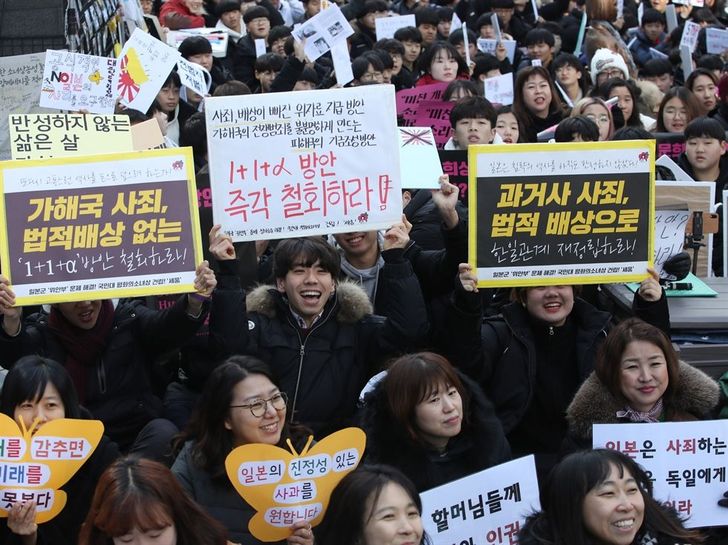
Protesters hold placards urging National Assembly Speaker Moon Hee-sang to stop submitting bills on historical forced labor issues during a weekly demonstration against Japan's wartime atrocities in Seoul, Wednesday. Yonhap