Human rights issues; Seoul's Achilles heel
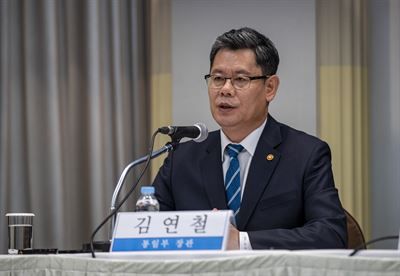
Unification Minister Kim Yeon-chul speaks during an open forum event with reporters at the Press Center in central Seoul, Monday. / Korea Times photo by Shim Hyun-chul
By Jhoo Dong-chan
South Korea's recent decision to expel two North Korean fishermen suspected of killing their fellow crewmembers is raising questions on the country's position on human rights. Human rights groups said the deported North Koreans should have been ensured a chance to contest their deportation to the North.
The reason for this is that under Article 3 of the Constitution, all laws promulgated in the South cover the entire Korean Peninsula. That means that even though the Refugee Law precludes individuals who have committed serious non-political crimes outside the country of entry from receiving refugee status, the Human Rights Law prohibits the returning of anyone to a country where they could be at substantial risk of being tortured whether they are a refugee or not.
According to the country's unification ministry, because the North Koreans confessed to being directly involved in the killings, the government decided to categorize them as a “potential threat to the lives and safety of South Korean citizens,” if accepted into South Korean society.
“Brutal criminals can't be understood and recognized as refugees under international laws,” the ministry said.
However, the government has “downplayed” the significance of its decision to expel the two as it seeks to preserve the outlook and prospects for diplomatic progress in denuclearization talks between the United States and north Korea.
The government says it has long been committed to dealing with atrocities and concerns regarding human rights issues in North Korea. President Moon Jae-in, a former human rights lawyer, has also “remained firm” on promoting human rights in the North.
The issue is a sensitive topic for North Korean leader Kim Jong-un and the administration is apparently willing to take a less provocative approach toward this amid the stalled denuclearization dialogue.
Reports said it appears the North is preparing for new missile tests at its Tongchang-ri missile launching site. The North's official KCNA said Washington had better behave with “prudence at a sensitive time.” Kim set Dec. 31 as a deadline for the U.S. to come up with a different approach to the talks, aimed at dismantling his nuclear program.
In another move apparently not to annoy Pyongyang, the government recently withdrew the South's name from a list of over 40 co-sponsors of a United Nations General Assembly resolution condemning human rights abuses in the North. The United States and its Western and Asian allies have sought for years to use the UN as an avenue to turn up the diplomatic pressure on Kim's regime by spotlighting its human rights abuses.
Recently, the foreign ministry in Seoul said it was taking active measures to bring 11 North Korean defectors to the South, but has not released any news about their whereabouts for the last couple weeks.
One of the two defectors who had a cell phone called the Korean embassy in Vietnam for help when they left China and tried to enter Vietnam, Nov. 21, but no help was provided by the government here, according to Peter Jung, a Christian pastor active in helping North Koreans escape to South Korea.
“The government must take a strong stand at some point. It can't keep appeasing Pyongyang forever,” said Goh Young-hwan, a former researcher of the Institute for National Security Strategy.