Seoul, Washington fail to reach deal in 4th SMA talks
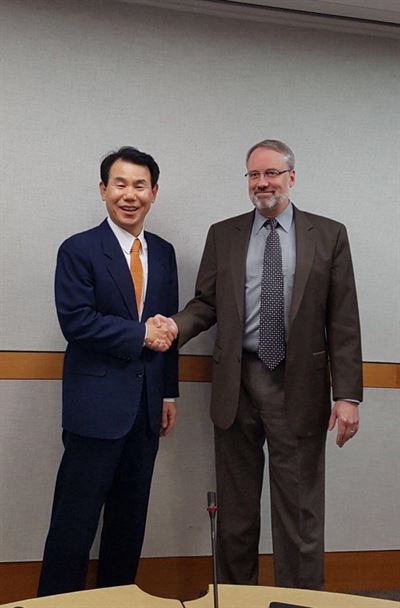
South Korea's chief negotiator Jeong Eun-bo, left, shakes hands with his U.S. counterpart James DeHart before the fourth round of Special Measures Agreement talks in Washington, D.C., Dec. 3 (EST). / Yonhap
By Jhoo Dong-chan
South Korea and the United States have failed to reach an agreement in the latest round of talks on next year's cost-sharing for the 28,500 American troops stationed here.
According to the Ministry of Foreign Affairs, Thursday, South Korea's chief negotiator Jeong Eun-bo met his American counterpart James DeHart twice in Washington, D.C., Dec. 3 and 4 (EST), but they failed to reach an agreement.
The ministry said it stressed that the basic framework of the cost-sharing pact, known as the Special Measures Agreement (SMA), should be conducted in a “fair, reasonable and mutually acceptable” manner.
“We stressed that the negotiations should be made within the SMA framework and that a fair, reasonable and mutually acceptable agreement should be reached in a way that strengthens the South Korea-U.S. alliance and the allies' defense posture,” the ministry said in a press release.
“The next round will take place in South Korea this month. A concrete schedule will be outlined soon.”
The statement indicated the two parties have yet to find a middle ground on how much of the costs Seoul should cover for the upkeep of American troops stationed here.
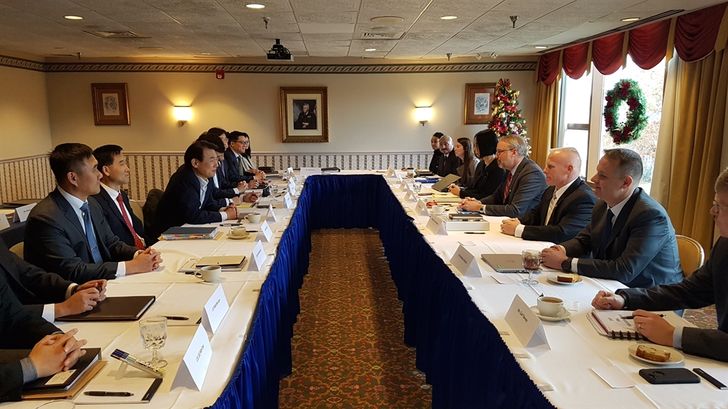
South Korean and U.S. officials discuss next year's cost-sharing for 28,500 American troops stationed in South Korea in Washington, D.C., Dec. 4 (EST). / Courtesy of Ministry of Foreign Affairs
U.S. President Donald Trump is known to have said he wants Seoul to pay 5 trillion won ($4.2 billion) next year to maintain U.S. troops here, which senior South Korean officials immediately refused to accept.
The figure is expected to cover the total expenditures related to supporting American troops' families and conducting combined military exercises as well as the deployment of U.S. strategic assets in the future.
South Korea paid 1 trillion won for 2019.
Lawmakers and civic groups said Trump's demand is unacceptable, against fair and mutually acceptable principles and undermines the 70-year-long alliance between South Korea and the United States.
Rep. Yoon Sang-hyun of the main opposition Liberty Party Korea said the 5 trillion won figure is unacceptable. He is also a chief of the National Assembly Diplomacy Committee.
“Trump's demand is a fivefold increase. It is nonsense,” he said. “This idea could also deliver the wrong message to the Korean people. I understand there are now administrative efforts among working-level officials in Washington to revise it.”
Yoon added Seoul is expected to burden around $2 billion as the cost-sharing for the U.S. troops next year, but if Trump presses ahead with his idea, Seoul should then consider nuclear armament.
“Obviously Washington won't accept [nuclear armament]. If Korea does, Taiwan and Japan will ask for the same. Washington shouldn't push too hard here,” he said.