Japan offers apology over inapropriate actions: NSO chief

Chung Eui-yong, right, chief of the presidential National Security Office (NSO), speaks with NSO first deputy director Kim Yoo-geun during a meeting of the House Steering Committee at the National Assembly, Friday. Yonhap
By Park Ji-won
Japan issued an apology over alleged “inappropriate actions” it committed after South Korea's decision to conditionally renew the General Security of Military Information (GSOMIA), presidential National Security Office (NSO) chief Chung Eui-yong told lawmakers at the National Assembly, Friday.
“Before and after the announcement of the GSOMIA extension on Nov. 22, Japan took several impropriate actions. So, the government issued a strong complaint. Later that night, Japan explained the situation and made an apology through diplomatic channels and reaffirmed the agreement remained in force,” Chung said during a meeting of the House Steering Committee.
Chung's remarks came a few days after the NSO chief strongly condemned the Japanese government for its alleged involvement in intentionally leaking the relevant information regarding the GSOMIA extension to the Japanese media. Japan's Chief Cabinet Secretary Yoshihide Suga, however, denied the claim by the NSO chief. Since then, Seoul and Tokyo have exchanged barbs over the alleged apology and Japan's export restrictions against South Korean companies.
The NSO chief also strongly criticized Rep. Na Kyung-won, floor leader of the main opposition Liberty Korea Party (LKP), for asking the United States not to hold a summit with North Korea before the South's general election in April, during her recent visit to Washington.
“I had several meetings with (former) national security adviser John Bolton and U.S. Special Representative for North Korea Stephen Biegun, but Seoul and Washington didn't reach any agreement related to domestic politics… Her proposal may have puzzled the U.S. side. I urge Na to make such remarks as nonpartisan as possible,” Chung said.
On a related note, the National Assembly Intelligence Committee said North Korea's launching of projectiles in recent weeks was mostly aimed at pressuring the United States to come up with measures that Pyongyang wants to renew their denuclearization talks before the end of this year.
“The National Intelligence Service (NIS) expects that North Korea will continue to take provocative actions to get practical measures from the U.S. before the end of the year which is a deadline that Pyongyang set for denuclearization talks,” lawmakers on the committee told reporters after being briefed by NIS members including Director Suh Hoon in a closed-door meeting Friday.
They added that the NIS said North Korea apparently “intended” to warn the U.S. and South Korea through the launches that it could return to the past if it fails to achieve its goals with Washington on nuclear disarmament.
North Korean leader Kim Jong-un has set the end of the year as a deadline for restarting denuclearization talks with the United States. Working-level dialogue between Washington and Pyongyang held in Stockholm, Sweden, was halted after the two failed to narrow their differences with regards to specific steps toward a nuclear-free North Korea and Korean Peninsula.
On Thursday afternoon, North Korea launched two short-range projectiles from appeared to be a multiple rocket launcher into the East Sea, according to the Joint Chiefs of Staff (JCS) and North Korean media. The North carried out a live-fire exercise involving coastal artillery Nov. 23, which was a violation of the inter-Korean military agreement signed Sept. 19, last year, the defense ministry said.
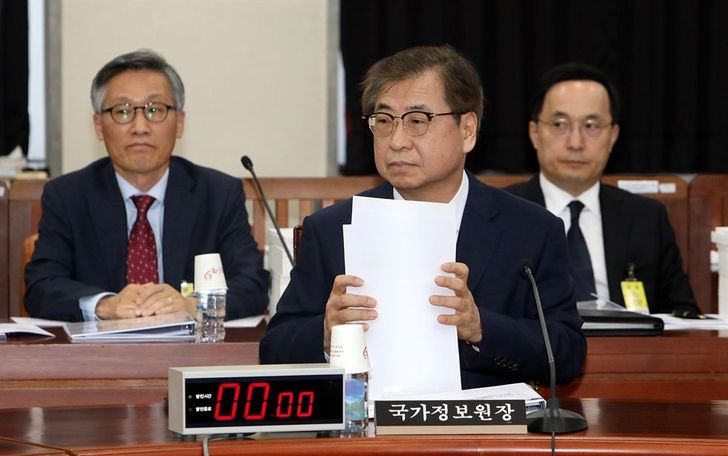
National Intelligence Service (NIS) Director Suh Hoon participates in a meeting of the National Assembly Intelligence Committee, Friday. Yonhap