Opposition leader stages hunger strike for 7th day in protest of reform bills

Liberty Korea Party chairman Hwang Kyo-ahn on his seventh day of hunger strike at his tent in front of Cheong Wa Dae, Nov. 26. Yonhap
The chief of the main opposition party continued his hunger strike for a seventh straight day Tuesday to protest key reform bills that were placed on a fast-track despite objections from the conservative party.
Liberty Korea Party (LKP) chairman Hwang Kyo-ahn began his fast Wednesday in front of the presidential office in a bid to change the policies of President Moon Jae-in.
Two of his three major demands are to revoke bills to set up a special unit to probe corruption by high-ranking government officials and to adopt a new proportional representation system as part of electoral reform.
The ruling Democratic Party (DP) and three minor parties reached a deal on details of the key political and judiciary bills in April. They designated them as fast-track bills later amid scuffles with LKP lawmakers.
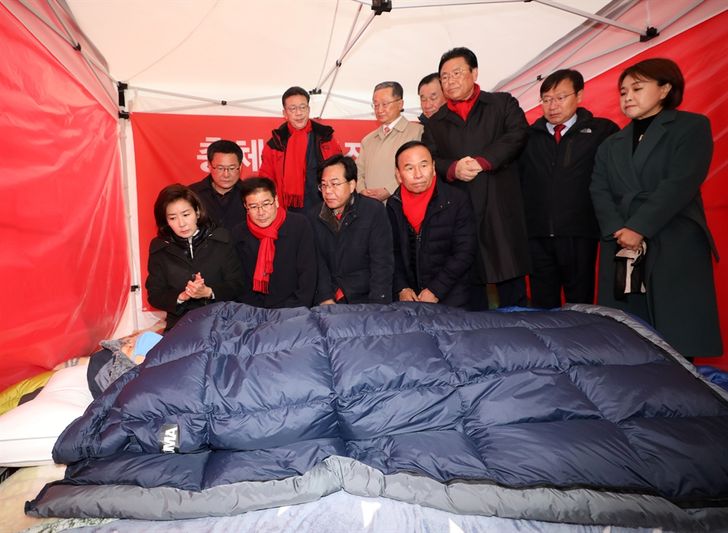
Liberty Korea Party floor leader Na Kyung-won, holding Hwang's hand, and other members of the party visited Hwang in the morning of Nov. 26. Yonhap
An election reform bill is expected to be referred to a parliamentary plenary session set for Wednesday.
The DP and others agreed to introduce a mixed-member proportional (MMP) representation system in which parliamentary seats are tied to the percentage of voters' support for parties, but it will operate in a less strict manner.
The bill will raise the number of proportional representation slots from the current 47 to 75, while keeping the total number of parliamentary seats unchanged at 300.
National Assembly Speaker Moon Hee-sang earlier announced a plan to refer the prosecution reform bill to a plenary meeting on Dec. 3.
A special probe unit, if established, will not have extensive authority for indictment, but it will be able to file charges against judges, prosecutors and high-ranking police officers over alleged corruption.
The establishment of such a unit is one of the liberal president's key election pledges, designed to keep state prosecutors in check. Disgraced former justice minister Cho Kuk was the main architect of the prosecution reform bill. (Yonhap)