LKP leader under fire for 'extreme' political performances without cause

Hwang Kyo-ahn, chairman of the main opposition Liberty Korea Party, continues his hunger strike for the fifth day in front of Cheong Wa Dae, Sunday, urging the National Assembly not to pass the fast-tracked bills on electoral and judiciary reform. Yonhap
By Park Ji-won
Hwang Kyo-ahn, chairman of the main opposition Liberty Korea Party (LKP), is under fire for taking “extreme” actions without cause to protest the government's decisions as it may simply tarnish the reputation of the conservative party.
Hwang, a former justice minister and prime minister under the former Park Geun-hye administration and leading prospective presidential candidate, continued his hunger strike for the fifth day in front of the presidential office, urging the National Assembly to scrap the fast-tracked bills on establishing an independent body that can investigate high-ranking officials and expanding the proportional representation election system.
Last year, the LKP's then floor leader Kim Sung-tae faced ridicule and even physical assault when he staged a hunger strike to call for a special investigation into opinion-rigging allegations involving a ruling party lawmaker.
Hwang is also boycotting National Assembly activities including regular meetings with leaders of rival parties and National Assembly Speaker Moon Hee-sang.
Originally, Hwang called for Cheong Wa Dae to stop the termination of the General Security of Military Information Agreement (GSOMIA) and the National Assembly to reject the fast-tracked bills. In September, he also shaved his head calling on Moon to unseat then embattled Justice Minister Cho Kuk.
The ruling and minor opposition parties went all-out to criticize Hwang's ongoing hunger strike and previous protests, saying he is not working for a great cause but trying to save his political career.
“Hwang's hunger strike is not appealing to people's hearts. Even the LKP members found it coming out of nowhere… Because it has no great cause or touching story but is his political maneuver to save his leadership in crisis,” Rep. Hong Ik-pyo, spokesman of the ruling Democratic Party of Korea (DPK), said in a commentary.
“If Hwang really wants to do something good for the country, he should faithfully rejoin the discussion on the country's reform so that Korea can go one step further.”
Calling his hunger strike a luxury and an expression of anxiety created by his leadership crisis, Kim Jung-hwa, spokeswoman of the minor opposition Bareunmirae Party said, “Please stop complaining because we have a lot to do and discuss.”
Political sources say Hwang's move is likely aimed to gain more support from conservative voters and his party before the April general election and save his lackluster leadership which faces eroding support for the party.
Recently, criticism has been growing against Hwang after some LKP senior lawmakers decided not to run in the general election, calling the party de facto “defunct” and asking for the dismantling of the party amid its support rating continuing a downward trend.
Also, given the fact that laborers, pro-democracy activists and independence fighters around the world have relied on hunger strikes against authoritarian governments, risking their lives for greater causes, political sources say his protests didn't give a plausible explanation to citizens whether he is truly cornered to risk his life for his demands, calling it a political “show.”
“He has been criticized for failing to control the party before the important race and some party members weren't satisfied with his recent announcement of an election rule as it may remove their seats, meaning that he needs to impress his people through the strike,” an LKP member said.
“In other words, if the hunger strike fails to raise support for the party, he might be urged to quit his post to take responsibility for it.”
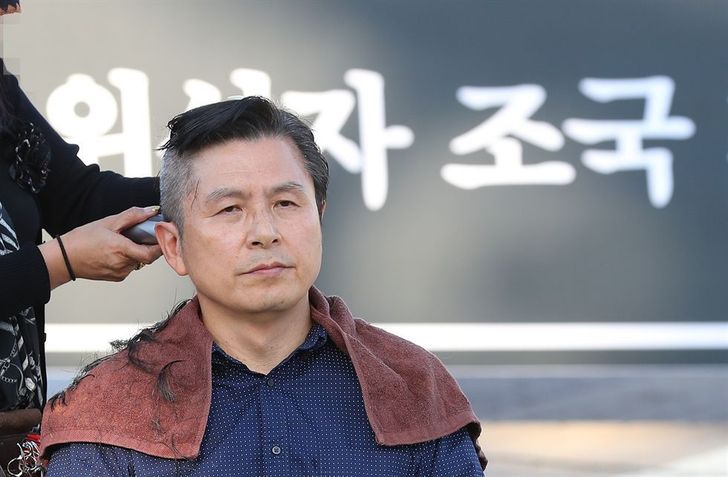
Hwang Kyo-ahn, chairman of the main opposition Liberty Korea Party, shaves his head in front of Cheong Wa Dae calling for the dismissal of Justice Minister Cho Kuk in this Sept. 16 file photo. Korea Times file