'Third US-North Korea summit to surely produce results': Moon

President Moon Jae-in gestures at the start of a nationally-televised live town hall meeting with 300 citizens aired by local broadcaster MBC from its news center in Mapo, Seoul, Tuesday. On Moon's left is Bae Chul-soo, the host of the meeting. No pre-submitted questions were used as the President took random ones, according to Cheong Wa Dae. Yonhap
By Kim Yoo-chul
If a third summit between U.S. President Donald Trump and North Korean leader Kim Jong-un takes place, then that will “surely produce results,” President Moon Jae-in said, Tuesday night.
Speaking in a nationally-televised question-and-answer session with 300 selected South Korean citizens at MBC news center in Mapo, northern Seoul, the President said efforts were already underway to make the third summit North Korea happens.
“Just as the United States and North Korea have announced publicly, I think efforts via working-level discussions are already underway for another Trump and Kim summit within this year,” Moon said; but declined to elaborate further.
He remained positive with regard to the outcomes of such a meeting. “I am sure results will be generated if the third summit between Trump and Kim actually happens,” the President said.
Kim and Trump have had two official summits since last June ― historic occasions for the leaders of the two nations engaged in a Cold War-era standoff after the 1950-1953 Korean War ended with the signing of an armistice, not a peace treaty. They also met briefly on the South's side of the Demilitarized Zone on the U.S. president's way back to Washington D.C. after participating in this year's G20 summit in Osaka, Japan. But that meeting wasn't an official summit.
The two heads of state have so far failed to reach any substantial agreement. However, as the end-of-year deadline for the denuclearization talks set by Kim approaches, Trump recently wrote on Twitter urging his North Korean counterpart to “act quickly.”
Moon said the two Koreas may see results in their stalled relations depending on progress of the nuclear disarmament negotiations.
“Compared to 2017, I can say threats of a possible war have been eliminated as the two Koreas are on track to develop ties through dialogue. But I have to admit that efforts in advancing this dialogue have seen quite tepid progress. As the current peace mood could turn back to the past, we have to keep the momentum for dialogue alive,” he added.
“It's a long process to end hostility and confrontation that have continued for over the last 70 years via dialogue and diplomacy. We have no option but to embrace these challenges. I want the public to understand that aspect.”
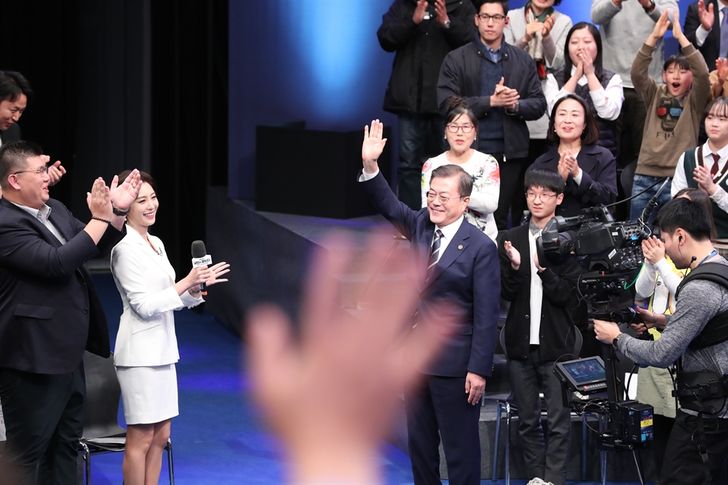
President Moon Jae-in enters the MBC studio to meet 300 citizens for a town hall meeting on Tuesday. Yonhap
As to resuming tours to Mount Geumgang ― and possible compensation for South Koreans that invested in the tourism project ― and operation of the Gaeseong Industrial Complex, the two symbolic inter-Korean economic projects, President Moon said his administration will try to get sanctions relief from the United Nations Security Council (UNSC) in order to restart them.
“The two Koreas have completed joint surveys for linking their railways and roads. We are ready to initiate these, however, because the necessary parts and equipment should be taken into North Korea, we have to get sanctions exemptions from the UNSC. That will be dependent upon the success of the denuclearization talks between the United States and North Korea. We can figure it out and we are working on it,” Moon said.
The President noted that his administration would do its “utmost” to avoid the termination of the General Security of Military Information Agreement (GSOMIA), a military intelligence sharing pact with Japan, saying maintaining the Seoul-Washington-Japan security alliance was “very important” for national security.
“But it's up to Japan. When Japan announced its decision to implement export controls on industrial materials crucial to our country's manufacturing industry, Tokyo said it was because of its distrust of South Korea. Japan said it didn't trust South Korea and yet it wants to share military information. I think that's very ironic,” Moon said, adding the ending of the GSOMIA was a reasonable countermeasure by Seoul.
Regardless of the fate of the GSOMIA, Moon said: “We will continue cooperating with Japan on the security front. If Japan doesn't want to see the official expiration of GSOMIA, then it should talk with South Korea in addressing the export discriminatory measures.”
Regarding his drive to reform the prosecution, the President said he was sorry about the recent fiasco surrounding former Justice Minister Cho Kuk. Moon belatedly accepted the resignation of Cho who along with his family was being investigated for corruption, something that sparked huge protests.
“As the President, I again offer my public apology for causing social polarization and a public divide regarding issues relating to the former justice minister. But the issue did help the public get a chance to debate the need for the prosecutorial reform,” Moon said.
“I was expecting the close collaboration between former minister Cho and Prosecutor-General Yoon Seok-yeol to move my initiatives for reform of the prosecution forward. But that didn't happen.”
However, Moon stressed he will “never stop” exploring prosecutorial reform.
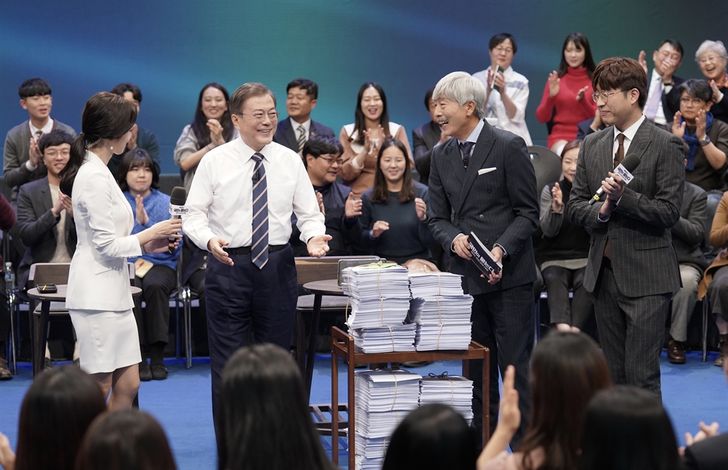
At the end of the town hall meeting, President Moon Jae-in is shown stacks of papers containing questions from citizens which he couldn't answer due to the meeting's limited time. Yonhap
On the issue of the soaring property market, the President said his administration will apply “every possible measure” to curb soaring housing prices.
The government has already imposed restrictions in “overheated speculative zones” ― people owing two homes for investment purposes are required to pay an addition capital gains tax upon the sale of a property.
“I am confident that my administration will address that issue as we have lots of plans. If upcoming policies don't work, then we will apply much stronger measures. But the government will review plans to help the public who want to purchase a home to actually live in, not for speculation. One plan is to ease the regulations on loans,” he said, adding the government is investigating speculative zones with high-priced apartments in the capital and metropolitan areas.
According to the President, the previous government's property policies were used to boost the local economy.
“That's because the property sector had the potential in terms of creating jobs and boosting the local economy. But one thing that is clear is that my administration won't use the real estate market as a policy tool to boost the local economy. If South Korea again has difficulties in economic growth, we will not use the property market as a policy tool,” Moon said.
With regard to changing the country's mandatory military service, Moon dropped hints at reviewing alternatives, specifically a “mid- to long-term plan.” He said the government would possibly apply greater flexibility for people from ethnic minorities.
“South Korea has to embrace ethnic minorities as members of society. They have become very important members of society and that means we have to treat them equally without discrimination. For military service, the key point is we have provide them with the right conditions as different ethnic groups have different needs,” Moon said.