Moon to face tough questions on economy, diplomacy

President Moon Jae-in talks on the phone on Jan. 1. Courtesy of Cheong Wa Dae
'Town hall' meeting may let people down without convincing answers
By Do Je-hae
President Moon Jae-in's upcoming appearance on a live televised question and answer session is generating a lot of public interest amid the wide range of challenges he is facing in the latter half of his presidency.
Cheong Wa Dae has underlined that the MBC program, which will start at 8:00 p.m. Tuesday, is different from previous media events in that there has been no scenario prepared. The audience will consist of 300 applicants who registered on the MBC website. The moderator is Bae Cheol-soo, who is a well-known radio program host and singer. This will be the first time for Moon to appear on public television to directly answer questions about his management of state affairs since a one-on-one interview on KBS, May 9.
“We have no idea what the questions are,” presidential spokeswoman Ko Min-jung said in a radio program last week. “But we have faith that he will do well. The President has the most knowledge about the core issues that the people are concerned about.”
One of the biggest issues the Q&A session is expected to cover surround his embattled aide Cho Kuk, who resigned as justice minister last month and is currently undergoing investigation over allegations of corruption. The Cho scandal has raised serious questions in regards to the integrity of the Moon administration as well as his push for prosecutorial reform, in addition to triggering huge protests both for and against the administration. There is also much public interest in an upcoming reshuffle to replace the justice minister and other key posts.
Moon will also face tough questions regarding his drive for “justice” and his economic policies, such as income-led growth.
Another big issue will be Korea's response to the ongoing row with Japan, and whether there will be any last-minute change to Cheong Wa Dae's decision to end the General Security of Military Information Agreement (GSOMIA) which expires at the end of the week. Seoul has faced increasing pressure from Washington to reconsider the decision. “If we reverse the GSOMIA decision when there is no change in Korea-Japan relations, it would mean that our initial decision was not prudent. That is not the case. The decision was made carefully,” Ko said.
Rebuilding Moon's image
Cheong Wa Dae is eyeing the upcoming session as an impetus to improve his image and raise public support for the President who has suffered a serious blow to his job approval rating in light of his weak performance in key areas of state affairs, in particular those concerning the economy and diplomacy.
With the rare Q&A session, Cheong Wa Dae is also hoping to revive Moon's image as an effective communicator. Moon's easy-going demeanor in public and openness toward the media were some of the qualities that contributed to his sweeping popularity at the beginning of his presidency. Right after taking office in May 2017, he appeared at a press conference at Cheong Wa Dae to announce the key nominations for his Cabinet, which was considered very rare, particularly in comparison to his impeached predecessor Park Geun-hye who was often criticized for shunning the media. At the beginning of Moon's presidency, his job approval rating had hovered over the 70 percent range, largely owing to his penchant for active communication with the public.
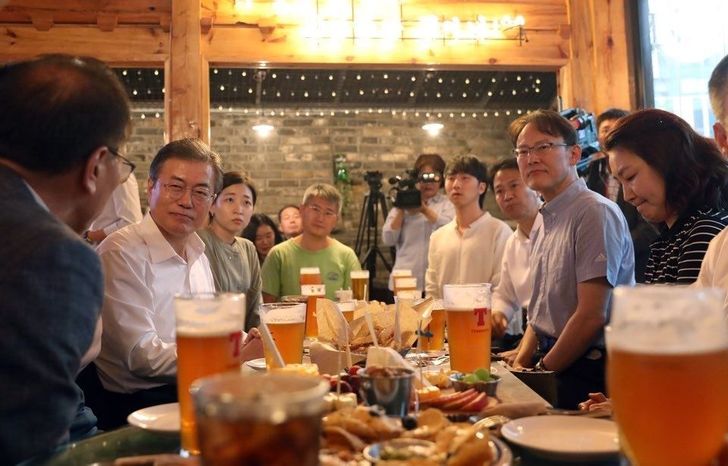
Moon's 'hof' talk in July 2018 Courtesy of Cheong Wa Dae
One of the events that showed his commitment to getting in touch with the people was a gathering at a pub in Gwanghwamun, central Seoul, to listen to concerns of people from various walks of life over beer in July, 2018. The participants included a female jobseeker who had to quit her job after giving birth, local office workers and owners of small businesses such as convenience stores and restaurants.
During the event, Moon asked the small business owners about their perception of the increase in the minimum wage and the shorter working hours, which have been increasingly criticized for going against their original intent to raise the quality of life of workers. But the opposition has slammed the “lack of sincerity” of such events and has brushed them off as merely as “show.”
Moon began the second half of his presidency Nov. 10 with a joint conference from his three top aides ― chief of staff Noh Young-min, chief of the National Security Office (NSO) Chung Eui-yong, and policy chief Kim Sang-jo. On the same day, Moon also held a private dinner at his residence with the leaders of major parties, responding to growing public calls for “cooperative politics” to fight grave challenges facing the nation. During the dinner, Moon reportedly requested main opposition Liberty Korea Party Chairman Hwang Kyo-ahn to send material on the party's policy suggestions for the economy and peace diplomacy to Cheong Wa Dae.