ANNIVERSARY Head of Korea-Japan lawmakers union stresses dialogue

Rep. Kang Chang-il of the ruling Democratic Party of Korea and head of the Korea-Japan Parliamentarians' Union speaks during an interview with The Korea Times at his office at the National Assembly, Tuesday. Korea Times photo by Shim Hyun-chul
By Park Ji-won
The National Assembly's role in facilitating dialogue between Korea and Japan has gained special importance amid the two countries' continued rigid positions regarding a Korean Supreme Court ruling on forced labor. This is at the root of a prolonged conflict that has spilled over into other key areas for bilateral cooperation, such as trade and security. Rep. Kang Chang-il of the ruling Democratic Party of Korea (DPK) has been at the forefront of the Assembly's mediation efforts.
The head of the Korea-Japan Parliamentarians' Union (KJPU) traveled to Japan at the start of the bilateral trade row in August following trade restrictions Tokyo imposed on the export of certain materials to South Korean companies. Kang recently returned from a three-day trip to Japan, Nov.2, with a Korean delegation after taking part in the 42nd joint congress of the KJPU and the Japan-Korea Parliamentarians' Association. During the congress, lawmakers of the neighboring countries shared their views on key points of contention, including the 2018 Supreme Court ruling ordering Japanese companies to compensate Korean victims of forced wartime labor, and Seoul's decision to end a pact sharing sensitive military intelligence signed in 2016 at the initiative of the U.S.
National Assembly Speaker Moon Hee-sang is in Japan this week to take part in a meeting of Assembly leaders of G20 countries in Tokyo starting Sunday.
The consecutive visits by key members of the Assembly comes on the heels of Prime Minister Lee Nak-yon's visit to Japan last month to attend the coronation of new Japanese Emperor Naruhito. Prime Minister Shinzo Abe has refused to meet with President Moon Jae-in until Korea brings a “solution” to the forced labor ruling that Japan can accept. Abe's position remains unchanged even after Moon sent a letter to him via the prime minister to convey his wishes for a meeting in the near future. Japanese media have reported that Abe will not meet Moon this month.
Significance of PM's visit
Abe's reaction has triggered a negative assessment about Lee's visit to Tokyo and meeting with Abe, the highest-level bilateral meeting since the forced labor ruling in October 2018. But Rep. Kang stressed that Lee provided a crucial impetus for reviving Korea-Japan dialogue during an interview with The Korea Times at his office, Tuesday. “Prime Minister Lee's attendance at the coronation in itself can be seen as the start of talks,” Kang said. “It is also significant that the prime minister was able to meet and talk with Abe. The biggest outcome of Lee's visit is that it provided an occasion to reaffirm that diplomatic channels are operating. It can be the start of the process for finding a resolution.”
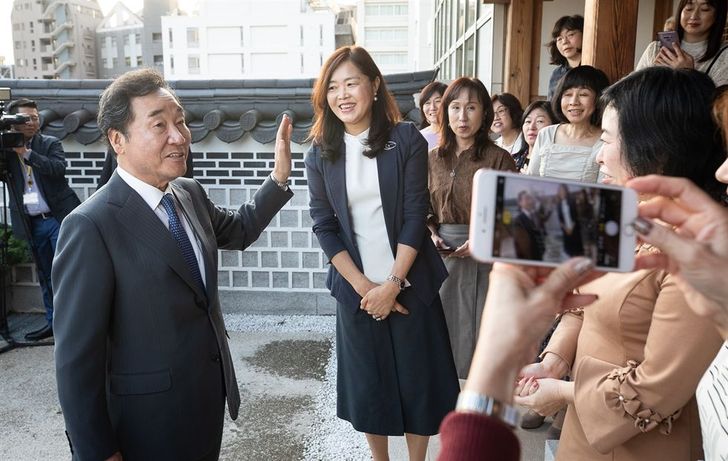
Prime Minister Lee Nak-yon during his Oct. 23 visit to Japan Yonhap
The four-term lawmaker also urged the role of the business sectors of the two countries. “After Lee's visit, businessmen in Korea and Japan are taking strong actions, and urging their respective governments to improve ties as the strained relations have had a bad impact on them.”
A year after the ruling, the two countries remain polls apart on the Japanese firms' liability in compensating the victims during Japan's 1910-1945 colonial rule of the Korea Peninsula. “There is a huge gap in both countries' positions, so we must put our wisdom together. In Korea, there is the need to respect the Supreme Court ruling. But Japan's position is the 1965 Korea-Japan Normalization Treaty took care of all compensations issues and it cannot tolerate any damage to Japanese firms. There is a fundamental difference in the two countries' positions. But it is the responsibility of politics to seek a resolution despite the differences. Various solutions for a compromise are possible if the two countries place a priority on normalizing relations.”
In response to Korea's top court ruling in October last year, the Japanese government removed Korea from its whitelist of countries receiving preferential trade procedures; while the government decided not to extend the military intelligence sharing pact, the General Security of Military Information Agreement (GSOMIA). Many Korean citizens continue to boycott Japanese products and trips to Japan. The boycott has had a negative impact on sales of Japanese products including beer, consumer goods and cars.
Narrowing differences
To minimize further damage to bilateral relations, the most urgent task for the two governments is to narrow their differences on the court's ruling. Japan has refused to accept Korea's proposal in June for a plan whereby Japanese and Korean firms jointly provide funds to compensate the victims. “Japan's basic position is that Japanese firms should not take part in any compensation. But it will not be able to stop firms from participating voluntarily,” Kang said.
Japanese media recently reported a proposal for the creation of an “economic cooperation fund” by the Korean government and companies and Japanese companies for the surviving victims and their families. On the other hand, some local experts have raised the possibility of compensation through public fundraising. “Some Koreans say that Korea should stop requesting reparations and compensate the victims through public fundraising. This could be seen as giving Korea an ethical edge over Japan,” Kang said.
Kang proposed that the government should consider some variation of its original proposal, which Japan sees as unacceptable under its interpretation of the 1965 treaty. “The government could first provide compensation to the victims and then claim the amount from the Japanese firms later,” the lawmaker said. He also urged the National Assembly to swiftly pass related bills on supporting the victims.
Boosting ties through Olympics
Some Koreans have raised the possibility of a boycott of the 2020 Tokyo Olympics, but Kang underlined the need use it to promote people-to-people exchanges. After the cancellation of the APEC summit where Moon was hoping to meet Abe, Seoul is eyeing the Olympics as an occasion to possibly bring the two leaders together.
In a move to improve ties, Kang said the KJPU and its Japanese counterpart discussed the establishment of a special committee for the support of 2020 Tokyo Olympics which aims to boost tourism in Tokyo. “The unions will form an advisory group from various sectors in society ranging from economics to civic groups and sports for the Olympics special committee. Because the Olympics is a festival to boost peace in the world, we can urge Koreans to go to the international sports event and travel to local cities in Japan.”
During the congress, Kang encouraged Japanese lawmakers to improve the strained relations. “There is a certain consensus between members of the parliamentarian unions of Korea and Japan that the strained relations should be improved. It is important to have the determination for better relations despite differences between the two,” Kang said. “At a grave period in bilateral relations, there were a lot of topics for discussions, such as the GSOMIA and the whitelist issue. The parliamentarians also shared views on how to improve cooperation ahead of the 2020 Tokyo Summer Olympics and improving the rights of Koreans residing in Japan, in addition to the forced labor issue and repatriating the remains of those who died in Japan during the colonial period.”
Kang earned a Ph.D. in from Tokyo University and lectured at Pai Chai University. He was first elected as a lawmaker in 2004.