Anniversary 'Korea will set diplomatic milestone in summit with ASEAN'

Foreign Minister Kang Kyung-wha speaks at the ministry's headquarters in downtown Seoul, Wednesday. Courtesy of Ministry of Foreign Affairs
By Lee Min-hyung

At a time of growing geopolitical uncertainty amid a global economic downturn, Southeast Asia is emerging as a new hub for growth with its massive trading and demographic potential.
South Korea also hopes to latch on to this by solidifying partnerships with countries in the region, in a more sustainable manner, to tackle its sluggish economy.
On the political front, Seoul's alliance with the Southeast Asian nations is crucial at a time when it needs to win more international support to achieve the denuclearization of the Korean Peninsula.
The upcoming summit between South Korea and the ten member states of the Association of Southeast Asian Nations (ASEAN) will be a “historic milestone” for both sides to draw a blueprint for an unwavering political and economic alliance, Foreign Minister Kang Kyung-wha told The Korea Times in an interview marking the publication's 69th anniversary.
Under the theme, “Advancing Partnership for Sustainability,” the ASEAN-Republic of Korea (ROK) Commemorative Summit will take place for two days from Nov. 25 in the southern port city of Busan.
“The 2019 ASEAN-ROK Commemorative Summit is being shaped as a pivotal moment to take our partnership with ASEAN and its member states to a whole new level,” Kang said, adding the number of people traveling between ASEAN and Korea reached an all-time high in 2018, surpassing 11 million for the first time. “ASEAN is Korea's second-largest trading partner in the world, with two-way trade volume having reached a record high of $160 billion (185 trillion won) last year.”
She also underlined the importance of the role of ASEAN in Korea's push for peace on the divided peninsula.
“ASEAN is a steadfast partner of Korea in our pursuit of peace and security, with its unwavering support for and constructive role in our efforts to achieve complete denuclearization and permanent peace on the Korean Peninsula,” Kang noted.
“The summit will be an opportunity to reaffirm the solid support of ASEAN for the peace process on the peninsula.”
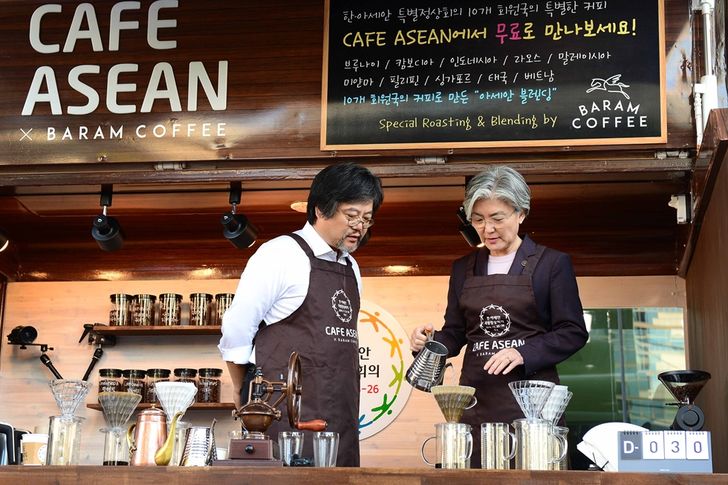
Foreign Minister Kang Kyung-wha, right, brews coffee at a coffee stand set up in a truck, as part of a promotional event for the upcoming ASEAN-Korea Commemorative Summit which will take place for two days from Nov. 25 in the southern port city of Busan. Courtesy of Ministry of Foreign Affairs
The upcoming summit will also serve as a critical event to back up President Moon Jae-in's signature New Southern Policy.
The initiative is top of the President's diplomatic agenda. Under the policy, South Korea aims to raise and diversify its diplomatic links with ASEAN states to a similar level as that of the so-called big four powers surrounding the peninsula ― the United States, China, Japan and Russia.
“We will boost people-to-people and cultural exchanges in line with the vision of the New Southern Policy, that is, to create a people-centered community of peace and prosperity.”
Kang went on to express her anticipation for the upcoming summit, and pledged to generate “tangible and substantial” achievements during the event.
“It will be the biggest diplomatic event to be hosted by the South Korean government under the Moon Jae-in administration,” she said.
“It will be an excellent occasion to take stock of the accomplishments of the partnership over the past three decades and draw a blueprint to make it stronger for the next thirty years.”
“Concrete measures are being spelled out to strengthen economic ties with ASEAN, in particular in trade, investment and connectivity, and micro-, small- and medium-enterprises (MSMEs) and startups,” she said. “We are also seeking cooperation in addressing the challenges of the Fourth Industrial Revolution, utilizing Korea's rich experience in socio-economic development and technological expertise.”
Invisible breakthrough in Seoul, Tokyo feud
During the interview, she reiterated the government's firm position on the ongoing history dispute with Japan.
“The South Korean Supreme Court ruling did not rescind or break the 1965 claims agreement with Japan,” Kang said. “It only clarified the scope of its application in accordance with the general rules regarding treaty interpretation under international law.”
“Indeed, compensation for unlawful acts against humanity under Japanese colonial rule were not reflected in the 1965 agreement, as throughout the many years of negotiations leading up to it, Japan had refused to accept any responsibility for the illegal colonial rule. The Korean Supreme Court decision simply reaffirmed this.”
Last year, the Supreme Court here ruled Japanese firms should compensate surviving South Korean victims forced to work for them during wartime. This drew a fierce backlash from Tokyo which argued the issue was settled in 1965 when both sides signed a treaty to normalize diplomatic relations.
In apparent retaliation against the court ruling, Tokyo imposed a series of trade restrictions on South Korean companies, and which eventually included removing Seoul from its whitelist of countries receiving trade benefits.
The government took corresponding steps against Japan by deciding to stop extending their bilateral military intelligence-sharing pact ― the General Security of Military Information Agreement (GSOMIA).
“Japan's unilateral and retaliatory trade restrictive-measures, citing a lack of trust in Korea, triggered a re-evaluation on our part and compelled our decision not to renew the GSOMIA with Japan, which requires a far higher level of trust,” she said.
It appears unlikely that Seoul and Tokyo will come to terms over the issue in the near future due to a wide discrepancy in their views.
But despite the obstacle, Kang stressed that the two neighboring countries were continuing to seek a breakthrough in the dispute.
“The South Korean government is fully committed to building a future-oriented relationship with Japan, while managing issues of the past,” she said. “Overcoming history takes time and cannot be settled all at once. The government is proceeding with prudence and care in managing and developing the bilateral relationship.”
'Beauty of patience'
Regarding the North Korea nuclear issue, the foreign ministry head called for the need to “wait patiently.”
“Overcoming 70 years of hostility and achieving complete denuclearization is by no means an easy task,” she said. “It requires time, effort and patience to make substantial progress. And as President Moon has stated repeatedly, the only way to get there is through dialogue and communication among the two Koreas and the U.S.”
Until last year, the outlook for the talks looked rosy, with leaders of the two Koreas holding three summits and discussing peace on the peninsula in an upbeat atmosphere. South Korea also played an active role as a mediator for talks between the U.S. and the North.
The positive mood for nuclear negotiations between Washington and Pyongyang appeared to have been revived earlier last month when both sides ended a months-long stalemate and held working-level talks in the Swedish capital of Stockholm. But these didn't produce any visible agreement as the two sides failed to narrow their stark differences over comprehensive steps the North should present on its denuclearization and the level of sanctions relief it would receive.
“The working-level negotiations between the U.S. and the North in Stockholm in early October did not produce an agreement, but it was still meaningful in that it involved extensive exchanges of views and positions between the two sides, for the first time since the Hanoi summit in February,” Kang said.
“Things may look to have stalled at the moment, but when we take a step back and look at the situation on the Korean Peninsula in a larger timeframe, we can say for sure that the U.S.-North Korea dialogue has brought about a much improved situation, from Singapore to Hanoi to Panmunjeom and recently to Stockholm,” she said.
Ever since the collapse of the Hanoi summit, the North has stepped up its provocative rhetoric against the South and the U.S. But the foreign minister said the government will never change its stance on “peace talks” with the North.
“We see that the chronicle of inter-Korean relations does not form a straight line, but is filled with twists and turns,” she said. “My government's commitment to peaceful dialogue with the North is unwavering and persevering, firmly grounded in the solid ROK-US combined defense posture. Without being easily swayed by the momentary ups and downs, we are staying the course in close coordination with the U.S.”