Anniversary GSOMIA decision leads to questions about alliance

Kim Hyun-chong, second deputy director of the presidential National Security Office (NSO), explains Korea's case for deciding to terminate the General Security of Military Information Agreement (GSOMIA) during a press conference at Cheong Wa Dae on Aug. 23. Yonhap
Dartmouth professor stresses US role in facilitating Korea-Japan dialogue
By Do Je-hae
Since the start of the Korea-Japan trade row in July, the U.S. has maintained a low-key stance in the conflict. But with the official conclusion of the military-intelligence sharing pact between Korea and Japan fast approaching, Washington is taking a more active approach in urging Seoul to reconsider its decision not to renew the General Security of Military Information Agreement (GSOMIA).
When Cheong Wa Dae announced the decision in August, Kim Hyun-chong, second deputy director of the presidential National Security Office (NSO) and the President's key man on dealing with the Korea-Japan row, underlined that the GSOMIA termination was decided for the sake of “national interest” and that the decision would contribute to strengthening the Korea-U.S. alliance in the long run.
But some U.S. experts have been showing concern regarding such views. During a Korea Times anniversary interview, Dartmouth College professor Jennifer Lind said the “shocking decision” makes South Korea appear to be “allowing domestic politics to triumph over important national security interests.”

Prof. Lind, associate professor in the Department of Government at Dartmouth College Courtesy of Jennifer Lind
Despite Prime Minister Lee Nak-yon's meeting with Prime Minister Shinzo Abe during Naruhito's coronation, the two sides have yet to be able to find a breakthrough in mending ties which have been severely hampered over their differences regarding a local ruling on colonial past. Lind also underlined U.S. role in facilitating dialogue between its two biggest allies in the region during these difficult times in bilateral relations.
The following are edited questions and answers from a written interview with Prof. Lind, associate professor in the Department of Government at Dartmouth College.
Q) How do you assess Seoul's response to the ongoing conflict with Japan over history, trade and security?
A) As someone with deep affection for and close ties with both countries, and someone from the U.S. (which has long sought to encourage a stronger trilateral relationship), I see the recent Japan-South Korea crisis as very unfortunate. The Korean judiciary has upheld a decision that goes against Korean treaty law, and has ruled to seize the private assets of a close trading partner and investor. These judicial decisions have potentially alarming implications not only for bilateral relations with Japan, but for South Korea's economic partners more broadly. And by linking this issue to intelligence-sharing, the Moon government has also moved this beyond an economic problem to a security one as well.
Q) Do you think the U.S. has reason to worry about the trilateral security cooperation following Seoul's GSOMIA decision?
A) The U.S. has a long relationship with South Korea; we are close allies with a lot of history, who respect and value each other a great deal. So I know American leaders take a very broad view of the alliance, rather than focus on one policy such as the GSOMIA decision. That said, however, this policy shocked many people ― in the American view, the government of South Korea appears to be allowing domestic politics to triumph over important national security interests. The fact that the South Korean people, or their government, apparently don't regard these as important interests sends a pretty striking signal: that is, maybe our interests aren't as shared as we had thought. If our interests are starting to diverge, this leads to questions about the future of our alliance.
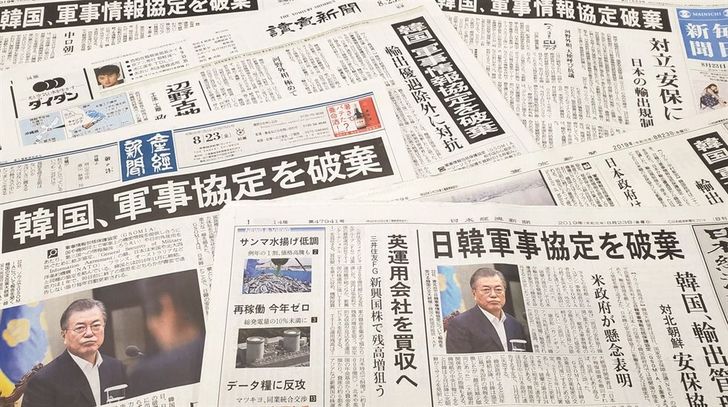
Major newspapers in Japan are seen highlighting Korea's decision to end GSOMIA on their front pages on Aug. 23. Yonhap
Q) What do you think is primarily needed to improve Korea-Japan ties?
A) The future of historical reconciliation depends to some extent on the regional security environment (namely, how much the two countries believe they need to cooperate with one another, and thus are willing to compromise on history issues). It also depends on domestic politics. Japanese conservatives tend to be less willing to encourage a national reckoning about Japanese atrocities on the Korean Peninsula. And Korean liberals seem to be less willing than conservatives to adopt a more forward-looking, pragmatic approach toward Japan. American foreign policy elites frequently assert that the U.S. should be playing a helping role in historical reconciliation. I'm not sure what the U.S. can do, but it's my hope that the U.S. can facilitate dialogue, and be willing to help in ways that the two countries would appreciate.
Q) How do you assess the two summits between President Trump and Kim Jong-un?
A) President Trump not only wants denuclearization for security reasons (for the United States and for the region) but also because he has strong convictions about the lack of imagination or leadership skills by previous U.S. presidents, and his own ability to “get things done.” Indeed, he campaigned on this platform. Therefore Trump feels a strong personal as well as strategic desire to bring peace to the Korean Peninsula ― an important part of which would be denuclearization.
Q) Do you think it will be possible to achieve some tangible results in the U.S-North Korea talks during the Trump administration and beyond?
A) Theoretically, the administration could seek to move beyond the grand goal of denuclearization and move toward more modest arms control measures. But an administration as embattled and distracted as this one will probably find it hard to focus on the Korean Peninsula. Trump has a domestic political fight on his hands with impeachment, and the Syria-Turkey situation has commanded a lot of attention lately. Trump is also in the middle of a consequential trade war with China ― so given all this, it's hard to imagine he'll be able to devote the energy and care to making progress on the issue of North Korean nuclear weapons.
Q) What is Kim primarily looking to achieve through the talks with the U.S.?
A) It's impossible to say what Kim is thinking or hoping for, but in general he's looking for respect and recognition for his regime, and he's trying to buy time as his scientists and engineers try to move the country toward a survivable second-strike nuclear capability against the United States. The Trump administration is giving him both.
Who is Jennifer Lind?
Jennifer Lind is associate professor in the Department of Government at Dartmouth College. She is also a Faculty Associate at the Reischauer Institute for Japanese Studies at Harvard University, and a Research Associate at Chatham House, London. She is the author of the book “Sorry States: Apologies in International Politics (Cornell 2008),” and of several articles in international security journals. She often writes for the wider public in Foreign Affairs and the National Interest, and can be found on Twitter at @profLind.