Lee becomes Korea's longest-serving PM in 30 years
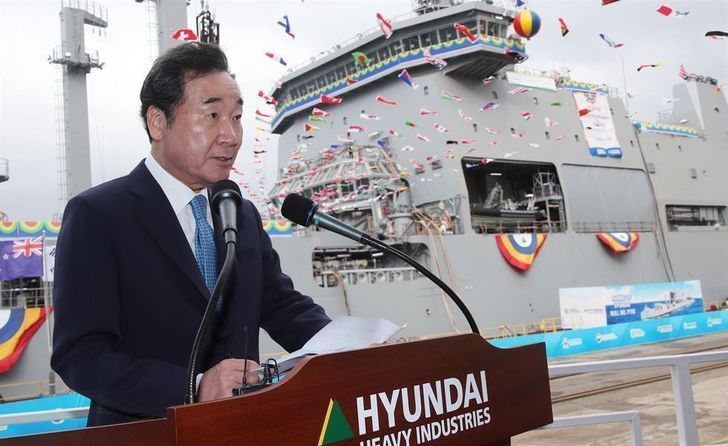
Prime Minister Lee Nak-yon delivers a congratulatory speech at the naming ceremony of New Zealand's brand new auxiliary vessel HMNZS “Aotearoa,” which is the indigenous Maori name of the country, held at Hyundai Heavy Industries shipyard in Ulsan, Oct. 25, attended by officials from South Korea and New Zealand. Yonhap
By Jung Da-min
Prime Minister Lee Nak-yon has become the longest-serving prime minister of South Korea's since 1988, Monday.
This marked the 881st day of his term, after he took office on May 31, 2017, surpassing Kim Hwang-sik, who served as prime minister between 2010 and 2013 during the Lee Myung-bak administration.
“The honor is more than I deserve,” Lee said on the way to his office. “Some economic figures have improved but there are still people suffering economic difficulties. … The Moon Jae-in administration will make efforts to come closer to those in need, those in the lower class.”
One thing being closely watched is whether Lee will run for a National Assembly seat in the April general election on the ruling Democratic Party of Korea's (DPK) ticket. If he does he will have to quit his post mid-January and rejoin the party by February as the Public Official Election Act mandates government officials must leave government positions if they want to participate in an election.
Lee is considered a potential leading presidential candidate among ruling party hopefuls, according to recent polls.
Before becoming prime minister, Lee served four terms as a lawmaker from 2000 to 2014, and was then elected governor of South Jeolla Province.
Most recently Lee has been seeking to find “common ground” with Japan to resolve a trade and diplomatic feud between Seoul and Tokyo. As a correspondent in Tokyo with the Dong-a Ilbo daily newspaper before entering politics, Lee made extensive ties there. He recently met with Japanese Prime Minister Shinzo Abe and other senior politicians during a trip to Tokyo for the coronation of Japan's emperor.
“My future course is not a matter that I can deal with by myself,” Lee said, adding he will make future steps in accordance with the directions of the party and the government.