Kim Jong-un is flexible, resolute: Moon

In this April 27, 2018, file photo, North Korean leader Kim Jong-un, left, and President Moon Jae-in raise their hands after signing on a joint statement at the border village of Panmunjeom in the South Korean side of the Demilitarized Zone. AP-Yonhap
'Kim didn't ask for USFK pullout during denuke talks'
By Kim Yoo-chul
President Moon Jae-in has expressed hope that Chinese President Xi Jinping's recent summit with North Korean leader Kim Jong-un in Pyongyang will be a “turning point” in the suspended denuclearization dialogue between the United States and North Korea.
In a joint written interview with six news agencies, Moon said South Korea and China “frequently consult” with each other on ways to achieve complete denuclearization and permanent peace on the Korean Peninsula.
“As China fully understands my administration's approach to the Korean Peninsula peace process, we closely cooperate,” Moon said. “I will hear about the results of President Xi's visit to North Korea during my meeting with him.”
The President said he appreciated Kim's efforts to expand the scope of his contacts with the international community. “North Korea becoming a part of the international community is part of the process of establishing peace,” Moon said.
Moon said the international community is “prepared to lift economic sanctions” on the North, but only if substantive progress is made in denuclearization talks.
Describing the North Korean leader as “quite a flexible yet resolute person,” Moon said he believes in Kim's commitment to finalizing the nuclear disarmament process “as soon as possible so as to focus on economic development.”
“The resumption of operations at the Gaeseong Industrial Complex and other joint inter-Korean projects will be moved forward with according to the level of progress in nuclear negotiations between the United States and the North. If substantive progress is made, the international community could agree to a partial or gradual easing of U.N Security Council sanctions,” Moon said.
Moon stressed he will continue to promote mutual trust between U.S. President Donald Trump and Kim, as well as between the North Korean leader and other heads of state.
“Not only myself but also other leaders who have met the North Korean leader in person, including Chinese President Xi and Russian President Vladimir Putin, all speak of their trust in Kim's promise. Trust can be said to constitute a precondition for dialogue. The key is trust. In particular, North Korea must trust the promise of the international community to ensure its security, and a bright future, provided that it abandons its nuclear program. Trust, of course, must be reciprocal,” he said.
“If the denuclearization negotiations resume in earnest going forward, the key will be to determine what kind of measures the North will have to complete to say that substantive denuclearization has been achieved ― in other words, to regard the North as having entered an irreversible stage. It will be linked to the definition of denuclearization being clarified, upon which an agreement was not reached at the Hanoi summit.”
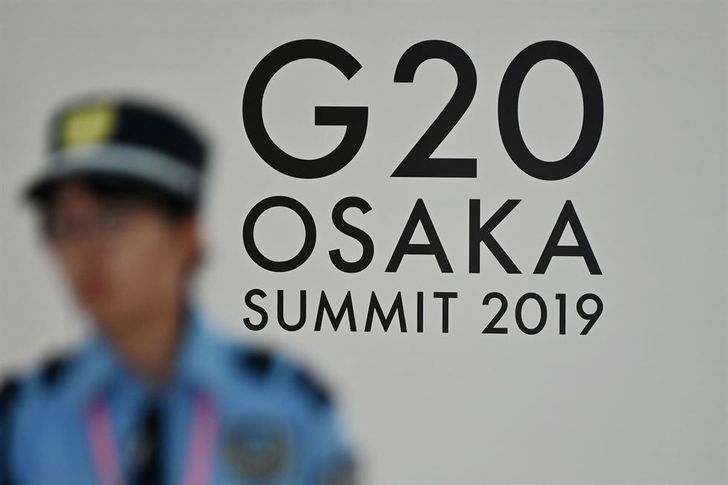
A member of security team is pictured June 26 at the venue for the G20 Osaka Summit, ahead of its start later this week. AFP-Yonhap
Moon said Kim has “never linked denuclearization” with the military alliance between the United States and South Korea or a pullout of the United States Forces Korea from the peninsula.
'
Seoul can help Tokyo normalize ties with Pyongyang'
By reiterating the importance of bilateral ties between South Korea and Japan, Moon urged Tokyo not to use “historic issues” for “domestic political gain.”
“Recently, Seoul came up with a viable solution to the issue of forced labor during World War II and conveyed it to the Japanese government. As the government of a democratic nation, we respected a verdict rendered by the Supreme Court in the process of formulating the proposal, and compiled the opinion of various groups within society that have maintained a longstanding interest in the forced labor issue, including requests from the victims. This is a measure that will help foster reconciliation between the stakeholders and move Korea-Japan relations one step forward,” Moon said.
According to the President, history issues stem from the two countries “unfortunate history.” Moon said wounds from the past are “surfacing anew as international norms develop and awareness of human rights is enhanced.” From that perspective, Japan should accept that the victims are still suffering pain.
The government is considering asking the International Court of Justice to rule on the matter of compensation for South Korean victims of forced wartime labor, and has asked victims' lawyers to postpone requesting the seizure of Japanese companies' assets here.
“The door is always open for dialogue between our two leaders in order to advance Korea-Japan relations, including the issue of forced laborers,” Moon said, adding he can also take a role in helping Japan normalize diplomatic ties with North Korea.
“That's because normalization of North Korea-Japan relations is a must in the process of establishing peace on the Korean Peninsula. My government supports the Japanese government's stance of pursuing dialogue with the North without preconditions, and will actively provide support and cooperation to ensure that a North Korea-Japan summit takes place soon,” he added.