INTERVIEW 'S. Korea will eradicate power abuse in public sector'

Minister for Government Policy Coordination, Noh Hyeong-ouk, speaks during an interview with The Korea Times in his office at the Government Complex Seoul, Tuesday. Korea Times photo by Shim Hyun-chul
Marking the second anniversary of the Moon Jae-in administration, The Korea Times, in collaboration with the Hankook Ilbo, interviewed Cabinet ministers to review his government's policies on tackling corruption to create a more just society, as well as other pending issues. This is the last of the interviews. ― ED.
By Park Ji-won
One of President Moon Jae-in's major election promises was the eradication of corruption from all levels of society. This is being accomplished by first of all eliminating abuses of power in the public sector, according to Noh Hyeong-ouk, head of the Office for Government Policy Coordination.
“After the Park Geun-hye administration's corruption scandal, anti-corruption efforts to eliminate existing cheating and abuse of privileges became our mission, as mandated by the people who took to the streets calling for the creation of a just country,” Noh said during an interview at his office at the Government Complex Seoul, Tuesday
“If you think about corruption, people might recall Park's scandal, but it is something people can face every day. There are a number of continuing unfair practices that the government must eliminate.”
Noh, who took office in November, is in charge of the government's anti-corruption drive, mapping out its direction and coming up with related policies.
Hierarchical abuse of power, called “gapjil” in Korean, has emerged as a key social issue. Suicides by nurses have made headlines for years, with junior staff members taking their own lives to escape bullying by their senior colleagues. This “bullying culture” termed “taeum” (burn to ashes in English), saw senior nurses using their hierarchical leverage to harass juniors and “maintain control” over them. As a result of the deaths, calls have been growing to tighten laws to root out this kind of abuse.
Moon pledged to eradicate the practice, and recently Noh's office has been making intergovernmental efforts to achieve this goal.
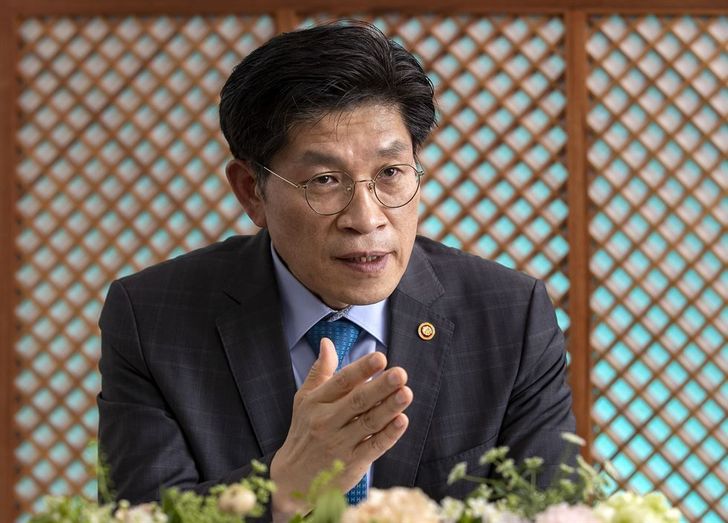
Noh Hyeong-ouk, the minister for government policy coordination, speaks during an interview with The Korea Times in his office at the Government Complex Seoul, Tuesday. Korea Times photo by Shim Hyun-chul
To tackle the issue and other systemic problems, the office introduced comprehensive measures last July to eradicate power abuse within the public sector. The measures included the prevention of unfair practices, stepping up punishment for those responsible and providing assistance to victims. Noh expressed his hopes that these will be adopted by the private sector as well to establish a new, fair norm.
More specifically, the office has defined gapjil by civil servants as an act of power abuse which unfairly restricts the rights of subordinates. It has also begun to criminalize all forms of power abuse which could lead to severe penalties for those found guilty of such behavior.
A government complaint center has been established for both the public and civil servants to report cases of power abuse. Those investigated and found guilty of this will be subject to stronger punitive measures, including dismissal and referral to the prosecution. So far, about 900 complaints have been filed with the center, according to the office.
In addition, Noh said the government will revise related laws in order to prevent people lacking in so-called “gapjil sensitivity” from becoming civil servants; while it will screen existing public officials for this when deciding on promotions.
The office is planning to introduce similar measures for the private sector in conjunction with the Korea Chamber of Commerce and Industry.
Starting this year, it will make public the evaluations of civil servants performance at 228 provincial government offices.
Noh stressed that all the measures being introduced by his office are a means to seek economic growth, saying “If the South can meet the criteria of the OECD average in terms of the Corruption Perceptions Index, this will add 0.8 percentage points to gross domestic product (GDP) growth annually.”
“As society changes and develops, we have to have higher expectations. Changing the system and thus adapting to a changing society will eventually make us more competitive.”