South to begin procedures for food aid to NK

A North Korean farmer walks through a village in an area damaged by summer floods and typhoons in South Hwanghae Province, Sept. 30, 2011. Reuters-Yonhap
By Kim Yoo-chul
South Korea will provide humanitarian food aid to North Korea after U.S. President Donald Trump expressed support for this idea in a phone conversation with President Moon Jae-in, a senior presidential aide said Wednesday.
The unification ministry confirmed this later, saying it will decide on how much and when food aid would be delivered to the impoverished North.
Moon and Trump exchanged views about a recently released joint food security assessment from the World Food Program (WFP) and Food and Agriculture Organization (FAO) during their conversation Tuesday (KST). Trump told Moon that Seoul's provision of food to the North was “well-timed” and called the plan a “positive measure.”
“When you read recently released WFP reports about the food situation in North Korea, it's been advised to help needy North Korean citizens as the country is combating continued chronic food shortages. Seoul and Washington are speaking in one voice on such humanitarian assistance issues regarding North Korea,” the aide said.
The U.N. report said 10.1 million North Koreans continue to suffer food insecurity, and predicted falling crops yields, expanding food shortfalls and lower Public Distribution System (PDS) rations. “Overall, it is estimated that 10.1 million people (40 percent of the population) are food insecure and in urgent need of food assistance,” it noted.
The aide didn't rule out the possibility of the government being directly in charge of the entire process. “There will be announcements by government agencies but only upon the level of progress and results,” she told reporters.
The White House said Trump and Moon discussed recent developments with North Korea and “how to achieve the final, fully verified denuclearization” of the country. Its brief statement, however, didn't mention food aid.
“I told you the exact details of their phone talks,” the presidential aide said.
In 2017, South Korea approved a plan to send $8 million worth of humanitarian aid to North Korea in accordance with its greater aid policy that the administration claims is “unaffected” by geopolitical tensions. At that time, Seoul said it was aiming to send $4.5 million worth of nutritional products for children and pregnant women through the WFP and $3.5 million worth of vaccines and other medical supplies through UNICEF.
This was put on hold after North Korea conducted nuclear and missile tests that year, but the United States signaled its openness for the aid to be delivered at the end of 2018 when the State Department said it was exploring ways to relax sanctions on humanitarian assistance.
Biegun arrives in Seoul
Washington's special envoy to the North Korea Stephen Biegun arrived in Seoul, Wednesday, and during his four-day stay he is expected to discuss specifics on delivering the aid and other related details, according to Cheong Wa Dae and diplomatic sources.
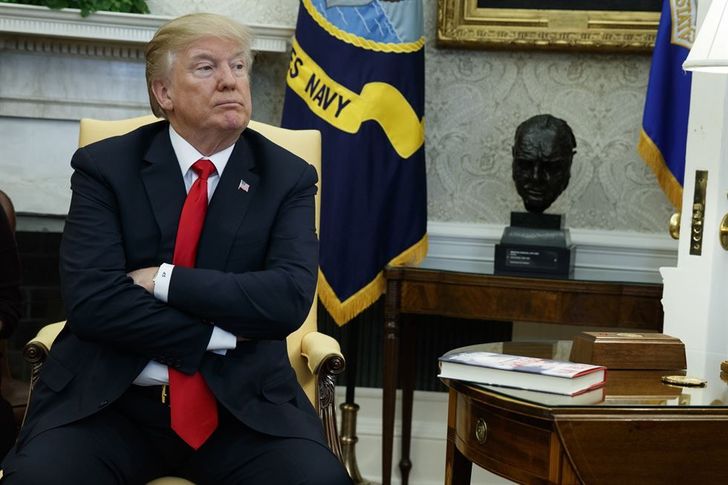
In this Feb. 2, 2018 file photo, U.S. President Donald Trump listens during a meeting with North Korean defectors in the Oval Office of the White House. AP-Yonhap
Countries are allowed to provide humanitarian aid to North Korea, but some items such as farming and medical equipment need a sanctions exemption from the United Nations, which can delay the delivery. But no U.N. restrictions are necessary on sending food and agricultural products to the North.
Biegun plans to meet his counterpart Lee Do-hoon, May 10, Cheong Wa Dae said, adding that he will also visit the presidential office during his stay. Biegun was hoping to meet deputy chief of the National Security Office (NSO) Kim Hyun-chong and NSO head Chung Eui-yong for “deep discussions” on ways to quickly resume denuclearization talks between Washington and Pyongyang.
Biegun told a Japanese lawmaker Wednesday during a stopover in Tokyo that North Korea's latest weapons test was a “sign of impatience” after Washington refused to accept Kim Jong-un's request for sanctions easing, Japanese broadcaster NHK reported.
Following North Korea's missile launches over the weekend, Washington has so far remained silent with U.S. Secretary of State Mike Pompeo saying “no response was planned” and that he will keep trying to negotiate with Pyongyang. Seoul is also saying North Korea tested “projectiles” not missiles.